Overview
The importance of technology use in education has been widely acknowledged. Many researchers have posited that technology use integrated with relevant teaching methods improves student learning (Hastings & Tracey, 2005; Kozma, 2003; Winn, 2002). Researchers report that technology can not only provide authentic, engaging, and collaborative learning environments but also can enable students to learn at any time with peers outside of classrooms (Jonassen, Peck, & Wilson, 1999; Kozma, 2003; Morey, Bezuk, & Chiero, 1997). Yet, the evidence is mixed, at best, that this investment of time, money, and resources has produced measurable change in student learning outcomes, or in teaching practices that effectively leverage the capabilities of technology to improve student learning (Cuban, Kirkpatrick, & Peck, 2001; Mehlinger & Powers, 2002; National Center for Education Statistics, 1999, 2000; Windschitl & Sahl, 2002).
Based on these findings, it is not surprising that much of the research related to technology integration in K-12 classrooms continues to demonstrate that teachers feel inadequately prepared to use technology effectively in their classrooms, particularly to support teaching and learning activities in their disciplines (Hew & Brush, 2007; Schrum, 1999; Strudler & Wetzel, 1999). This lack of support leads teachers to use technology for low-level, supplemental tasks, such as drill and practice activities, word processing, educational games, and computer-based tutorials (Strudler & Wetzel, 1999; Willis, Thompson, & Sadera, 1999).
Ineffective or inadequate use of technology by K-12 teachers may be directly related to the preparation provided to preservice teachers at teacher education institutions. Some researchers believe that teacher certification programs still view technology as an add-on to their curricula (Brush et al., 2003; Pellegrino, Goldman, Bertenthal, & Lawless, 2007). This lack of appropriate preparation perpetuates teachers’ feelings of ill-preparedness with regard to technology (Schrum, 1999; Strudler & Wetzel, 1999). As a result, they continue to use computers for lower level tasks, many of which align minimally with core academic standards (Strudler & Wetzel; Willis et al., 1999).
Despite conclusions such as these, solid theoretical frameworks that focus on preparing teachers to leverage technology in ways that enhance teaching methods in K-12 classrooms are rare. Many times, preservice teachers are exposed to a plethora of skills-based training activities (e.g., creating multimedia presentations, creating Web sites, developing blogs and wikis, and editing video). However, insufficient effort is made to align technology with discipline-specific pedagogy (Brush et al., 2003; Mishra & Koehler, 2006). Thus, researchers have begun examining methods for developing technological pedagogical content knowledge (TPCK) among both beginning and experienced teachers (Koehler, Mishra, & Yahya, 2004; Mishra & Koehler, 2006).
The TPCK model posits that context-neutral approaches to preparing teachers to utilize technology for pedagogical purposes will generally fail because they tend to overemphasize pure technology skills as opposed to methods of integrating technology into teaching and using technology to support pedagogical goals (Mishra & Koehler, 2006).
Thus, technology integration experiences integrated with authentic teaching and learning experiences in teacher preparation are recognized as more effective than traditional stand-alone technology classes, in which technology skills and experiences are taught separate from the classroom context (Brush et al., 2001; Hoelscher, 1997; Strudler & Wetzel, 1999).
Specifically with respect to social studies, Lee (2008) has provided a set of guidelines for effectively integrating TPCK into a social studies context. These guidelines include the following:
- Locating and adapting digital resources for use in the classroom.
- Facilitating students’ work in nonlinear environments.
- Working to develop critical media literacy skills among students.
- Providing students with opportunities to utilize the presentational capabilities of the Web to motivate and encourage students.
- Using the Internet to extend collaboration and communication among students.
- Extending and promoting active and authentic forms of human interaction and technology enabled social networks. (Lee, 2008, p. 130)
Although these guidelines generally focus on integrating technology in the classroom to support the link between technology, content, and pedagogy, they also provide a framework for effective methods of incorporating technology into preservice teacher education programs in social studies. Integrating TPCK into preservice teacher education poses additional challenges. Many times, preservice teachers are simultaneously learning content, technology, and pedagogy—as well as learning the craft of teaching (Saye, Kohlmeier, Brush, Maddox, & Howell, 2007)—which can prove overwhelming to individuals just entering the teaching profession. As Niess (2008) stated, “The question then is how to prepare preservice teachers for the multitude of variables that impact the potential effectiveness of classroom activities when technology is integrated as a learning tool” (p. 241).
In our work with preservice social studies teachers, we have used a number of strategies to help them understand and apply models and practices for effectively integrating technology into their future classrooms—thus, strengthening the link between technology, pedagogy, and content. Our efforts with preservice teachers have particularly focused on providing the best experiences that allow them to engage a multitude of variables within authentic learning contexts.
Promoting TPCK With Preservice Social Studies Teachers
The strategies employed to promote TPCK with our preservice teachers have been shaped by both successful strategies with in-service social studies teachers to promote pedagogical change (Saye & Brush, 2006) and strategies employed to integrate technology more fully into our preservice teacher education programs (Brush et al., 2003; Brush, 1998). Activities include
- Viewing, critiquing, and discussing authentic cases of social studies teachers utilizing various technology resources to implement inquiry-based learning activities in their classrooms.
- Providing preservice social studies teachers with opportunities to explore innovative, emerging technologies and to integrate those technologies into rich learning activities within the context of their teacher education programs.
- Providing preservice social studies teachers with opportunities to implement activities that effectively utilize technology in authentic classroom settings.
We will describe concrete examples of how these strategies have been implemented into our teacher education programs at Indiana University and Auburn University and discuss potential barriers to providing preservice teachers with integrated technological and pedagogical experiences.
Analyzing Models of Effective Technology Use in Social Studies Classrooms
Many researchers and teacher educators believe that the best opportunity for preservice teachers to strengthen TPCK and, thus, practice effective strategies for integrating technology into their teaching occurs through authentic classroom experiences, such as field-based practicum activities, teaching internships, and student teaching. These types of experiences, when implemented effectively, provide some of the best opportunities for beginning teachers to see how different classroom variables (e.g., resources available in classrooms, class size, and student demographics) can have an impact on teaching methods and strategies (Brush et al., 2003).
Unfortunately, numerous issues hinder the quantity and quality of the field-based components of their teacher education experiences. Difficulties in finding appropriate placements, coupled with the number of students who need to be placed, many times force the teacher education programs at our institutions to limit the opportunities for field-based practica prior to student teaching (Allen, 2003; Wilson & Floden, 2003).
In addition, even when we are able to provide multiple field experiences to preservice teachers, exposing them to high-quality models of effective uses of technology that are integrated with secondary social studies curricular activities is difficult. A number of factors affect the quality of in-school modeling, including lack of resources available in field placements, lack of experience or expertise with regard to technology integration among field placement teachers, and lack of opportunities for preservice teachers to integrate technology in meaningful ways into the activities they design and implement during their field placements (Niess, 2008; Posner, 1996; Smoot, 2000).
In order to provide more targeted models of technology integration, we have been exploring the use of specific teaching cases within our social studies methods courses. Within all of our preservice teacher education courses, we integrate a collection of online curriculum resources we have developed – the Persistent Issues in History Network (PIHNet – http://pihnet.org). PIHNet includes a set of Web resources to help upper elementary and secondary preservice and in-service social studies teachers implement problem-based inquiry (PBI) activities (Brush & Saye, 2000, 2008; Saye & Brush, 2004, 2007).
One of the major resources available in PIHNet is the Persistent Issues in History wise practice video case database. The wise practice video case database was designed and developed to exemplify PBI activities in order to assist preservice teachers in understanding and incorporating similar pedagogies in their future classrooms. The database has 20 fully developed classroom cases, each of which includes from 20 to 40 minutes of classroom video, reflections of the implementation of the classroom activity by the teacher, pre- and post-interviews with the teacher, state and national standards associated with the activity, and any resources used by the teacher and students during the activity.
Although the video database was designed to help teachers master the challenges of inquiry-based social studies teaching of any sort, we have also used specific cases within the database explicitly to provide models of teachers effectively using technology to support specific pedagogical and content goals.
One case we have used successfully with preservice classes focuses on a teacher’s use of a specific teaching strategy known as an “interactive slide lecture.” With this strategy, the teacher provides students with a series of historical photographs and uses various interactive activities (e.g., role playing, think-alouds) to establish foundational knowledge of a historical topic and encourage historical thinking. This particular case provides preservice teachers with an example of how to locate and adapt digital resources effectively for use within a learning activity, as well as examine and evaluate critically those resources as historical artifacts (Lee, 2008).
In our teacher education classes, we designed this particular video case activity to focus learners’ attention on several critical components of the teaching strategy and, specifically, on how the technology used by the teacher facilitated the successful implementation of the strategy in his classroom. The activity focused student attention on the overview of the lesson provided by the teacher, the classroom video segments dealing with the lesson implementation, and the teacher’s reflection regarding the effectiveness of the particular teaching strategy exemplified in the video case (particularly, his discussion of how he used technology within the lesson).
As students watched each video clip, they were provided with an online scaffold that assisted them with focusing on specific technological, pedagogical, and content aspects of each video through the use of guiding questions (see Figure 1). Questions were linked to specific video clips within the overall video case. Questions contained in the scaffold include
- Think about what kind of preparations a teacher might need to make to implement this lesson. What would the teacher need to think about, both from a technological standpoint and a pedagogical standpoint?
- What social studies content would a lecture/discussion/role-play activity like this allow you to foster in your students?
- How did the technology used add to this lesson?
- Using the Indiana Standards, what social studies standards might this lesson address?
- What ISTE student technology standards might this lesson address? (see International Society for Technology in Education, 2007)
- What strategies would you use to assess student performance in this lesson?
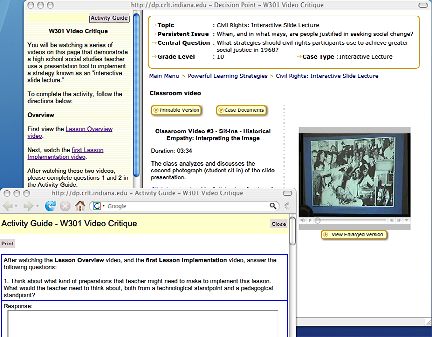 Figure 1. Video case activity completed by preservice teachers.
Secondary preservice teachers’ reactions to participating in this and other video case activities have been extremely positive. For example, when asked what they liked best about a specific video critique activity, one preservice teacher commented, “This is a great example of good social studies teaching. Instead of having our professors tell us about good teaching, I could see it for myself. Good videos and they allowed me to observe without traveling an hour to a high school to observe.”
Another preservice teacher said, “I love watching other teaching strategies. I like to see different techniques so I am able to use those techniques in my own classroom.” Finally, numerous preservice teachers specifically discussed the benefits technology provided in the lesson. For example, one preservice teacher stated, “The technology gave students something more interesting and specific than a textbook…it made the lesson more relevant and closer to home” (Brush et al., 2007). (For access to any of the online video cases, contact either of the authors for an account.)
Modeling Specific Technology-Rich Activities
A second approach to providing TPCK to preservice teachers is to design activities in which preservice teachers serve as students and participate in technology-rich, content-based activities. Preservice teachers can engage in classroom activities that they potentially could use in their own classrooms. Teacher education faculty members serve as the teachers for these activities and are then able to discuss the affordances technology can provide within the activities, the strengths and weaknesses of the activities from a pedagogical standpoint, and potential issues with implementing these activities in more authentic settings.
One example of how this strategy has been implemented is with a group role-play activity focusing on the 1964 Democratic National Convention available on the PIHNet Web site (see Figure 2). Teacher education and educational technology faculty members team teach this Web-based activity, in which students explore the perspectives of historical figures playing significant roles during the convention. The activity itself provides preservice teachers with a model of teaching and learning strategies that they can utilize in their future classrooms – including empathetic role-playing, historical think-alouds, and group decision-making. In addition, the activity provides a model of how technology can be leveraged to facilitate these learning outcomes.
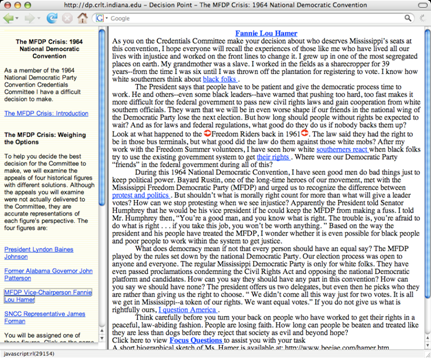 Figure 2. Online PIHNet activity.
Preservice teachers are able to see how hyperlinks within Web-based documents can be used to provide additional background, contextual, and even metacognitive cues to assist learners with interpreting historical accounts and developing historical empathy. They can obtain a better understanding of how technology can facilitate the pedagogical goals of the activity. In addition, they gain experience working with nonlinear environments and engaging in authentic forms of human interaction and technology enabled social networks (Lee, 2008). These types of activities could be implemented without technology, but technology provides unique attributes to activities that enhance their effectiveness with students. For example, technology may provide just-in-time information that allows students to understand the larger historical context within which a particular event is situated.
Modeling Technology Tools to Enhance Pedagogical Goals
In addition to integrating specific technology-rich activities into various aspects of the teacher education program, preservice teachers should also have an understanding of the multiple technology tools available and how they can be used to enhance a wide variety of activities in social studies (Lee, 2008; Saye & Brush, 2007). In our teacher education courses, we model emerging technological tools available at little or no cost to teachers that facilitate powerful learning activities for students.
For example, we provide preservice teachers with opportunities to explore resources such as Google Earth and model how this tool can be used to enhance instructional activities in history and geography. Various overlays (or “kmz” files) developed by teachers and historians can be integrated into Google Earth to allow students to explore a broad range of historical topics.
Figure 3 is a screenshot of an overlay created by teachers focusing on the history of Russia from 4000 BC to present (refer to http://bbs.keyhole.com/ubb/showflat.php/Cat/0/Number/746050/an/0/page/4#746050 to access this overlay). A wide variety of overlays are available via the Google Earth Community Web site (http://bbs.keyhole.com). These overlays provide information and resources for topics in history, geography, people and cultures, and a wide variety of other pertinent areas.
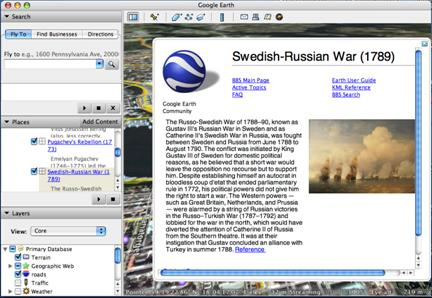 Figure 3. Google Earth overlay focusing on the history of Russia.
In addition to allowing our preservice teachers to explore the use of various overlays developed by other educators, we also provide opportunities for preservice teachers to create their own overlays using the Google Earth authoring tools. They can integrate the resources they create into instructional activities they then implement with students during their field experiences and practica. This activity allows our preservice teachers to both select and modify digital resources for pedagogical purposes, as well as utilize the presentational capabilities of the Web (Lee, 2008).
We have also integrated digital video into our teacher education courses as a tool for students to demonstrate knowledge and understanding of social studies content. We have worked with teachers on numerous activities in which they had their students construct multimedia historical narratives as a method of culminating unit assessment (e.g., Brush & Saye, 2008).
In this case, preservice teachers were paired with a team of junior high teachers and teacher educators and required to create documentary videos of the Reformation period. These videos were developed to serve as models for the partner teachers’ students in order to facilitate the creation of their own video documentaries (dealing with the Industrial Revolution). The preservice teachers used simple video editing software (such as iMovie or Windows Moviemaker), and went through a process similar to the process the students were expected to complete.
As a culmination of the activity, not only did preservice teachers provide several model storyboards and video documentaries for the partner teachers to show to their students, but they also provided valuable suggestions regarding potential issues teachers may face when implementing the activity with their students and suggestions for addressing those issues, thus, enabling them to collaborate and communicate with both their peers and more experienced teachers (Lee, 2008).
In addition, preservice teachers received firsthand knowledge and experience regarding how digital media could be used by classroom teachers to facilitate alternative methods of student assessment in social studies. Finally, preservice teachers were asked to upload all of their videos and video resources to Teacher Tube (http://www.teachertube.com), thus, providing other educators with examples of video documentaries that could be used with a wide range of students across the country. (For examples, see Video 1 at http://dp.crlt.indiana.edu/reformation/Group4_reformation.mov and Video 2 at http://dp.crlt.indiana.edu/W301/deseg.wmv, which focuses on the Student Nonviolent Coordinating Committee’s desegregation efforts during the early 1960s.)
Supporting Exploration in Authentic Classrooms
Although modeling effective use of technology and providing opportunities to explore emerging technologies are important in providing preservice social studies teachers with the TPCK needed to utilize technology effectively in their future classrooms, preservice teachers also need opportunities to examine the use of technology in authentic classroom settings and explore how they can use technology to support student learning. Without these types of opportunities, they may develop an unrealistic perspective regarding how technology can be (and is being) utilized in social studies classrooms (Niess, 2008). This perspective, in turn, could impact their views of how technology can facilitate the implementation of innovative pedagogical strategies.
To provide these experiences, we have designed specific activities that preservice teachers complete as part of their field-based practicum experiences. Emerging technological resources are integrated into these activities, and preservice teachers are encouraged to explore how more advanced technologies can enhance their own teaching. For example, once they are assigned to their initial field placement site, preservice teachers are required to complete a technology needs assessment. The purpose of this activity is to allow preservice teachers to examine critically the resources available at their placement school, to obtain perspectives from teachers regarding effective uses of technology, and to determine the level of technology support available to teachers and how teachers access that support. Since several preservice teachers are placed at each field placement school, this activity gives them an opportunity to explore how online collaboration tools can facilitate group data collection, analysis, and reflection. We provide preservice teachers with a data collection scaffold (see Figure 4) via an online collaboration tool such as Google Docs (http://www.google.com/docs) and have them collectively gather, analyze, and interpret information for their placement school.
Once they have completed their needs assessments, teacher education faculty conduct a group debriefing session, in which they discuss the types of resources available at each of the field placement schools, ways those resources can be used to enhance social studies instruction, and ways teachers at the field placement schools are using the resources available to them to facilitate social studies instruction.
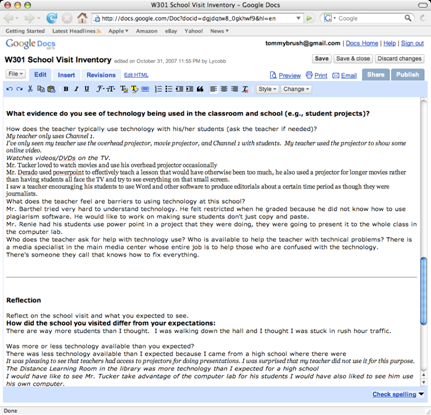 Figure 4. Google Docs technology needs assessment activity.
A second example of how we provide preservice teachers with authentic experiences using technology to support teaching and learning occurs as a direct result of the technology needs assessment. As part of their methods classes, preservice teachers are required to design and implement several small learning activities in cooperation with their field placement teachers. For one of these activities, preservice teachers must use the data obtained from their needs assessments in conjunction with knowledge gained from the modeling experiences they participated in to design a technology-integrative classroom activity for students in their field placement classroom, implement the activity with at least a subset of those students, evaluate the effectiveness of the activity, and reflect upon how well the technology supported the goals of the activity and modifications that they would make to future iterations of the activity. Preservice teachers are required to incorporate technological resources currently available at their field placement schools (or accessible via the Internet).
In addition, preservice teachers are encouraged to develop their instructional activities collaboratively (and use collaborative online tools to facilitate the process) and are required to complete a blog (using a resource such as http://www.blogger.com or http://www.edublogs.org) to document the design process and to record their reflections on the implementation of their activities.
Some of the topics and tools preservice teachers have implemented with their students include using digital images and Google Earth to explore the Civil War and Reconstruction, using blogs and blogging to examine the issue of personal rights and freedoms, using video podcasts to examine issues of bias in global media reports of issues, and using Internet resources and video to explore changing political affiliations in post-World War II Europe.
Finally, as a capstone professional development experience, preservice teachers are required to use a simple Web page development tool such as Google Sites (http://sites.google.com) or NVue Mambo (http://nvue.net) to develop Web-based professional portfolios. These portfolios serve as a framework that preservice teachers can update as they progress through their teacher education programs. Not only are they required to link activity resources, reflection blogs, and any other artifacts to their portfolios, but they are expected to continue to update these portfolios with teaching artifacts as they continue through their programs (see Figure 5). (To view examples of preservice teachers’ portfolios, see http://sites.google.com/site/jasonquillin/ or http://andrewmyron.googlepages.com/home.)
 Figure 5. Preservice teachers’ professional portfolio (used with permission of author).
Conclusion: Barriers to Integrating Technology and Pedagogy
This paper describes several strategies we have employed to integrate effective technology integration strategies into teacher education experiences provided to preservice social studies teachers. These strategies have been designed potentially to increase preservice teachers’ TPCK by providing them with opportunities to explore innovative and emerging technology resources in authentic social studies learning and teaching situations.
However, providing preservice teachers with “authentic” experiences can expose other issues that can hinder their knowledge and skills with integrating technology and pedagogy. One major issue involves the types of models preservice teachers are exposed to in their field placement experiences. As with many teacher education programs, we are not always able to select field placements that provide optimal technology integration experiences for our preservice teachers. Many of the teachers who have the skills and experiences to serve as mentors for our preservice teachers find themselves inundated with other professional responsibilities.
As Teale, Leu, Lagbbo, and Kinzer (2002) stated, “Teachers who provide outstanding…instruction are usually in such demand to assist with staff development and mentoring first- and second-year teachers in their building that they rarely have time to supervise preservice field work” (p. 655). Thus, in some instances preservice teachers are placed in classrooms in which teachers are not comfortable using technology for instructional purposes and do not use technology in innovative ways. As one preservice teacher stated during the debriefing session of the technology needs assessment activity, “I never saw [my placement teacher] use computers in his classroom. They were just sitting in the back of the room collecting dust.”
In addition, even if mentor-teachers do have expertise in technology integration and time to mentor preservice teachers, they may not have the opportunity to model diverse teaching strategies in the limited amount of time a preservice teacher is present in their classroom, or they may lack of technology resources at a given placement school. As one preservice teacher said, “I would have liked to see Mr. [XXX] take advantage of the computer[s] with his students. I would have also liked to see him use his own computer.” In terms of lack of technology resources available, one preservice teacher said, “There was less technology than I expected. I came from a high school where there was an abundance of technology.”
Finally, although we have discussed a variety of strategies employed in our preservice teacher education programs to facilitate the transfer of TPCK to authentic classroom settings, we have yet to complete any rigorous studies that examine the extent to which this knowledge transfers to actual classroom practices once preservice teachers obtain professional placements. We are currently designing several studies to examine the link between technology experiences in our preservice programs and those experiences that induction and experienced teachers find relevant and meaningful in their teaching (refer to Brush & Ottenbreit-Leftwich, 2008, for an overview of these studies).
Our continued goal is to refine effective models and strategies for preparing preservice teachers to integrate technology and pedagogy in their future classrooms and share those models with the professional community. The challenges with regard to locating field placements that provide opportunities for rich technology integration experiences for our preservice teachers potentially can be addressed by incorporating more video case modeling activities into our teacher education courses or by developing and sharing additional technology modeling activities with preservice teachers. However, video cases, although they are exceptional teaching and learning tools, can go only so far in providing preservice teachers with opportunities to explore the interaction of technology, pedagogy, and content to provide optimal learning environments.
One of our persistent challenges will be to develop and integrate more authentic classroom experiences in which preservice teachers can explore the use of technology to promote pedagogical goals within our teacher education programs. By meeting this challenge, we may be able to provide preservice teachers with a better understanding of how technology, when used appropriately, can support innovative pedagogical strategies that have a positive impact on learners’ engagement with and retention of content.
References
Allen, M. (2003). Eight questions of teacher preparation. What does the research say? Denver, CO: Education Commission of the States. (ERIC Document Reproduction Service No. ED479051)
Brush, T. (1998). Teaching preservice teachers to use technology in the classroom. Journal of Technology and Teacher Education, 6(4), 243-258.
Brush, T., Glazewski, K., Rutowski, K., Berg, K., Stromfors, C., Van-Nest, M. H., Stock, L., & Sutton, J. (2003). Integrating technology in a field-based teacher training program: The PT3@ASU projects. Educational Technology Research & Development, 51(1), 57-72.
Brush, T., Igoe, A., Brinkerhoff, J., Glazewski, K., Ku, H., & Smith, T. C. (2001). Lessons from the field: Integrating technology into preservice teacher education. Journal of Computing in Teacher Education, 17(4), 16-20.
Brush, T., & Ottenbreit-Leftwich, A. (2008, November). Supporting the use of emerging technologies in schools: Research and implications. Paper presented at the annual meeting of the Association for Educational Communication and Technology, Orlando, FL.
Brush, T., & Saye, J. (2000). Implementation and evaluation of a student-centered learning unit: A case study. Educational Technology Research and Development, 48(3), 79-100.
Brush, T., & Saye, J. (2008). The effects of multimedia-supported problem-based inquiry on student engagement, empathy, and assumptions about history. Interdisciplinary Journal of Problem-Based Learning, 2(1), 21-56.
Brush, T., Saye, J.W., Kohlmeier, J., Hur, J. W., Kale, U., Feng, Y., et al. (2007, April). Evaluating the persistent issues in history laboratory for virtual field experience (PIH-LVFE). Paper presented at the annual meeting of the American Educational Research Association, Chicago, IL
Cuban, L., Kirkpatrick, H., & Peck, C. (2001). High access and low use of technologies in high school classrooms: Explaining an apparent paradox. American Educational Research Journal, 38(4), 813-834.
Hastings, N. B., & Tracey, M. W. (2005). Does media affect learning: Where are we now? TechTrends, 49(2), 28-30.
Hew, K., & Brush, T. (2007). Integrating technology into K-12 teaching and learning: Current knowledge gaps and recommendations for future research. Educational Technology Research and Development, 55(3), 223-252.
Hoelscher, K. (1997). The road ahead: Preservice educators’ ideas for using technology in K-6 classrooms. Computers in the Schools, 13(1-2), 69-75.
Jonassen, D. H., Peck, K. L., & Wilson, B. G. (1999). Learning with technology: A constructivist perspective. Upper Saddle River, NJ: Prentice-Hall.
Koehler, M. J., Mishra, P., & Yahya, K. (2004, April). Content, pedagogy, and technology: Testing a model of technology integration. Paper presented at the annual meeting of the American Educational Research Association, San Diego, CA.
Kozma, R. B. (2003). Technology and classroom practices: An international study. Journal of Research on Technology in Education, 36(1), 1-14.
Lee, J.K. (2008). Toward democracy: Social studies and TPCK. In the AACTE Committee on Innovation and Technology (Ed.), Handbook of technological pedagogical content knowledge (TPCK) for educators (pp. 129-144). New York: Routledge.
Mehlinger, H.D., & Powers, S.M. (2002). Technology and teacher education: A guide for educators and policymakers. Boston, MA: Houghton Mifflin.
Mishra, P., & Koehler, M. J. (2006). Technological pedagogical content knowledge: A framework for teacher knowledge. Teacher College Record, 108(6), 1017-1054.
Morey, A. I., Bezuk, N., & Chiero, R. (1997). Preservice teacher preparation in the United States. Peabody Journal of Education, 70(1), 4-24.
National Center for Education Statistics. (1999). Teacher quality: A report on the preparation and qualifications of public school teachers. Washington, DC: U.S. Department of Education.
National Center for Education Statistics. (2000). Public school teachers’ use of computers and the Internet. Washington, DC: U.S. Department of Education.
Niess, M.L. (2008). Guiding preservice teachers in developing TPCK. In the AACTE Committee on Innovation and Technology (Ed.), Handbook of technological pedagogical content knowledge (TPCK) for educators (pp. 223-250). New York: Routledge.
Pellegrino, J., Goldman, S., Bertenthal, M., & Lawless, K. (2007). Teacher education and technology: Initial results from the “What Works and Why” project. Yearbook of the National Society for the Study of Education, 106(2), 52-86.
Posner, G. J. (1996). Field experience: a guide to reflective teaching. White Plains, NY: Longman Publishers USA.
Saye, J.W., & Brush, T. (2004). Promoting civic competence through problem-based history learning experiments. In G.E. Hamot, J.J. Patrick, & R.S. Leming (Eds)., Civic learning in teacher education (Vol. 3; pp. 123-145). Bloomington, IN: The Social Studies Development Center.
Saye, J., & Brush, T. (2006, December). Supporting problem-based historical inquiry with technology-enhanced learning environments. Paper presented at the College and University Faculty Assembly of the National Council for Social Studies, Washington, DC.
Saye, J., & Brush, T. (2007). Using technology-enhanced learning environments to support problem-based historical inquiry in secondary school classrooms. Theory and Research in Social Education, 35(2), 196-230.
Saye, J.W., Kohlmeier, J., Brush, T., Maddox, L., & Howell, J. (2007, November). Using lesson study to build a professional knowledge community for problem-based history study. Paper presented at the College and University Faculty Assembly of the National Council for Social Studies, San Diego, CA.
Schrum, L. (1999). Technology professional development for teachers. Educational Technology Research and Development, 47(4), 83-90.
Smoot, S.L. (2000, November). Evaluating field-based placements for preservice teachers: Measuring the mentoring qualities of the host teachers, student satisfaction with placement, and gathering program evaluation data for N.C.A.T.E. reaccreditation. Paper presented at the annual conference of the Teacher Education Division of the Council for Exceptional Children, Las Vegas, NV. (ERIC Document Reproduction Service No. ED478496)
Strudler, N., & Wetzel, K. (1999). Lessons from exemplary colleges of education: Factors affecting technology integration in preservice programs. Educational Technology Research and Development, 47(4), 63-81.
Teale, W., Leu, Jr., D., Labbo, L., & Kinzer, C. (2002). Exploring literacy on the Internet. The Reading Teacher, 55(7), 654-659.
Willis, J., Thompson, A., & Sadera, W. (1999). Research on technology and teacher education: Current status and future directions. Educational Technology Research and Development, 47(4), 29-45.
Wilson, S.M., & Floden, R.E. (2003). Creating effective teachers: Concise answers to hard questions. An addendum to the report “Teacher Preparation Research: Current Knowledge, Gaps, and Recommendations.” Washington, DC: AACTE Publications. (ERIC Document Reproduction Service No. ED476366)
Windschitl, M., & Sahl, K. (2002). Tracing teachers’ use of technology in a laptop computer school: The interplay of teacher beliefs, social dynamics, and institutional culture. American Educational Research Journal, 39(1), 165-205.
Winn, W. (2002). Current trends in educational technology research: The study of learning environments. Educational Psychology Review, 14(3), 331-351.
Author Note:
Support for this work has been provided by the Fund for the Improvement of Postsecondary education, Grant P116B041038, the National Endowment for the Humanities, Grant ED-22175-02, Auburn University Outreach Scholarship Grants, Auburn University College of Education and Indiana University School of Education.
Thomas Brush
Indiana University
[email protected]
John W. Saye
Auburn University
[email protected]
