Recently, during fieldwork, the author was observing in a high school government class. The social studies concepts discussed in the lesson were political parties, the role of campaigning, and the impact of media on citizens’ decisions. The teacher integrated a variety of traditional and constructivist instructional methods. She incorporated a brief lecture, questioning strategies to discuss readings, graphic organizers, and video clips of recent election campaign commercials. Despite her efforts to engage students, the class was chaotic. What follows is an excerpt from the author’s field notes describing the complexities of the classroom environment.
Twenty-five students are seated in pods of four. One girl in the back is putting on eyeliner and eye shadow. She frequently chats with two boys seated at her table. She proceeds to mash zits. Two girls and one boy socialize in the back of the class. They are more concerned about the social complexities of the school rather than listening. However, periodically one will shout out a correct answer without interrupting the flow of the social conversation. One girl, sitting in the back of the class, totally isolates herself and has no verbal or nonverbal communication with her peers or the teacher. A quiet boy and two girls sit at a table located in the front of the class. They do not share comments and appear to be intimidated by their peers.
A girl on the other side of the class begins to sing and continues to do so periodically throughout the class time. Another girl gets up and walks around the room. She is told to sit down, which she does, and in five minutes gets up and walks around again. She is struggling to stay in her seat and is clearly unconcerned with the class discussion. A boy in the center of the class covers his head with his hood, lays his head down, and goes to sleep. Two other girls at his table are engaged in a conversation about who will be homecoming queen.
What is a teacher to do with a class like this? This is a perplexing situation, yet a common dilemma teachers encounter. Many teachers struggle with the lack of student interest in the content which translates into a lack of motivation to learn. This is especially prevalent in social studies classrooms. Research indicates that students often are uninterested in social studies because they perceive it as a boring subject (Schug, Todd, & Berry, 1984; Shaughnessy & Haladyana, 1985). Students tend to equate uninteresting with unimportant; thus, students are not motivated to learn social studies content due to the lack of value of the content. Educators suggest that lack of student interest in social studies is related to the instructional methods utilized in disseminating information (Martorella, 1997).
This paper describes my investigation of technology integration in social studies instruction to build an understanding of why technology is being used to teach social studies content. Given the nature of social studies instruction and the need to engage students in the learning process, I selected motivational theory as a theoretical frame for this research.
Motivational Theory
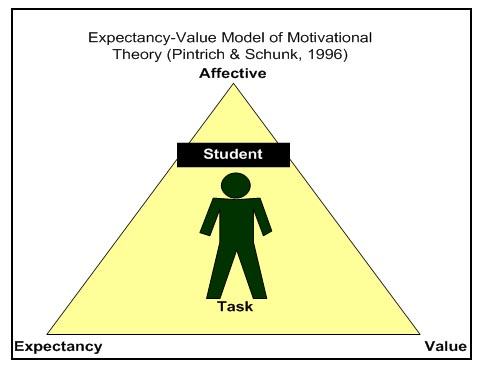 Figure 1. Expectancy-Value Model
To clarify a general misconception, motivation and ability are not equivalent. Motivation refers to what a person will attempt, yet ability is defined as what a person can do (Pintrich & Schunk, 1996). Thus, the purpose of motivation theory is to explain student behavior and influence future behavior. Recent theories of motivation can be categorized as variations of expectancy-value model of motivation (Pintrich & Schunk, 1996). This model focuses on three areas: value (students’ beliefs about the importance or value of a task), expectancy (students’ beliefs about their ability or skill to perform the task), and affective (emotional reactions to the task and self-worth evaluation). Figure 1 represents the relationship between the three areas of expectancy-value motivational theory (Pintrich & Schunk, 1996).
First, task-value motivational theory addresses the question of why an individual completes a task. The value component of motivation focuses on the reasons why students become involved (or not involved) in an instructional activity (Pintrich & DeGroot, 1990; Wigfield & Eccles, 1992). It defines students’ beliefs about the importance or value of a task and why students approach or avoid a task. Engagement in the task varies with the value that students place on the academic task and students’ self-confidence in their ability to accomplish the task successfully if appropriate effort was made (Brophy, 1983).
Whether or not a student attempts a task is dependent upon students’ perceived success in completing the task (Atkinson, 1957; Stipek, 1997). Perceptions of success are shaped by the nature of the task. The nature of the task, defined as the procedures, social organization and products that each task requires, regulates what students learn and how students learn (Doyle, 1983). If students perceive the task as boring or too difficult, they will avoid the task. Students will approach tasks they believe are fun, require a moderate amount of effort, and are reasonably challenging. Thus, the nature of the task and student perception of the importance of the task become key factors influencing student motivation for approaching or avoiding the task (Blumenfeld, Mergendoller, & Swarthout, 1987; Eccles et al., 1983).
Second, the concept of expectancy represents the key idea that students will not choose to do a task or continue to engage in a task that they believe exceeds their capabilities, but students will take on tasks and activities that they believe they can handle (Schunk, 1991). If students expect failure, they will avoid the task; conversely, if students anticipate success, they will approach the task.
Expectancy relates to students’ self-efficacy, students’ confidence in their cognitive skills (Bandura & Schunk, 1981). Student self-efficacy is influenced by past experiences and familiarity with the task (Bandura, 1993; Schunk, 2000). Students’ perceptions of competence about personal skills and abilities are influenced by the learning environment. Positive learning environments provide nurturing experiences for students to build their self-confidence in their skills. Students are able to develop their skills comfortably without the fear of failure. Students develop a familiarity with the skills necessary to complete the tasks. It is this familiarity with the tasks that builds students self-efficacy (Eccles & Wigfield, 1993). Expectancy motivational theory addresses the question of “Can I do what is being asked?” or “Am I capable of accomplishing this task?”
The final area of motivational theory relates to the affective domain and identifies students’ emotional reactions to the task and self-worth evaluation. A central part of all classroom achievement is the need for students to protect their sense of worth or personal value (Covington, 1984). Self-worth theory focuses attention on the pervasive need implied within the conflicting interests of desire to approach success that invokes social recognition and a feeling of competence and to avoid failure that causes a sense of worthlessness and social disapproval (Covington, 1984; Pintrich & Schunk, 1996). Students’ perceptions of the causes of their successes and failures influence the quality of their future achievement. According to self-worth theory, high ability signifies worthiness. Because ability is tied to worthiness and it is related to accomplishments, then self-perceptions of ability are significant to the way students interpret their personal success (Midgley, Arunkumar, & Urban, 1996). Self-worth theory rests upon the perception that students are motivated to establish, maintain, and promote a positive self-image (Covington, 2000).
Methodology
A descriptive and exploratory case study (as described by Yin, 2002) was utilized to examine the integration of technology for social studies instruction. This case study sought to unveil the tacit knowledge, deconstructing student attitudes about technology and motivations for using technology (Patton, 1990), to build an understanding of why technology is being used to teach social studies content. Qualitative methods were employed to provide an in-depth description of technology use in a natural setting. The purpose of this study was to interpret the phenomena and the meanings that students brought to this setting and to describe them (Denzin & Lincoln, 2000; Glesne & Peshkin, 1999; Marshall & Rossman, 1999).
The participant for this study was an in-service teacher. The secondary social studies teacher taught 9th- and 10th-grade social studies classes. She taught World History, Economic, Legal, and Political Systems, and a tenth grade seminar that integrated the curriculum for English and social studies. Her undergraduate degree was in early childhood education. She later returned to school for her second undergraduate degree of history with a minor in secondary education. After teaching for 7 years, she obtained her master’s degree in social studies education. In addition she has achieved recognition as the only nationally board certified social studies teacher in her high school.
This case study is atypical because this teacher has excellent professional credentials and has had much experience at integrating technology in social studies content. The uniqueness of this case study provides valuable insight into research on technology integration in the social studies curriculum. This research addresses a recognized need for examples of content specific technology use in the social studies (Martorella, 1997; Mason, 2000-2001; Mason et al, 2000; Vanfossen, 2001; White, 1999) and supports existing qualitative research that emphasizes the benefit of looking at best practices in teaching (Grossman, 1990).
Data sources for this study included interviews, observations, field notes, and artifacts, such as technology work samples produced by the students, teacher curricula, and teacher lesson plans. Interviews, field notes, and classroom observations followed procedures outlined by the work of Spradley (1980) and Schensul, Schensul, and Lecompte (1999). Field notes were condensed accounts of events observed in the classroom. Missing gaps in these data were filled with data collected from teacher and student interviews.
Before data collection and analysis began, study propositions were formulated. In keeping with Yin’s (2002) case study methodology, two propositions formed the core of the research framework: (a) Technology improves students’ motivation to learn content and (b) technology augments the development of student work through providing students with organizational frameworks, connecting students to resources, and supporting students’ creativity. The integration of technology within the social studies provides crucial links in building content and technological literacies.
Collected data was linked to the propositions through comparison of common patterns (Denzin & Lincoln, 2000; Yin, 2002), analyzing emergent themes (Spradley, 1980), and triangulation (Denzin & Lincoln, 2000; Yin, 2002). After the data was collected, analysis of the data formed links between the theoretical framework and the results of the case. A crosswalk of issues showed the links between the study questions, data sources, data analysis, and theoretical framework and also helped establish reliability for the study.
A Closer Look
To redress the initial question of what a teacher is to do with these uninterested and unmotivated students, a closer look at the case described is necessary. Once the teacher in the scenario described earlier finished with the classroom instruction, she assigned the students a project of creating a PowerPoint slide as a political campaign advertisement for their state’s senatorial race. Students were expected to research their candidate of choice and develop an advertisement utilizing one of the various media strategies for which the teacher had provided information. The teacher distributed a handout clearly identifying the types of campaign advertisements and the expectations for the task. Then the class was off to the computer lab.
The hallway trip was no different than the classroom scenario provided, but something happened when they entered the computer lab. Students immediately sat down at their computers and promptly began their work. Students exuded self-confidence in their abilities, not only to work with the technology but to master the content and successfully complete the task. Students had no difficulty locating the websites for the candidates and finding the facts they needed to construct their campaign advertisements. Students captured the key political stances of each candidate. They also demonstrated an understanding of the various campaign strategies. In addition to understanding the content, students designed graphically appealing and interactive campaign ads using PowerPoint. Several students knew about the intricacies of the software program and tutored others on how to complete the desired special effects. Students were collaborated and exchanged ideas. Students eagerly shared their work and ideas with their peers.
Students were excited about learning and displayed pride in the PowerPoint slides they created. The slides included sound bytes, video clips, pictures, text, and animation. The product outcomes were impressive, but what was even more impressive was the level of engagement. All students actively created their products, learning about the candidates and the types of campaign advertisements that are utilized in politics. It was an amazing transformation. The same students who were described earlier were now focused and on task. Not only were they actively involved in their project, they were learning social studies.
Students enjoyed working on the project with technology because they viewed technology as more engaging and entertaining. All students reported enjoyment in the task because technology made their work easier and more fun to do. One student commented, “I like using computers, the Internet, and PowerPoint because it is fun, fresh, and invigorating.” Many students identified that technology made it possible for them to complete their work more quickly and efficiently. One of the most common reasons for enjoyment in the task was that computer use made students’ work neater, enabled them to add nice graphics, and made the overall presentations look professional. These feelings were captured in this student’s statement: “I like using technology to do my work because you can do more with technology. You can make a really cool presentation that wouldn’t be possible without the technology.”
Additionally, students reported that using technology enabled them to find more information and helped them understand what they were talking about in class. A student commented, “I like using computers to do school work, because it helps me get my thoughts out better.” Another student replied, “I like using computers because it’s easy to find lots of information about the stuff we are discussing in class.”
One final point made by students was that working with computers gave them the opportunity to refine their technology skills. Students identified that they felt confident in their ability to use technology and liked having the opportunity to complete tasks that allowed them to work with skills they already possessed. At the same time, students felt that the task was challenging and required them to take their skills to the next level.
Observations
Technology offers many benefits to enhance education. Most importantly, technology integration has the potential to increase student motivation (Anderson, 2000). The case described presents three elements of how technology positively impacts student motivation. These factors are based upon expectancy-value model of motivation (Pintrich & Schunk, 1996). Using technology changes the nature of the task, increases student self-efficacy, and improves student self-worth.
First, task-value motivational theory addresses the question, “Why do I approach the task?” In the case presented, students were actively involved in the project because they were working with technology. Students felt confident in their ability to accomplish the task due to their familiarity with the technology. The focus of the task shifted from social studies content to technology use. Since students were self-confident in their technology skills, they eagerly approached the task. Students were excited about the opportunity to test their skills and viewed the task as challenging and engaging. This was in contrast to the traditional classroom environment, where students avoided the task either because it was boring or because they believed that they lacked the skills necessary to be success in this environment.
Technology empowers students by engaging students in the learning process. The nature of the task shifts from teacher centered to student centered. Given the flexibility of technology to diversify tasks, the activity was designed to build upon students’ prior knowledge and to address student interests. Research indicates that challenging and engaging academic tasks that build upon students’ prior knowledge and enable students to construct their own understanding of the content are more apt to enhance student motivation and increase student self-confidence in their cognitive abilities (Brophy, 1983; Meece, 1991; Miller & Meece, 1999).
Additionally, the use of technology improves student interest due to students’ familiarity with the technology. Increased enjoyment in learning is related to students’ natural affinity for computer-based instruction; consequently, social studies can become a more attractive subject when computers and the Internet are included as teaching tools (Cassutto, 2000, pp. 100-101). Research touts technology use in social studies as a purposeful method of instruction to best meet the needs of students and to promote student interest in the task (Berson, 1996; Martorella, 1997; White, 1999).
Second, expectancy motivational theory addresses the question “Can I use this technology or am I capable of accomplishing this task?” As identified in the case, students displayed more self-confidence in the computer than in the traditional classroom setting. Students possessed the skills necessary to successfully accomplish the assignment. They felt comfortable in the secure environment that the computer lab offered. This nurturing learning environment enabled students to accomplish more with technology than they could without it. Students were able to generate attractive, creative, and content rich PowerPoint slides. Students took pride in their creations and eagerly shared their work with their peers.
According to Ames (1990) technology has the potential to increase student motivation by increasing student self-efficacy. This was evidenced in a research study of the impact of technology use on high school student learning conducted by Rochowicz (1996). Data identified that using computers increases students’ self-efficacy; consequently, students develop a more positive attitude toward learning. Rochowicz concluded that computers make learning more relevant, meaningful, and enjoyable; consequently, academic frustration declines. Students experience a greater enjoyment from learning content because they are confident in their ability to accomplish the task when using technology.
Additionally, technology enables students to accomplish more than they could without the use of technology. Technology affords students opportunities to access information and resources to create products far beyond their perceived capabilities. Research identifies the benefits of technology integration as the technical aspects to enhance the quality of work, promote access to resources, positively impact student learning, and promote student metacognitive skills (Heafner & McCoy, 2001; Scheidet, 2003). With the improved output, students take pride in the products they create, which increases their self-efficacy. This self-efficacy can have a positive impact on overall student motivation. As Brophy (1983) contended, student motivation improves with students’ increased self-confidence in their abilities to complete the academic task.
Third, self-worth and affective motivational theory addresses the question, “How do my feelings about myself affect whether or not I will attempt or avoid this task?” Using technology enabled these students to feel more self-confident in completing the assignment due to their familiarity with technology. Initially, the focus of learning shifted from social studies content to technology. Technology integration camouflaged the learning process by drawing students into a fun activity that relied on familiar technical skills. Once students engaged in the task their attention shifted to the content. With the integration of a familiar learning tool, students approached social studies content that they had avoided in the traditional classroom setting. Students eagerly approached the task when they were able to use an instructional tool with which they had the knowledge, skill, and confidence in using. Familiarity with the technology also increases students’ belief in their ability to accomplish the task; consequently, students are more willing to take risks and approach challenging tasks. This supports self-worth theory that students’ perceptions of worthiness are equated with ability (Covington, 2000; Midgley et al., 1996).
Typical instructional approaches utilized in social studies classes emphasize ability-related activities such as memorization and rote learning (Martorella, 1997). In contrast, technology facilitates the development of decision-making and problem-solving, data-processing, and communication skills (National Council for the Social Studies, 1994). Instruction that builds upon these higher order tasks generates a collaborative learning environment that promotes self-worth and enables students to overcome task-avoidance (Covington, 1984). Using technology to complete assignments changes the learning environment to focus on mastery learning while promoting cooperative learning. Class is less structured and diminishes traditional views of competition as a means to motivate.
Within this nurturing environment, students are able to rely comfortably on their peers to assist with technical difficulties without fear of social embarrassment. Students avoid feelings of worthlessness and social disapproval that accompany competitive learning environments (Pintrich & Schunk, 1996). As presented in the case, increased peer communication and collaboration were positive outcomes of technology integration. Students felt secure in sharing their knowledge and skills with their peers in the noncompetitive computer lab environment. This behavior contrasted with behaviors exuded in the traditional classroom, where students avoided tasks and engagement with their peers.
Cautions
Despite the recognized positive benefits of technology integration on improving student learning as identified in this case study, caution is advised. Much research exists that challenges the use of technology as positively affecting student learning. The hesitancy of many schools and teachers to openly embrace technology is, in part, related to their concern about the negative effects of technology on students and the educational process. Research recognizes various negative outcomes of technology use as social isolation, all information is “good” misperception, information overload, and the time consuming nature of technology (Clark, 1994; Cornelius & Boss, 2003; Heafner & McCoy, 2001; Scott & O’Sullivan, 2000; Salomon, 1997). These tradeoffs of technology can be a detriment to student learning.
This article does not contend that technology is the only method for instruction nor it is the only means of motivating students to learn social studies. Technology alone is insufficient to ensure effective social studies education (Staley, 2000). However, effective technology integration offers opportunities to enhance social studies instruction and to increase student motivation while preparing students with the knowledge, skills, and values necessary to become good citizens, which are the fundamental goals of the social studies.
Recommendations
When planning for instruction, social studies teachers need to strongly consider what motivates students to learn. Too often teachers sacrifice student interest for content coverage. In a high stakes testing environment, social studies teachers are entrenched in methods that rely heavily on lecture and discussion. This teacher-centered classroom structure does not offer much opportunity for motivating students to take an interest in social studies content. Students have no motivation to learn social studies beyond the common justification of “it will be on the test.” This lack of student interest inhibits student development of metacognitive skills, which greatly impacts student achievement.
To develop a more nurturing and engaging learning environment that promotes cognitive growth, social studies teachers need to incorporate instructional practices that are student centered. By focusing on students, teachers are able to encourage student interest, which translates into increased student motivation to learn. This article advocates the use of technology as a means to motivate students by engaging students in the learning process with the use of a familiar instructional tool that improves students’ self-efficacy and self-worth. If teachers build students’ self-confidence, then students will more likely enjoy learning, which can greatly impact student achievement.
Additionally, teachers should take into consideration that students are individuals and may accomplish the same task for many reasons. Consequently, social studies teachers should incorporate various instructional methods that provide students with diverse, engaging, and challenging tasks to meet the needs of all students. This is what technology affords educators and why technology has the potential to impact student motivation positively and, subsequently, student learning. The potential that technology offers to positively affect student achievement is sufficient reason to integrate technology as a means to motivate students to learn social studies.
References
Ames, C. A. (1990, Spring). Motivation: What teachers need to know. Teachers College Record, 91(3), 409-422.
Anderson, M. A. (2000). It’s in the research. Library Talk, 13(1), 31-33.
Atkinson, J. W. (1957). Motivational determinants of risk-taking behavior. Psychological Review, 64, 359-372.
Bandura, A. (1993). Perceived self-efficacy in cognitive development and functioning. Educational Psychologist, 28(2), 117-149.
Bandura, A., & Schunk (1981). Cultivating competence, self-efficacy, and intrinsic interest through proximal self-motivation. Journal of Personality and Social Psychology, 42, 586-598.
Berson, M. (1996). Effectiveness of computer technology in social studies: A review of the literature. Journal of Research on Computing in Education, 28(a4), 486-499.
Brophy, J. (1983). Conceptualizing student motivation. Educational Psychologist, 18, 200-215.
Blumenfeld, P. C., Mergendollar, J., & Swarthout, D. (1987). Task as a heuristic for understanding student learning and motivation. Journal of Curriculum Studies, 19, 135- 148.
Cassutto, G. (2000). Social studies and the World Wide Web. International Journal of Social Education, 15(1), 94-101.
Clark, R. E. (1994). Media will never influence learning. Educational Technology, Research and Development, 42(2), 21-29.
Cornelius, C., & Boss, M. (2003). Communication abstracts. Communication and Information Technology, 25(4), 533-555.
Covington, M. V. (2000). Goal theory, motivation, and school achievement: An integrative review. Annual Review of Psychology, 51(1), 171-190.
Covington, M. V. (1984). The self-worth theory of achievement motivation: Findings and implications. The Elementary School Journal, 85(1), 5-20.
Denzin, N. K., & Lincoln, Y. S. (Eds.). (2000). Handbook of qualitative research. Thousand Oaks, CA: Sage Publications, Inc.
Doyle, W. (1983). Academic work. Review of Educational Research, 53, 159-199.
Eccles, J., Adler, T., Futterman, R., Goff, S., Kaczala, C., et al. (1983). Expectancies, values, and academic behaviors. In J. T. Spence (Eds.), Achievement and achievement motivation (pp. 75-146). San Francisco: Freeman.
Eccles, J., & Wigfield, A. (1993). Motivational beliefs, values, and goals. Annual Review of Psychology, 53(1), 109-133.
Glesne, C., & Peshkin, A. (1999). Becoming qualitative researchers. White Plains, NY: Longman.
Grossman, P. L. (1990). The making of a teacher: Teacher knowledge and teacher education. New York: Teachers College Press.
Heafner, T. L., & McCoy, L. P. (2001). Technology and the academic and social culture of a university campus. In J. Price, D. Willis, N. Davis, & J. Willis (Eds.), Proceedings of the Society for Information Technology in Teacher Education 01. Charlottesville, VA: Association for the Advancement of Computing in Education.
Mason, C. L. (2000-2001, Fall/Winter). Collaborative social studies teacher education across remote locations: Students’ experiences and perceptions. International Journal of Social Education, 16(2), 46-61.
Mason, C., Berson, M., Diem, R., Hicks, D., Lee, J., & Dralle, T. (2000). Guidelines for using technology to prepare social studies teachers. Contemporary Issues in Technology and Teacher Education [Online serial], 1(1). Retrieved March 31, 2004, from https://citejournal.org/vol1/iss1/currentissues/socialstudies/article1.htm
Marshall, C., & Rossman, G. B. (1999). Designing qualitative research. Thousand Oaks, CA: Sage Publications, Inc.
Martorella, P. H., (Ed.). (1997). Interactive technologies and the social studies: Emerging issues and applications. Albany, NY: State University of New York Press.
Meece, J. L. (1991). The classroom context and students’ motivational goals. In M. L. Maher & P. R. Pintrich (Eds.), Advances in motional and achievement (Vol. 7, pp. 261-285). Greenwich, CT: JAI Press.
Midgley, C., Arunkumar, R., & Urban, T. (1996). If I don’t do well tomorrow, there’s a reason: Predictors of adolescents’ use of academic self-handicapping strategies. Journal of Educational Psychology, 88, 423-434.
Miller, S. D., & Meece, J. L. (1999). Third graders’ motivational preferences for reading and writing tasks. The Elementary School Journal, 100(1), 19-35.
National Council for the Social Studies. (1994). Curriculum standards for social studies: Expectations of excellence (Bulletin No. 89). Washington, DC: National Council for the Social Studies.
Patton, M. Q. (1990). Qualitative evaluation and research methods (2nd ed.). Newbury Park, CA: Sage.
Pintrich, P. R., & DeGroot, E. V. (1990). Motivational and self-regulated learning components of classroom academic performance, Journal of Educational Psychology, 82, 33-40.
Pintrich, P. R., & Schunk, D. H. (1996). Motivation in education: Theory, research, and applications. Ohio: Merrill.
Rochowicz, J. A., Jr. (1996). The impact of using computers and calculators on calculus instruction: Various perceptions. The Journal of Computers in Mathematics and Science, 15(4), 423-435.
Salomon, G. (1997). Of mind and media. Phi Delta Kappan, 78(5), 375-381.
Schensul, S. L., Schensul, J. J., & LeCompte, M. D. (1999). Essential ethnographic methods: Observations, interviews, and questionnaires. Walnut Creek, CA: Altamira Press, a subsidiary of Sage Publications.
Scott, T. J., & O’Sullivan, M. (2000, May-June). The Internet and information literacy: Taking the first step toward technology education in the social studies. The Social Studies, 91(3), 121-125.
Scheidet, R.A. (2003). Improving student achievement by infusing a web-based curriculum into global history. Journal of Research on Technology in Education, 36(1), 77-94.
Schug, M. C., Todd, R. J., & Berry, R. (1984). Why kids don’t like social studies. Social Education, 48, 382-87.
Schunk, D. H. (2000). Motivation for achievement: Past, present, and future. Issues in Education, 6(1/2), 161-166.
Schunk, D. H. (1991). Self-efficacy and academic motivation. Educational Psychologist, 26(3/4), 207-232.
Shaughnessy, J. M., & Haladyna, T. M.. (1985). Research on student attitude toward social studies. Social Education, 49, 692-95.
Spradley, J. P. (1980). Participant observation. Fort Worth, TX: Holt, Rinehart and Winston.
Staley, D. J. (2000). The role of technology in social studies education. International Journal of Social Education, 15(1), 1-127.
Stipek, D. J. (1997). Motivation and instruction. In David C. Berliner & Rober C. Calfee (Eds.), Handbook of Educational Psychology (pp. 85-113). New York: MacMillan.
Vanfossen, P. J. (2001). Degree of Internet/WWW use and barriers to use among secondary social studies teachers. International Journal of Instructional Media, 29(1), 57-75.
White, C. (1999). It’s not just another new thing: Technology as a transformative innovation for social studies teacher education. Journal of Technology and Teacher Education, 7(1), 3-12.
Wigfield, A., & Eccles, J. (1992). The development of achievement task values: A theoretical analysis. Developmental Review, 12, 265-310.
Yin, R. K. (2002). Applications of case study research (2nd ed.). Thousand Oaks, CA: Sage Publications, Inc.
Author Note:
Tina Heafner
University of North Carolina at Charlotte
email: [email protected]
