Recent federal funding focused on improving the technology preparedness of future teachers, coupled with the latest understandings of how technology can be used in teaching and learning, has prompted great change in how institutions prepare new technology-using teachers. Interestingly, even with these conceptual advances, the very structure of preservice educational technology courses has remained virtually constant. In fact, the majority of teacher preparation institutions employ the model of a single introductory technology course (Hargrave & Hsu, 2000) designed to introduce the usage of technology tools (Mehlinger & Powers, 2002).
It is not difficult to see why this single, stand-alone course is the model of choice: It provides an overview of basic technologies; students have sufficient time to practice skills; there is a baseline of student skills that faculty members can count on students being able to use in their own courses (Mehlinger & Powers, 2002); and faculty members who specialize in technology can efficiently and systematically address this one course, leaving other program faculty to focus their time on what they do best (Wetzel, 1993). Among a number of attempts to restructure this single-course model, the radical approach is to drop the existing stand-alone course altogether in favor of an infusion model in which technology instruction is delivered throughout the entire teacher-preparation curriculum (Eifler, Greene, & Carroll, 2001). This wholly integrated model introduces technology skills as a part of other methods courses, taught by those methods faculty (Mehlinger & Powers, 2002). The integrated approach exposes students to technology multiple times in multiple ways throughout a program, an extended exposure time that is less possible in a single semester course.
Although an enticing ambition, such a model that entirely eliminates the separate technology course faces challenges with faculty willingness and commitment, faculty skills proficient enough to address technology effectively on their own (Eifler et al., 2001), and appropriate modeling of good educational technology use with other methods topics (Mehlinger & Powers, 2002).
In our experience at the University of Houston, the “one-shot” course, disconnected from content area strategies, left students on their own to make meaningful links between learning to teach and learning to use technology tools, associations that we know were often overlooked. When surveyed, preservice teachers perceived the importance of technology, but infrequently saw or used technology in any other methods courses (Pierson & McNeil, 2000). Anecdotal evidence from student teachers confirmed our suspicions that the single technology course was not effective in producing lasting learning. Student teachers reported not remembering how to use technology tools, not being familiar with the latest online resources or new software programs, and having no knowledge of new state and national standards that guide teacher technology use.
It may, in fact, be true that neither a stand-alone course nor an integrated approach are adequate preparation exclusive of one another (Wetzel, 1993). Instead, a sequence of courses with meaningful, hands-on technology use (Stuhlmann, 1998) may be necessary to impact the way preservice teachers think about teaching. A coordinated course sequence can be a negotiation of a more central point on the continuum between the stand-alone and integrated approach extremes, an option that is attractive for both cognitive and curricular reasons. The ways this teaching model facilitates unique perspectives through which teacher candidates are encouraged to view the use of technology are discussed in this paper.
An Expanded Instructional Technology Experience
Learning is richest when it occurs over time, as exemplified in such diverse research as that which shows positive outcomes from extended learning experiences for young children (Frazier & Morrison, 1998; Gullo, 2000) to the findings of greater self-efficacy among preservice teachers with greater time spent practicing computer use (Albion, 2001). In a phenomenon known as the spacing effect, researchers have consistently shown that distributing the time needed to study over several sessions, as opposed to massing the same amount of time into one session, results in increased retention of knowledge (Dempster & Farris, 1990; Willingham, 2002). Although learning to use technology for teaching is undeniably not merely an endeavor of memorization, the recognition that spacing learning strengthens the brain’s capacity to form retrievable knowledge is a compelling argument for considering extending the time on task beyond a single semester.
Added to the idea of simpler types of learning improved through time is the complex nature of teaching, which demands that teacher candidates engage in frequent and varied classroom experiences with regular discussion and reflection. Further, our program is making a conscious shift away from devoting precious class time to the teaching of “button-pushing,” in favor of using class time for group-oriented discussions and collaborative activities. This means that students now need increased time to explore and learn independently outside of class.
A single semester course in which students attempt to learn basic tool operation and then in the space of a couple of months are expected to consider complex issues of integration and implementation places unreasonable expectations for success. Even the most carefully integrated course may be lost on students not yet ready to make cognitive sense of authentic uses of technology. Given these considerations, we concluded that our teacher candidates needed more than a single semester to digest the wide ranging types of experiences and information with which we intended them to interact. We set out to design a learning context that not only highlighted appropriate and exemplary uses of technology for a variety of teaching and learning goals but also extended the amount of time students worked with these technology models so as to allow us to scaffold gradually the development of deep cognitive teaching structures.
Most teacher preparation institutions, forced to assert their vital role in the development of highly qualified teachers, cannot afford to add hours to degree plans and still remain competitive with alternative licensure routes. So the question for us became, how can we extend the instructional technology experience without increasing the credit-hours required of our students? A simple process of division was proposed that would allow programs to require the same number of hours and still extend the time preservice teachers have to absorb, reflect about, connect with, and be supported by technology.
Our solution was to reorganize our existing single, three-credit-hour educational technology course, entitled Technology in the Classroom, into three one-credit-hour courses designed to be taken over the three semesters preceding student teaching. The courses were intentionally coordinated with other teacher preparation courses, further supporting students by connecting technology to other new pedagogical concepts. This planned alignment facilitated development of the ability to use technology in meaningful ways to occur simultaneously with the development of the skills and knowledge necessary to be an effective teacher. (Course websites, which include course syllabi, can be viewed at http://www.coe.uh.edu/courses/cuin3111 (first course), http://www.coe.uh.edu/courses/cuin3112 (second course), and http://www.coe.uh.edu/courses/cuin3113 (third course).
Through Time Came the Development of Vision
Our initial goal was to extend the amount of time our teacher candidates were exposed to technology for teaching. A facet of this organization that we did not consider from the outset was that not only was the expanded length of time beneficial for new learning to be assimilated, but dividing the course into three components allowed us to use the time in different ways and with different goals in mind than a single course. These latter courses were not simply continuations of the same course; instead, they allowed us to encourage students to look from three different and yet progressive perspectives as they experienced the role of technology in their developing pedagogical schema.
Each semester provided the natural break in time to refocus and come at the task with fresh eyes, in a way a single semester course could not. Like circling an object of art to view it from various vantage points, we introduced students to the concepts of teaching with technology through three active stages that we came to understand as establishing, negotiating, and seeking vision of effective technology use.
Introduction and Development: Establishing Vision
Educators would not think of teaching children to write by handing them a blank piece of paper. Quite the contrary, children are immersed in good models of writing in the form of quality literature, and then they use those models to cultivate their own emerging writing abilities. Likewise, our novice teachers need to be supported as they develop the vision of what it means to teach with technology. Teacher education students in their first semester of professional development coursework typically have an incomplete understanding of teaching. Although they expect to use computers in their teaching (Marcinkiewicz & Wittman, 1995), they lack understanding of just what effective technology use in contemporary classrooms looks like (Balli, Wright, & Foster, 1997).
The focus of the first course, typically taken during the first semester of the junior year, along with other preprofessional development courses, was the use of technology for communication and production of educational materials using productivity tools. Students worked toward goals far beyond mere button-pushing, instead learning to use software in the context of teaching or learning scenarios or tasks. National and state technology standards were embedded into this course as frameworks to identify areas for personal growth and as foundations on which to develop electronic portfolios throughout the program (See examples of final portfolios at http://www.coe.uh.edu/courses/cuin3113/portfolio.htm).
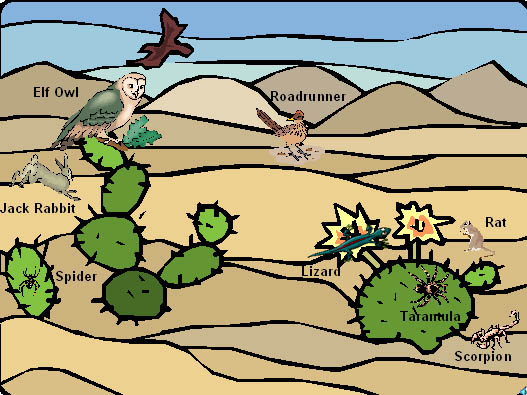 Figure 1. PowerPoint electronic slideshow depicting the world of habitats (arctic, deserts, rainforest, and coral reef) and the animals that live there. (More example student projects from this course can be found on the sample portfolios page of the website).
In a departure from previous strategies, students contemplated the power of technology before they even laid their hands on the tools. Counter to the accepted first step of sitting down in front of a blank screen to decide what to write, students immersed themselves in sample projects, playing, exploring, and critiquing. With the vision in mind of how various software tools could be used to solve learning problems, they proceeded to design and develop technology-enhanced learning materials.
Establishing a vision for technology use in this first course yielded educational products with dramatically improved quality over previous courses, and progressive competition led to results much more sophisticated than would have been imagined without first establishing what was possible with basic technology tools (See Figure 1)
Evaluation and Integration: Negotiating Vision
Our second course shifted the focus from tool use in developing and producing learning materials to integrating technology into standards-based curriculum. Students explored a number of instructional frameworks and approaches to plan lessons to meet specific learning goals. Often they modified technology-enhanced tools created in the previous class or those obtained from online sources so that they learned the craft of customization that all teachers must master when planning learning experiences to meet the needs of specific groups of students.
Effective technology-using teachers do not have to author unique digital presentations as a daily practice. Accepting this somewhat simple revelation has led us away from a solitary focus on development and has released in-class time to consider larger questions of meaningful integration. Quality and relevant resources exist online, and good teachers can mix and match sound educational materials in any number of meaningful ways, particularly with other non-technology teaching methods, to assist learning goals. In fact, lack of time is a barrier cited frequently by teachers who resist using technology.
It may be that teachers have been led to believe that “doing” technology necessitates presenting students with a shimmering, animated, masterpiece of an electronic presentation for every new lesson. Such a time intensive proposition puts technology, in many teachers’ minds, out of the question as a regular component of their teaching toolkits. We believe that teacher candidates prepared with the critical skills necessary to locate, evaluate, and employ online materials in a variety of creative ways will be better able to manage various types of online information and imagine multiple and flexible uses each has in enabling teaching and learning.
The majority of teacher candidates in the second course were in their final semester based at the university prior to field-work. Their growing understanding of what it meant to be a teacher was a balance between their lived experience as students and the instruction on pedagogy they received in their initial professional development coursework, as yet largely uninformed by any current K-12 experience. In an attempt to infuse their mental schema building with authentic flavors of school context, we used communication technology to bring the voices of real teachers and principals and students to our students.
Experienced classroom teachers and novice teacher education students collaborated on cross-level technology-integration planning; principals and elementary students guest-moderated discussion forums on acceptable use policy and favorite web resources; and realistic teaching scenarios were juxtaposed with an array of technology tools, challenging students to choose and defend appropriate technology use. These virtual experiences gave future teachers a sheltered glimpse into school stakeholders’ thought processes in planning, teaching, and evaluating technology-rich learning experiences so that they could negotiate an understanding of the challenges of teaching with technology before they became a full-fledged member of a school community (Visit the course discussion boards from http://discussions.coe.uh.edu/index.cfm?forumid=1).
Implementation and Assessment: Seeking Vision
The final one-hour technology course was taken while students taught in authentic school settings, concurrently with other field-based methods courses. Because students were at a distance from both the campus and from peers placed at as many as six different school districts, we capitalized on web-based discussion forums with which students had grown increasingly skilled throughout the course sequence. In addition to ongoing threads of informational discussion, students searched for, shared, and moderated discussions about current articles on teaching with technology and the applications they were able to incorporate in their placement classrooms.
 Figure 2. Screenshot of the Adopt-a-Student Case Study assignment (for more information, see http://www.coe.uh.edu/courses/cuin3113/case.htm
During the first two courses, we depicted possible visions of technology use and assisted teacher candidates in forming their own understanding. Now we set as their goal the active participation in forming their own visions by seeking answers to enable their success as future technology-using teachers. Students engaged in two research projects to understand technology use at their assigned schools at both the macro and micro levels.
First, students placed at a common school collaborated to survey the technology infrastructure in order to gauge the school technology climate on the large scale. Using teacher technology standards as a guide, students sought information related to school-wide resources, acceptable use policies, safety issues, and equitable access to technology (See the Technology Infrastructure Scavenger Hunt at http://www.coe.uh.edu/courses/cuin3113/tish.htm). On a smaller scale, students designed and conducted a needs assessment of an individual student and compiled the results as a case study report (See Figure 2). more about the Adopt-A-Student Case Study at ). Learning to ask questions such as these prepared students to be confident, active technology users in their future schools.
This school-based research also laid the groundwork for the final comprehensive integrated lesson assignment. Students expanded a lesson they were already designing for one of their methods courses to consider explicitly ways in which to incorporate technology. This integrated lesson required students to apply directly what they had learned in the past two courses regarding the theory of using technology for teaching, as well as what they had learned about the needs of the school community in which they were placed.
Teacher candidates were required to solicit multiple feedback sources before, during, and after lesson implementation, including discussing the learning needs of the class with their site-based teachers, inviting peer evaluation of both the plan and the implementation of the lesson, and reflecting on the strengths and needs for future applications. This was a concentrated teaching exercise, beyond merely drafting lesson plans, and it truly solidified the knowledge, skills, and dispositions that teacher candidates honed throughout their program.
Conclusion
Clearly, the extended amount of time that our teacher candidates spent developing knowledge and skills with technology use simultaneous to the development of their pedagogical knowledge and skills ensured a stronger grasp of the necessary relationship between the two. We have begun to collect evidence, through interviews, observations, portfolio artifacts, and concept maps that this extended-time three-course model could:
- Free students from having to focus on quickly learning how to use as many technology tools as possible, allowing time to consider the more overarching goals of technology in teaching.
- Allow a developing teacher’s conception of teaching with technology to grow and change as does the conception of teaching.
- Acknowledge the need for support for technology use for an extended period of time.
- Encourage students to view technology in a variety of ways.
- Permit integration with a whole range of preparatory coursework, including both foundations and methods.
Even more importantly, newly conceived methods such as the ones described here recognize technology not only as a topic of discussion but also as a connective device to assist future teachers to establish an initial vision, negotiate a developing vision, and seek a realistic vision of teaching. Whereas previous methods gave teachers blank tools, this model begins by giving teachers a vision of technology use. Whereas previous methods taught technology skills disconnected from content methods, this model presents technology in an extended, connected way that scaffolds learning. Whereas previous methods expected teachers to go forth and “integrate technology,” this model arms teachers with the right questions and resources to find success in any teaching assignment they might encounter.
By truly integrating the technology throughout the teacher preparation experience using a carefully designed, varied, and prolonged treatment, future teachers will be effectively prepared to face the real challenges that come with the present generation of teaching.
References
Albion, P. R. (2001). Some factors in the development of self-efficacy beliefs for computer use among teacher education students. Journal of Technology and Teacher Education, 9(3), 321-347.
Balli, S. J., Wright, M. D., & Foster, P. N. (1997). Preservice teachers’ field experiences with technology. Educational Technology Review, 37(5), 40-46.
Dempster, F. N., & Farris, R. (1990). The spacing effect: Research and practice. Journal of Research and Development in Education, 23(2), 97-101.
Eifler, K. E., Greene, T. G., & Carroll, J. B. (2001). Walking the talk is tough: From a single technology course to infusion. Educational Forum, 65(4), 366-375.
Frazier, J. A., & Morrison, F. J. (1998). The influence of extended-year schooling on growth of achievement and perceived competence in early elementary school. Child Development, 69(2), 495-517.
Gullo, D. F. (2000). The long term educational effects of half-day vs full-day kindergarten. Early Child Development and Care, 160, 17-24.
Hargrave, C. P., & Hsu, Y.-S. (2000). Survey of instructional technology courses for preservice teachers. Journal of Technology and Teacher Education, 8(4), 303-314.
Marcinkiewicz, H., & Wittman, T. (1995). From preservice to practice: A longitudinal study of teachers and computer use. Journal of Computing in Teacher Education, 11(2), 12-17.
Mehlinger, H. D., & Powers, S. M. (2002). Technology & teacher education: A guide for educators and policymakers. Boston: Houghton Mifflin.
Pierson, M. E., & McNeil, S. (2000). Preservice technology integration through collaborative action communities. Contemporary Issues in Technology and Teacher Education, 1(1), Available: https://citejournal.org/vol1/iss1/currentpractice/article1.htm
Stuhlmann, J. M. (1998). A model for infusing technology into teacher training programs. Journal of Technology and Teacher Education, 6(2-3), 125-139.
Wetzel, K. (1993). Models for achieving computer competencies in preservice education. Journal of Computing in Teacher Education, 9(4), 4-6.
Willingham, D. T. (2002). Allocating student study time: “Massed” versus “distributed” practice. Retrieved July 21, 2003, from www.aft.org/american_educator/summer2002/askcognitivescientist.html
Author Note:
Melissa Pierson
University of Houston
email: [email protected]
