Vision Vignette
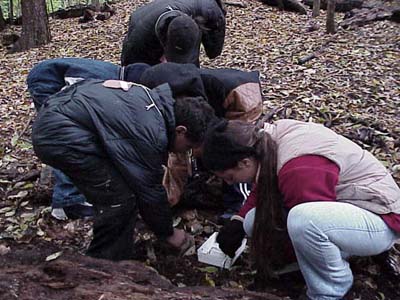
Figure 1. evTMB students investigating the forest floor with elementary school children.
Imagine, small groups of fourth graders are scattered about the natural area adjacent to the playground of Aldo Leopold Elementary School located in a small town in upstate New York (see Figure 1). They are equipped with laptop computers linked to the Internet via a digital wireless connection. One group is identifying insects using the online Audubon Field Guide. Another group has a microphone connected to the laptop and is trying to record the sounds of cicadas for use in a multimedia presentation they are creating about how insects communicate. Yet another group has a science probe that can measure temperature. They are working on a research project that compares the reflectivity of different soil types with the kinds of plants and animals that live there. Finally, another group is working on a time-lapse photography project which is chronicling the life cycle of different plants in the area.
Ultimately, they will be preparing charts and graphs that they will share in a collaborative project with students in a neighboring state. As they design the research study, they determine, in real-time consultation with their peers in the other state, some variables they need to consider for the project. As problems arise, the students connect with their colleagues in the other school via a video link from the Natural Area. Problems are addressed and resolved on the spot.
As the students work, their teacher, Ms. Smith, a recent SUNY Cortland graduate, walks around the Natural Area observing, questioning, and advising the students as they work on their projects. As she moves to the next group, she is pleased with what she observes. She recalls her own preservice training at SUNY Cortland in the Environmental Thematic Methods Block. This integrated approach to teaching elementary school helped her to see the power of integrated learning and technology for developing student understanding. The students seem to grasp new concepts much more quickly when they see how many ideas, concepts, and approaches can transcend discrete subject areas. This approach, while often seeming somewhat chaotic, actually results in her students becoming more involved in learning.
With this vision in mind, we developed the Environmental Thematic Methods Block (evTMB). The evTMB involves the integration of elementary education methods courses taken by preservice teachers. Specifically, the evTMB uses the topic of environmentalism as a foundational theme and technology as a tool of pedagogical inquiry and delivery to explore disciplinary connections between science, math, and social studies. We teach the same group of 50-75 students (depending on the semester) in order to facilitate the development of learning communities. In addition, the course content is connected by emphasizing similar themes and disciplinary connections. The evTMB is designed to prepare preservice elementary teachers to expand traditional disciplinary and professional boundaries.
Context
The State University of New York (SUNY) at Cortland is a public institution located in rural upstate New York. The college is the largest preparer of elementary education teachers in New York State and is one of the top 10 in the nation. Over 60% of its 7,200 students are seeking some form of teacher education credential. Our campus is currently in the midst of preparing for review by the following governing bodies: Middle States Accreditation, New York State Department of Education, and the National Council for Accreditation of Teacher Education. These external reviews require us to define what we do and then defend why we do what we do. We see the evTMB as one model to accommodate these external reviews. More importantly, however, we see this model as a catalyst for reform.
In what follows, we provide a glimpse of the literature that informed the theoretical foundation of the evTMB model and a glance at the evTMB in practice. There are three theoretical sites that inform the evTMB model: technology and teaching, disciplinary/content integration, teaching and learning community construction. The evTMB Mission Statement can be viewed at http://tmb.cortland.edu/CITEARTICLE/evtmb.htm.
Technology Immersion in the evTMB Model
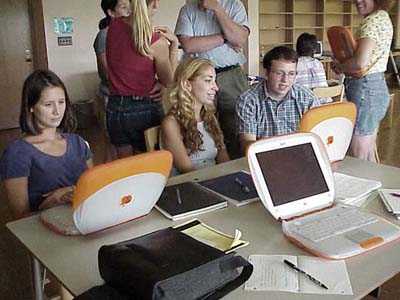
Figure 2. evTMB students working with wireless technology during class.
An interesting phenomenon appears in the literature concerning teaching and learning with technology. While most 1st-year teachers believe that using technology with instruction is important, a large portion of graduating preservice teachers report being poorly prepared to use technology (Strudler, McKinney, Jones, & Quinn, 1999; Topp, 1996; Willis, Austin, & Willis, 1994). In response, some teacher education programs offer a stand-alone educational technology course (Strudler et al., 1999). However, the impact of these courses is typically diminished because of their isolation in relation to the content teachers will be teaching (Bitter & Yohe, 1989; National Council of Accreditation of Teacher Education, 1997; Novak & Berger, 1991; Willis & Mehlinger, 1996).
These findings indicate the need for teacher educators who can provide models of technology integration for preservice teachers. The evTMB uses this research as support for the heavy emphasis of technology immersion it places on preservice teachers (see Figures 2 and 3). evTMB in Action
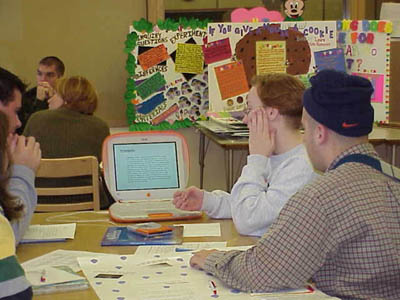
Figure 3. An evTMB student presenting the results of a scientific inquiry prompted by a children’s book.
Traditionally, Cortland offers EDU 314 – Teaching with Computers as a stand-alone course to teach the basics of computer usage in the classroom. However, in the evTMB we identified essential software applications and designed projects that relied on the various applications. This way, instead of EDU 314 serving as an isolated skill-based course, our preservice teachers brought assigned projects from math, science, and social studies and used the course (EDU 314) as a laboratory in which they investigated the various tools (hardware and software) at their disposal. Also, Karl Klein (EDU 314 professor) was able to assume the role of facilitator.
The Virtual Fieldtrip
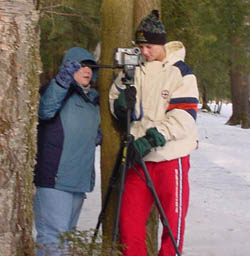
Figure 4. evTMB students working with a digital camera to prepare their virtual reality scene.
One project that was completed by the evTMB students required them to conduct historical research and use Quick Time VR Authoring Studio to showcase an historical site. SUNY Cortland owns Huntington Memorial Camp in the Adirondacks. Huntington was originally Camp Pine Knot and was one of the first “Great Camps” designed by William West Durant. Pine Knot is where Durant experimented with the architectural style that came to dominate Adirondack design. Also, Durant’s “rustic” style became a common attribute of other camps built in the Adirondacks by the wealthy.
Having Camp Huntington as a resource proved to be an asset to the evTMB. In a sense, the camp serves as an extension of the Cortland campus and provides students the opportunity to study environmental issues, conduct historical research, engage in leadership training, and enjoy the out-of-doors.
In support of the evTMB mission, a three day excursion to Camp Huntington occurred in late September for fall semester students and in late February for spring semester students. Along with a host of integrated learning experiences, our preservice teachers were required to complete an historical inquiry into one of the camp’s original buildings. They used primary documents, oral history techniques, on site interviews, and library research to craft a short narrative about the building. Our preservice teachers were also instructed on the use of digital photography and Quick Time VR Authoring Studio (Figure 4). These applications were used to create a panorama scene to be displayed with the narrative. To view a a completed project, go to http://tmb.cortland.edu/CITEARTICLE/chalet/chalet.htm.
The following week we were back on campus revising the narratives and cleaning up the VR scenes. Once completed, the VR scenes were used to develop a virtual field trip of Camp Huntington.
Because of the literature cited earlier, we designed the Virtual Fieldtrip to address some of the stated concerns. Our preservice teachers were required to use technology as a curricular tool. The skills needed to complete the task were not taught in isolation of content. Also, the virtual field trip serves as a model of the possibilities for use of technology in K-12 classrooms.
Integration of Content, Pedagogy, and Discipline Areas in the evTMB Model
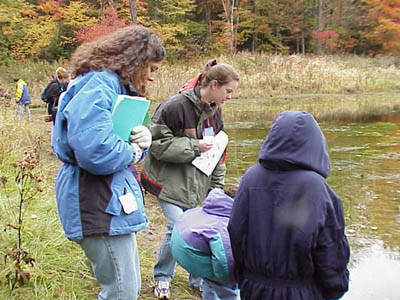
Figure 5. evTMB students working with elementary school children at Lime Hollow Nature Center.
The vast body of literature on teacher education suggests (a) that elementary school teachers often have weak understandings of the content they are teaching (Ball, 1990; Eisenhart et al., 1993; Post, Harel, Behr & Lesh, 1991; Simon, 1993); and (b) that despite the efforts of teacher education institutions, the most influential force in preparing preservice teachers to teach content is their “apprenticeship of observation” (Lortie, 1975; Slekar 1998). As Lampert and Ball (1998) put it:
Because of their many years of schooling, teacher candidates come with extensive exposure to teaching and the practice of teaching. They have watched their teachers over the years and constructed ideas about practice from their own perspective as students. They have observed what teachers do and are prepared to teach as their teachers taught — to stand at the board, to assign problems, to check homework from the key. (pp. 24-25)
The evTMB attempts to face both these challenges by integrating content into our teaching of methods and by modeling teaching that is inquiry based. For example, we use a joint text, Acid Rain, Acid Snow (Slade, 1999), which discusses the impact of air pollution and resulting acid rain on the ecosystems in New York’s Adirondacks. On a subsequent, 3-day trip to SUNY Cortland’s Camp Huntington in the Adirondacks, evTMB students meet with the author of the text to build further content knowledge and develop a sense of political advocacy. Other activities during this trip include, (a) discussion of the physical and chemical processes influenced by acid rain, (b) development of an understanding of the pH scale and the statistics associated with acid rain, and (c) investigation of the acid levels of local lake and stream water.
A second example of integrated content and pedagogy that evTMB uses involves a group field trip to Lime Hollow Nature Center, a local resource only 5 miles from SUNY Cortland (see Figure 5). During this field trip, evTMB students walk the paths of the nature center, looking for clues as to the historical use of the land. They also participate in several environmental education activities that encourage students to use scientific process skills (observation, measuring, estimating, etc.). Some of these activities involve simulations, such as the population growth and decline of various animal populations. Students “act out” this process through a game called “Oh, Deer!” (Western Regional Environmental Education Council, 1986), track the growth and decline of the population through the rounds of the game, and then graph the data.
The activities conducted on the field trips to Camp Huntington and Lime Hollow become the backdrop and reference points for the rest of the content of evTMB. From these field trips, generally held early in the semester, evTMB students immediately begin to understand how interdisciplinary study fits quite naturally in a variety of contexts. In particular, the environmental theme used in the evTMB makes obvious the presence of social studies, science, and math when inquiry in natural settings occurs. By modeling such interdisciplinary inquiry in our teaching, evTMB faculty members enable students to observe how such content-based activities can be created and implemented.
In addition, the field trips are simply a starting point for the work of evTMB students in thinking about interdisciplinary teaching and learning. Several other activities connect to the field trips. Later in the semester, evTMB students host local elementary school children on a field trip to Lime Hollow Nature Center. Working in small groups, the evTMB students must plan and implement an entire day of instructional activities. This enables evTMB students to use their familiarity with this setting as a means to apply their understanding of interdisciplinary teaching.
One of the final activities for all evTMB students is to create a set of interdisciplinary lessons for another informal teaching situation. Students must choose an “informal” context (such as a nature center, state park, science center, farm, etc.) and come up with instructional goals, activities, and assessment procedures that can be used to help children learn in the associated context. Activities must include both before and after activities, to prepare and provide closure for the teaching “off-site.” In addition, activities must be connected to state and national standards in science, math, social studies and language arts, so they must be interdisciplinary.
In introducing students to interdisciplinary content and pedagogy, the evTMB faculty create a series of activities in which students can participate and experience interdisciplinary learning for themselves. Then the faculty push students to build on these experiences by asking students to apply what they have learned through these experiences. Such a process encourages students to start thinking about content and investigation of content in an interdisciplinary way. Because students’ own experience within the environmental, interdisciplinary settings are generally positive, evTMB students tend to be eager to create and provide such powerful and enjoyable learning experiences for their future students.
Development of a Learning Community in the TMB Model
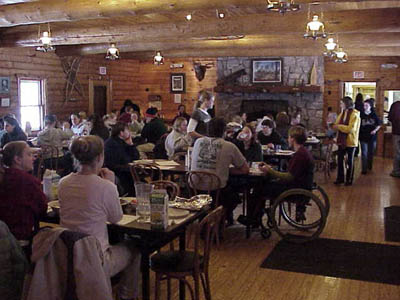
Figure 6. evTMB students sharing a meal in the dining hall at Camp Huntington.
A third body of literature on school and learning communities informs this work. Research on school change suggests that peer collaboration and support is crucial for teachers to be successful in restructuring their classrooms and their schools (Gilmore, 1995; Levine & Lezotte, 1995). In addition, there are a multitude of studies suggesting that teacher collegiality and professional communities are often hallmarks of successful schools (Little, 1982; McLaughlin & Yee, 1988; Rosenholtz, 1989; Westheimer, 1998).
In evTMB, preservice teachers are exposed to professional and learning communities in two ways. First, we (the faculty) plan and team teach. This serves as “professional community” model for our students. We meet each week, either formally or informally, to plan and schedule activities, as well as to troubleshoot and share insights. We also share with students our varying perspectives and processes for making decisions and creating curriculum. Students often observe us meeting together, eating lunch together, or simply sharing anecdotes in the hallway. Thus, students are made aware from the start of evTMB that we as faculty members work as a cohesive team, sharing jointly in the planning and implementation of the evTMB.
While the cooperative work of the faculty certainly models a type of “professional community” for students, students probably learn more about professional communities by actually participating in one. The structure of evTMB encourages the development of learning communities among its students, because all evTMB students are members of a given cohort. Students participate in all course activities with the same cohort. Sharing 11 hours of class time per week with the same group of students helps evTMB students become very familiar with their peers.
In addition, the evTMB courses stress group work, and many class activities and assignments must be completed in pairs or small groups. At the beginning of each semester, for example, students participate in several “team building” activities (Figure 6 and 7). Generally, they are given some kind of problem each small group has to solve. Solutions are shared with the larger group. In this type of activity, students get to observe the different perspectives and contributions of both individuals and small groups in their cohorts. They get to see and appreciate the different ideas and approaches of their peers. For some examples, see http://tmb.cortland.edu/CITEARTICLE/raquettelake2.html.
This cooperative group activity continues throughout the semester. Students often are encouraged to work together on assignments or projects. Generally, students are required to present their products to their evTMB classmates for constructive critique. Because students tend to get to know each other fairly well, students tell evTMB faculty that making presentations in evTMB classes is easier than presenting in a non-evTMB class. Thus, they come to enjoy and value the exchange of ideas, which is a characteristic of evTMB classes.
Technology also helps evTMB students share with and support each other. The evTMB has a listserv that allows any member of evTMB to send an email message to the whole evTMB group, including students in all the cohorts and faculty. Faculty use the listserv to update students on assignments or activities, answer general questions, or share news. Students also use the listserv to share information with each other. They offer advice or discoveries they have made. And the listserv provides just one more way for students to get to know and support one another. For example, during the 2nd week of the evTMB classes, one of the students posted this message to her colleagues on the evTMB listserv:
Hey everyone, my name is [student name] and I am a junior transfer student. On the first day of classes, I was a little overwhelmed with the curriculum we were presented with, but knowing that I have many classmates who are available for support and encouragement leaves me feeling excited to be part of a well recognized program. I hope everyone has a wonderful semester and let me know if I can do anything to help you out 🙂
Such continued working and sharing together creates an interesting phenomenon in evTMB. As the semester continues, and more outside assignments become due, students turn to each other for assistance. They begin to see each other as “experts” and “consultants” and will often go to their peers for assistance before seeking faculty advice. For example, at the end of the semester, students must present a webfolio as a culminating project for evTMB. The webfolio includes samples of work they have done all semester long. This work must illustrate how the students have met the objectives of each course in evTMB. To view a sample webfolio, go to http://tmb.cortland.edu/CITEARTICLE/simoes/splashscreen.htm.
The webfolio is a huge project for students and they spend many hours in the college’s computer labs working on this project. However, because students have developed such a learning community, they rely on each other for assistance as they work on this project. When someone “loses” something on disk, several peers assist the “victim” by trying to recover the lost item. When someone cannot figure out why a link will not work, a peer will be consulted to try to fix the problem. From student stories of antics and heroics in the computer lab, it is evident that evTMB students rely on and support each other outside as well as inside of class. By the end of the semester, they have clearly developed a learning community whose members look to each other for advice and expertise.
Research in Progress
With every educational reform movement seems to come a call for increased and improved preparation for teachers. Unfortunately, while the literature concerning the need for professional preparation is extensive, how to conduct successful professional preparation to enact reform throughout the entire pre-K to 16 system remains somewhat of a mystery. As Simon (1996) pointed out,
Descriptive research on teaching and teachers’ development generates accounts of what is in place currently. However, the current reform … requires … the reinvention of teacher education. Therefore, research must contribute to understanding a process that is largely unrealized at this time. We seem to have a “catch twenty-two;” we are unable to foster adequate teacher development because we don’t sufficiently understand the developmental processes, and we are unable to understand the developmental processes because we do not have situations to observe where teachers are developing this expertise. (p. 507)
We believe the evTMB is a means to “reinvent” teacher education, and it is a situation in which future teachers are developing the knowledge, understandings, and skills they will need to operate in “reformed” classrooms. Since our program is only a year old, we have limited evidence on its impact. However, both the anecdotal and formal evidence we have suggests evTMB has had a significant impact on students’ views of content and pedagogy.
For example, evTMB was offered for the first time in the Fall of 2000. During their time in evTMB, this “inaugural” group of students was often frustrated with evTMB and its faculty. They were not used to learning through inquiry or relying on technology so heavily. The “creative” scheduling of evTMB (to accommodate field trips and other “events”) confused them, and they longed for the days when they could depend on having the same class at the same time each week (i.e., every Monday, Wednesday, and Friday from 10-10:50 a.m.). They felt the evTMB required too much work of them and that the faculty’s standards and expectations were too high. Needless to say, we as faculty were somewhat concerned about the impact we had on our students. This was not the reaction we anticipated.
However, the next semester, spring 2001, when that first group of 72 evTMB students moved on to new education classes, we started getting incredibly positive feedback. Former students came back to us saying that they missed evTMB. They missed the hands-on classes, they missed knowing their peers so well, and they missed learning in the type of environment that TMB created. In their new classes, they felt disconnected from their peers and their instructors. And worst of all for them, none of their classes seemed to be connected or interrelated, as they had in evTMB.
At the same time, our colleagues who were now teaching our former evTMB students were telling us that there was a distinct difference between the evTMB and the non-evTMB students they had in their classes. The evTMB students tended to be more vocal. While many of our colleagues appreciated this characteristic, some instructors felt that evTMB alumni had an “air of entitlement” and complained too much about how courses were structured or how the college system worked. (Of course, we, as evTMB faculty, saw this as political advocacy!)
Colleagues also suggested that evTMB students shared many positive examples from evTMB during their class discussions. In one class, called Measurement and Evaluation, the instructor asked students to share positive evaluation experiences they had had in their school career. One by one, the evTMB alumni in her class brought forth assessment procedures used in evTMB. They appreciated the use of rubrics and peer assessment in determining grades for their work. They appreciated the fact that not all of their grade was determined by performance on written work, but by the quality of presentations they made to peers or the reflections they completed on their work with children.
Finally, many of them spoke of the impact of the webfolio on their learning. As a culminating project, students felt the webfolio allowed them to choose and exhibit their best work. It also forced them to reflect on all they had learned throughout the semester, and then demonstrate that learning to themselves and their instructors. Finally, the webfolio made them use the technological skills they had developed throughout the semester. Thus, to students, the webfolio seemed a powerful and authentic means for them to show what they had accomplished all semester. As faculty, we are elated with this feedback. This was the kind of result we hoped we would have.
We hope that analysis of more formal data we collect will support the great body of anecdotal evidence we have gathered. Unfortunately, while we have collected some data (through surveys and work samples) on students’ experiences with the evTMB, we have not yet finished analyzing most of this data. However, there is one small set of data that has recently been analyzed and illustrates some of the effects an innovation such as evTMB can have.
The data are open-ended responses to a survey for college students called the Measure of Epistemological Reflection (MER; Baxter Magolda, 1992; Baxter Magolda & Porterfield, 1985). The MER is meant to develop the level of intellectual development of college students by asking them about their perspectives on five domains related to learning: the role of the learner, the role of the instructor, the role of peers, the role of evaluation, and the nature of knowledge. In a small pilot study involving 60 students, we administered the MER to three groups of undergraduates: Group I consisted of students majoring in a liberal art or science, Group II consisted of elementary education majors who did not participate in evTMB, and Group III consisted of elementary education majors who participated in evTMB in fall 2000. All students in all three groups were juniors. All three groups were of similar composition in terms of gender, race, age, and GPA.
In analyzing student responses, a significantly larger percentage of evTMB students had reached higher levels of intellectual development than students in the other two groups. None of the evTMB students were in the earliest stages of development, compared to 25% of the liberal arts or sciences majors and 10% of the non-evTMB elementary education majors. At the other end of the scale, 45% of the evTMB students were at the highest level of intellectual development seen in this study, whereas only 15% of the arts and sciences majors and 30% of the non-evTMB elementary education majors were at this level. In short, this means evTMB students were more likely to see learners as needing to think for themselves, as opposed to gaining knowledge from the instructor. The evTMB students were also more likely to believe peers should be serving as sources of knowledge as opposed to being simply a means to share materials. In terms of the role of the instructor, evTMB students were more likely to feel instructors should be promoting students to think independently as opposed to communicating knowledge to learners. Evaluation should thus reward such thinking as opposed to showing the instructor what was learned. Finally, evTMB students were more likely to see knowledge as uncertain and open to interpretation as opposed to being certain and absolute.
Although this is a small study, the results do indicate that evTMB has an effect on how students think about knowledge and teaching. We hope to replicate these results in the next year, so that we can further analyze what components of evTMB have the greatest impact on student learning and thinking. In addition, we hope to follow the first group of evTMB students as they begin student teaching in the fall of 2001 to see in what ways, if any, their evTMB experience affects their classroom teaching.
Conclusion
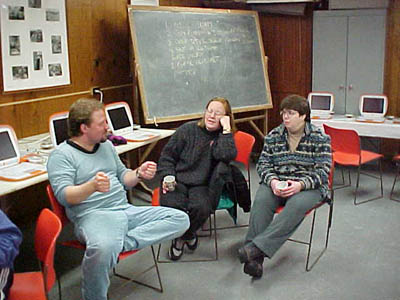
Figure 7. TMB faculty informally discussing plans at Raquette Lake.
The evTMB faculty believe that by integrating course content, developing deeper relationships with and among our students, and using technology throughout our teaching, our preservice teachers will be exposed to a model of teaching and learning better suited to the classrooms of the new millennium. Early indications from both formal and informal evidence suggest that evTMB students do recognize that the learning environment created through evTMB activities and relationships is one that supports student growth and understanding. We believe evTMB is an experience our students want to simulate in their own teaching. We hope that by following evTMB students through their student teaching and first teaching jobs, we will begin to see how the evTMB experience gets translated into elementary school teaching.
References
Ball, D. L. (1990). Prospective elementary and secondary teachers’ understanding of division. Journal for Research in Mathematics Education, 21, 132-144.
Baxter Magolda, M.B. (1992). Knowing and reasoning in college: Gender-related patterns in students’ intellectual development. San Francisco: Jossey-Bass.
Baxter Magolda, M.B., & Porterfield, W.D. (1985). A new approach to assess intellectual development on the Perry Scheme. Journal of College Student Personnel, 26, 343-351.
Bitter, G.G., & Yohe, R.L. (1989, March). Preparing teachers for the information age. Educational Technology, 12, 22-25.
Eisenhart, M., Borko, H., Underhill, R., Brown, C., Jones, D., & Agard, P. (1993). Conceptual knowledge falls through the cracks: Complexities of learning to teach mathematics for understanding. Journal for Research in Mathematics Education, 24(1), 8-40.
Gilmore, A.M. (1995). Turning teachers on to computers: Evaluation of a teacher development program. Journal of Research on Computing in Education, 27(3), 252-269.
Lampert, M., & Ball, D.L. (1998). Teaching, multimedia, and mathematics: Investigation of real practice. New York: Teachers College Press.
Levine, D.U., & Lezotte, L.W. (1995). Effective schools research. In J.A. Banks & C.M. Banks (Eds.), Handbook of research on multicultural education (pp. 525-547). New York: MacMillan.
Little, J.W. (1982). Norms of collegiality and experimentation: Workplace conditions of school success. American Education Research Journal, 19(3), 325-340.
Lortie, D. (1975). Schoolteacher. Chicago: University of Chicago Press.
McLaughline, M.W., & Yee, S.M. (1988). School as a place to have a career. In A. Lieberman (Ed.), Building a professional culture in schools (pp. 23-44). New York: Teachers College Press.
National Council of Accreditation of Teacher Education. (1997). Technology and the new professional teacher: Preparing for the 21st Century Classroom. Washington, DC: Author.
Novak, D.I., & Berger, C.F. (1991). Integrating technology into teacher education. Technology Horizons in Education Journal 18(9) 83-86.
Post, T. R., Harel, G., Behr, M. J., & Lesh, R. (1991). Intermediate teachers’ knowledge of rational number concepts. In E. Fennema, T. P. Carpenter, & S. J. Lamon (Eds.), Integrating research on teaching and learning mathematics (pp. 177-198). Albany, NY: State University of New York.
Rosenholtz, S.J. (1989). Workplace conditions that affect teacher quality and commitment: Implications for teacher induction programs. Elementary School Journal, 89(4), 421-439.
Simon, M. A. (1993). Prospective elementary teachers’ knowledge of division. Journal for Research in Mathematics Education, 24(3), 233-254.
Simon, M. A. (1996). A methodology for research on mathematics teacher development: The teacher development experiment. In E. Jakubowski, D. Watkins, & H. Biske (Eds.), Proceedings of the 18th Annual Meeting of the North American Chapter of the International Group for the Psychology of Mathematics Education. Columbus, OH: ERIC Clearinghouse for Science, Mathematics, and Environmental Education.
Slade, J. (1999). Acid rain, acid snow. Woodgate, NY: Woodgate International.
Slekar, T. D. (1998). Epistemological entanglements: Preservice elementary school teachers’ “apprenticeship of observation” and the teaching of history. Theory and Research in Social Education, 26(4), 485-508.
Strudler, N. B., McKinney, M. O., Jones, W. P., & Quinn, L. F. (1999). First-year teachers’ use of technology: preparations, expectations, and realities. Journal of Technology and Teacher Education, 7(2), 115-130.
Topp, N. (1996). Preparation to use technology in the classroom: Opinions by recent graduates. Journal of Computing in Teacher Education, 12(4), 24-27.
Western Regional Environmental Education Council. (1986). Project Wild: Elementary activity guide. Boulder, CO: Author.
Westheimer, J. (1998). Among schoolteachers: Community, autonomy, and ideology in teachers’ work. New York: Teachers College Press.
Willis, J., Austin, L., & Willis, D. (1994). Information technology in teacher education: Surveys of the current status. Houston, TX: University of Houston, College of Education.
Willis, J., & Mehlinger, H. (1996). Information technology and teacher education. In J. Sikula, T.J. Buttery, & E. Guyton (Eds.), Handbook on research in teacher education (pp. 978-1029). New York: Simon and Schuster Macmillan.
Tim Slekar
Penn State Altoona
email: [email protected]
