Teacher educators have the dual responsibility to ensure that preservice teachers can compose well-written expository text and that they are prepared to teach these skills to their students. Both state and national standards articulate the importance of teaching and learning about expository text structures. Language arts literacy standards for K-12 students call for the development of expository writing skills as part of a “repertoire of strategies that enables them to vary form, style, and conventions in order to write for different purposes, audiences, and contexts” (New Jersey Department of Education, 2004).
This paper describes an experimental exploration of special procedures used in a series of game-like online tasks designed to help preservice language arts teachers develop descriptive expository writing skills. It begins with brief reviews of referential communication tasks (the underlying paradigm for this study), the use of online technology in writing instruction, and a definition of expository writing skills. After a description of the current study’s methodology, the quantitative and qualitative results are reported, and their implications are discussed.
Background
Referential Communication Tasks
Referential communication tasks were designed to examine the communicator’s (speaker’s) ability to perform two types of informational analysis as part of perspective-taking communication (Krauss & Fussell, 1996, section 4.1.2). The first is to be able to describe or define the characteristics or attributes of a referent item (e.g., a pattern, object, or color) in such a way that it can be distinguished from similar nonreferent items. The second is to be able to take the listener’s background, current knowledge, and ability into account and adjust the communication accordingly. An example of these tasks is as follows: a speaker and a listener are seated with an opaque screen between them and are both given a set of pattern blocks. The speaker is then instructed to describe each pattern as it appears in a predefined array so that the listener can reconstruct the array.
Granted, these are not necessarily real-life situations. Instead, they are exercises in which feedback on the speaker’s descriptive proficiency is a nonjudgmental and objective assessment: whether the listener was able to correctly order the blocks. Studies in which participants engage in repeated referential communication tasks have shown that this type of feedback will help speakers improve their descriptive verbal communication skills (Krauss & Glucksberg, 1969; Yule, 1997). In this study we were interested in seeing whether a variation of a referential communication task could take advantage of the interactivity afforded by online technologies by giving participants a similar description task.
Online Technologies in Writing Instruction
Online technologies have been used successfully in writing instruction such as online writing labs (OWLs; Harris & Pemberton, 1995) and writing courses. Not only does the technology have the potential to make the composition, review, and revision process much easier, the online platform also provides a way for students to share their writing with a wider audience and use the feedback to gain a more accurate understanding of their intended audience (Blair, 2003). This is a necessary and fundamental element of effective writing. The interactivity afforded by online writing has also been shown to provide authentic and stimulating motivation for writers who might have previously been disenfranchised or disengaged as potential writers (Warschauer, 1999).
Additionally, in preservice teacher preparation programs, asynchronous computer- mediated communication technologies such as online discussion boards have been used to foster perspective-taking (e.g., recognizing the value of other students’ opinions and considering a discussion topic from different viewpoints; Järvelä & Häkkinen, 2002), to build conceptual connections between different components of a teacher education program (e.g., seeing the relationship between college-based theory courses and school-based field experiences; Mitchell, 2003), and to increase reflection and community building (e.g., participants have a better understanding of peers and their perspectives; Killian & Willhite, 2003). On the other hand, Cifuentes and Hughey (2003) found that the effect of computer conferencing on preservice teachers’ expository writing was influenced by the participants’ multiple intelligences characteristics. In the current study we did not explore any aptitude-treatment interactions, but future studies would certainly warrant taking this into account.
Expository Writing Skills
The purpose of expository text, as the name suggests, is to expose information to the reader. There are seven text structures (organizational patterns) commonly identified with expository writing, including definition, description, process (e.g., sequence), classification, comparison, analysis (e.g., cause and effect), and persuasion (Heller, 1991; Meyer & Freedle, 1984). One overarching skill identified with expository text writing is the student’s ability to recognize and understand these expository text structures (Flood, Lapp, & Farnan, 1986; Harvey, 1998; Mc Gee & Richgels, 1985). In the current study however, we focus on only one text structure—description.
Description was defined as the author’s ability to concisely list characteristics, features, and examples to illustrate the salient features of the selected topic (Blasingame & Bushman, 2005; McHugh, 1997; Tompkins, 2005). Again, as with referential communication tasks, effective descriptions are ones that let the unknown audience (or in the case of the communication tasks, the unseen listener) visualize the person, place, thing, or event being described, providing enough detail so they can reconstruct the intended meaning (Heller, 1991).
Drawing on these notions of description, we broke descriptive writing skills into four subcategories for the purposes of this study: feature set, word choice, conciseness, and text structure. Feature set is the ability to recognize and identify all defining attributes and characteristics, including any nonsalient features that become important when salient features such as color are hidden or non-unique. Word choice is the ability to use understandable and meaningful designations for features and aspects when specific expert terminology is not known or vocabulary is not universal or generally shared. Word choice also includes an acknowledgment of the dissimilarities and divergent backgrounds readers may have. Conciseness is the ability to provide an efficient, succinctly worded depiction that avoids repetition, extraneous information, and ambiguity in the description. Text structure is the ability to use semantics and syntax appropriately.
Current Study
Volunteers for the current study were recruited from three sections of an undergraduate language arts methods course, entitled Language Arts and Literature, during the spring 2004 semester. This course is required for undergraduate students in the K-8 initial teaching certification program and is taken in their third semester in the program along with a 2-day practicum field experience. All three sections were taught by the second author, a professor of literacy education in the College of Education at a medium-sized state university. Throughout the study, which ran for 10 weeks, the second author was unaware of participants’ identification and writing outcomes. Two of the course sections were used as the experimental group and the third section was used as the control group. The total number of students in the experimental group was 20, and the total in the control group was 11. However, due to attrition and noncompletion of the posttest at the end of the semester, the actual total number of participants was 15 in the experimental group and 11 in the control group. Participants were predominantly Caucasian females in the 20-30-age range, with one Caucasian male participant in the control group. Participants in the experimental sections were told that they would receive certificates acknowledging their participation in the study.
At the beginning of the semester, students in both the experimental and control sections were given a prestudy writing task in which they were shown a set of six similar objects (either Oriental rugs or antique quilts) on the computer monitor. They were asked to write a description on paper of the item (rug or quilt) labeled as #2. The same task was given again to all students at the end of the semester, but students who wrote about a rug in the prestudy task were asked to write about a quilt in the poststudy task and vice versa. This procedure ensured that any improvement in students’ writing was not due to a repetitive task effect, although that would be unlikely after a 10-week period between tasks.
During the semester, students in the control section did not participate in any of the study-specific writing tasks that students in the experimental sections did. However, a future study in which the control group simply wrote descriptions would be warranted to control for the effect of practice.
The students in the experimental group were randomly divided into five groups with four students in each group. Using private online discussion boards that were set up for them in the Blackboard course management system, each student was shown a picture that contained a set of six similar items, for example, a set of African masks (see Figure 1). Students were asked to write a description of a specified target item in that set sometime during the week. The instructions given were as follows
Please use the picture and write a description of mask number 4 in a reply message. The description should be thorough enough for someone else to be able to pick mask 4 from a similar picture, but should be succinct enough so you are not writing anything unnecessary.
At the same time, the other students in the group were asked to write about a target item in other picture sets, so that each student was a writer and a reader, as shown in the Table 1.
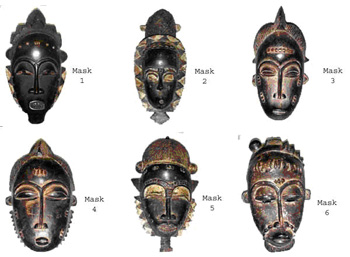 Figure 1. African mask picture set pictures (used with permission from Rebirth Africa (http://www.rebirth.co.za).
Table 1
Picture set assignments for writing and reading in each group.
Group member | wrote about… | read/made guesses on… |
A | African mask | figurine, shell, krater |
B | Aztec figurine | mask, shell, krater |
C | conch shell | figurine, krater, mask |
D | Greek krater | figurine, krater, shell |
Each writer’s description was then posted anonymously to the private discussion boards of the cohort members of their group along with a picture showing six similar items, including the target item. In the picture sets seen by the other cohort members, the items were rearranged and distracter items were similar but not always the same, so an effective description could not rely on position or relative modifiers (i.e., “target item is in upper-right corner” or “target item is larger than all other items”). Again, students were given 1 week to write their descriptions and were reminded ahead of time that good writers (whether online or not) could not necessarily assume that the audience had the same frame of reference as the writer.
The following week, cohorts were then asked to read the descriptions and guess the target item (and add a reason explaining their guess), using the Reply feature in their discussion board. In other words, all group members wrote one description, which was read and responded to by all of their cohort group members. Cohort responses were then anonymously copied back into each writer’s private discussion board to be used as feedback to improve their next writing task. This procedure was repeated three more times, with the intention of completing write-guess-feedback trials in the 10-week period. Groups were quasirandomly reassigned each trial so that no student was grouped with the same person twice. Each group consisted of four students, so each student would optimally receive three cohort guesses; however, this plan did not always work out due to sporadic participation from some students.
The picture sets were selected to become progressively more complex based on the authors’ assumptions that participants would not necessarily have expertise in or knowledge of vocabulary or feature sets specific to those items. In trial 1, the sets included stalks of pink flowers, blue and yellow parrots, yellow cacti flowers, and black and yellow fish pictures. All of these items were assumed to be ones that students were familiar with but not experts in (e.g., could recognize and use common terminology for almost all the parts of a flower such as stem, bud, petal, leaf).
In trial 2, the items within a set differed only in shape or pattern, and the sets included Aztec figurines, Greek kraters, African masks, and conch shells. In trial 3, the items within a set differed on slight color variations, and the sets included red apples (shown both whole and cross-section), white butterflies with brown markings, green frogs with brown markings and red daylilies with yellow and pink insides.
In trial 4, the items differed on attributes assumed to be only identifiable by someone with a lot of familiarity with those items. These sets included 18th-century sailing ships, jet planes, John Deere tractors (images used with permission) and wooden biplanes. Unfortunately, due to a slip in the time schedule, there were no feedback guesses collected for the fourth trial. (Since participants were given a week to asynchronously post their descriptions, and then another week to read and asynchronously post their guesses/feedback before the next trial began, this ended up limiting the number of trials possible in a 15-week semester by the time the trials actually started.)
Results
In addition to the paper-based pre- and posttest writing samples collected at the beginning and end of the semester from students in the experimental and control groups, we also collected all the online writing samples (including the descriptions and guesses), as well as a poststudy attitudinal survey given to participants in the experimental group to determine general feelings toward online writing and the writing tasks.
Results of the Pre- and Posttest Writing Samples
Based on our aforementioned four subcategories of descriptive writing skills, we developed a simple four-element, four-score (0 to 3) rubric to evaluate the writing samples for the paper-based pre- and posttests (descriptions of rugs and quilts) from both the experimental group and control group.
The four rubric elements included feature set (completeness of salient features identified and described), word choice (appropriateness of vocabulary and terminology to audience), conciseness (succinctly worded without extraneous details), and text structure (coherent structure and appropriate use of semantics and syntax). This rubric was then given to three raters along with brief verbal instructions for how to use it. Two of the raters were faculty members at colleges of education with expertise in language arts education, and the third rater was a retired grade-school teacher. No other training was given to the raters.
Although the scores of two students in the experimental sections improved, the scores, when analyzed using Mann-Whitney U-tests, revealed no significant differences (p > 0.05, two-tailed test) in either the experimental or control scores on any of the four elements. It was further noticed that pre and post scores from all three raters clustered towards the top end of the scale, particularly on word choice and text structure. We plan on creating a more precise and validated rubric for future studies.
Analysis of Selected Online Writing Trial Samples
Although not statistically significant all three raters identified two students, Betty and Jennifer (pseudonyms), as making gains in the feature set and conciseness subcategories, respectively, as compared to control group. We, therefore, focused on the repeated online writing trial samples of these two students to discern if their improvements were similar to those found in repetitive referential communication task studies. In other words, we considered whether these students refined their referent descriptions and improved on their ability to effectively describe the item and whether they incorporated the recipients’ feedback and modified their descriptions accordingly. The written descriptions of both students, as well as the feedback each received from cohorts over the repeated trials, were qualitatively analyzed with the intent to describe the characteristics of their writing over time, reflecting on the unique phenomena of these individuals within the context of this study (Brause & Mayher, 1991).
Betty’s Writing Trials. Based on her pre- and posttest scores, it appeared that Betty improved in the feature set subcategory and became more adept in identifying defining features of the target item based on the prototypical feature set for that item. In addition, it appeared that Betty gained confidence as a writer over the course of the repeated trials. Betty both received and gave feedback over the course of the first three trials. An examination of Betty’s descriptions suggested that she was mindful of the feedback she received as evidenced in succeeding trials.
In Trial 1, where the items were pink flower stalks, the peer feedback was constructive, explicitly describing the clues that helped the respondent guess the correct item, as follows:
| Betty’s description: | This flower has pink flowers at the very top of the stem. Three flowers look like they have bloomed already but there are about three or four buds still on the plant. The plant’s stem seems to start to divide about three quarters of the way up. The leaves on the plant are almost on a horizontal plan[e]. |
| Cohort feedback 1: | I definitely think it is flower 5. At first I wasn’t so sure but when I read that the leaves were horizontal and the stem split three quaters [sic] of the way up I knew. It was also good description saying that only three flowers have bloomed. |
| Cohort feedback 2: | I thought it was flower #5 because the leaves are more on a horizontal plain [sic] than any of the others. |
Betty was able to incorporate all common plant features such as flowers, bloomed, leaves, stem, buds, and plant; however, it appeared the most valuable information for the cohorts came when Betty situated the common features within a visual image and identified a unique characteristic. An important skill in the organization of descriptive expository text is characterized by listing factual clues that describe the target item thus assisting the reader to create a visual image (Piazza, 2003). Both cohorts reinforced that the word horizontal had helped them, and one cohort provided positive feedback (“a good description”). In other words, all the flower stalks had leaves, but what distinguished this stalk was that its leaf feature grew in horizontal planes. It appeared that Betty read and noted the peer feedback because she subsequently repeats the use of the word clue horizontal in Trial 2.
It also appeared in the analysis of Trial 1 that Betty was not confident in her abilities in this writing task. Betty employed tentative language in her responses, often hedging her descriptions with words and phrases such as “looks like,” “seems to,” and “almost.” Hedge words, according to Gee (1996), are “words and phrases…which mitigate the force of a claim made, lessen the force with which a property is attributed to a character, or worry about the extent to which the hearer may agree or disagree with a claim” (p. 178).
In Trial 2, where the set of items were wooden carved African masks, Betty’s description of the target picture contained less hedge words than Trial 1 and a greater focus on description of specific features of the target picture:
| Betty’s description: | This mask is mostly brown. T[he] areas around the eyebrows and nose (which look like a double sided hook upside down) are outlined in a light tan color. The mouth of the mask looks like it has a bar going horizontally across the [sic] it. Around the bottom part of the mask are triangular points that stick out from the ears down. They get smaller and smaller as they reach the chin, where they disappear. |
| Cohort feedback 1: | Mask 1 The description of the eyes helped. |
| Cohort feedback 2: | Mask 1. This was not an easy choice at first because all of the masks had the “upside down double hook” around the eyes and three were outlined in a lighter color. The description of the mouth helped narrow the choice down, but the triangles around the edge beginning under the ears, getting smaller and ending at the chin is what made me pick this mask. |
The use of the term horizontal was repeated, a clue that was described as helpful by both cohorts in the previous trial. In addition, Betty implemented the strategy of analogy by comparing the eye area of the mask to “a double sided hook upside down.” Often expository writing includes analogy as a means to provide an orderly analysis of parts. Interestingly, the use of analogy in this instance was described by one of the cohorts as not helpful “because all of the masks had the ‘upside down double hook’ around the eyes.” Rather, it was Betty’s description of another unique feature, the beard (although she did recognize it as such but instead identified it as triangular points) in addition to the description of the horizontal bar across the mouth that helped this person. It appeared in this trial that Betty once again used the spatial patterns (a strategy she was told worked well in Trial 1) to help the reader select the correct item.
In Trial 3, the set consisted of drawings of green leopard frogs, and in this trial the items were distinguishable mostly by slight color variations (which related to word choice), rather than unique features. Betty continued to use of analogy and spatial imagery; however, only one of the three cohorts was able to guess the correct frog (#4).
| Betty’s description: | This frog’s color is green like spring grass. It has black marks on it that start on third of the way from left to right. Its black marks on its front and hind legs look like leapard [sic] marks. It is crouched on the ground with its right leg bent down. The front of its face is rounded not pointy. Its eye is black and had some sort of brown area encircling it. |
| Cohort feedback 1: | It has to be frog number four without a doubt! |
| Cohort feedback 2: | I think it is #2 because of the leopard markings. |
| Cohort feedback 3: | I think it describes frog 2…frog’s leg helped me most. |
Betty’s written description displayed increased attention to details as she listed characteristics of the feature set including “front and hind legs” “face,” “eye.” As noted above, all the items in this set had similar features, and the color variations distinguished them. Betty described specific colors using analogy (“green like spring grass,” “looks like leopard marks,” “some kind of brown”), but two of her cohorts guessed incorrectly finding the “leopard marks” on the legs a misleading clue. However, this feedback, too, functioned as constructive, indicating that each reader may have a different perception or prior knowledge concerning the characteristics of leopard marks.
Spatial clues again appeared in this description—“black marks that start one third of the way from left to right”—and it appeared that Betty was repeating the strategies that had been successful in past trials. The language used in trial 3 rendered a far more confident writer, and Betty’s writing style exhibited more declarative language. For example, she wrote, “This frog’s color is…it has…it is crouched.” Her increased confidence may have been caused by the correct guesses of the cohorts in the previous trials as well as the positive and constructive feedback.
Trial 4 consisted of a set of wooden biplanes and was the most difficult of the items to describe because of the great similarities amongst the pictures. An analysis of this final writing sample revealed that Betty used precise language and focused clearly on the feature set. She addressed each feature of the plane in a clear and orderly fashion:
This plane’s whole body is brown and the top front of the plane is blue. It’s [sic] whole side of its propeller is visible. It is facing east. It has red white and blue stripe at the end of plane and a red, white, and blue target-like circle in the middle of its body and under its wing.
Betty systematically described each part of the plane and defined features in combination with color descriptions (“body is brown,” “top front is blue,” “red, white and blue stripe at end of plane,” “red, white, and blue target-like circe”). She also included spatial position (“top,” “middle,” “under,” “facing east”) and a common analogy (“target-like circle”). In Betty’s final written description she used only declarative sentences that suggested she gained confidence in her expository writing skills. In addition, she increasingly focused on the feature set and avoided misleading analogies.
Jennifer’s Writing Trials. An analysis of Jennifer’s written descriptions showed a decrease in the amount of extraneous text from Trial 1 to subsequent trials. To understand and interpret the improvement in Jennifer’s writing, we examined the peer feedback given to Jennifer.
In Trial 1, where the target picture was of cacti with a yellow flower, Jennifer’s writing contained numerous comparative feature characteristics and was written in a more narrative style.
| Jennifer’s description: | This cactus has a yellow flower, but what distinguishes it from the other yellow flowers is its white stem. The other yellow flowers do not have this white stem base, as mine does. This cactus is a round, more plump size, unlike some of them which are taller and more narrow. My cactus does NOT have string things coming out of the cactus nor does it have spikes, but it does have round dots on the green cactus body. These dots almost look like the cactus is wet with raindrops sliding downwards. There are rocks underneath this cactus, but this one has a brightly colored orangy [sic] rock directly in the middle of the rocks toward the front. |
| Cohort feedback 1: | Cactus number 4. The white stem clue really helped. |
| Cohort feedback 2: | I think cactus four b/c the flower has a white stem. |
| Cohort feedback 3: | Cactus 4 |
All three respondents correctly guessed the target picture, and two provided explanations indicating one feature (white stem) helped them in spite of the fact that Jennifer had described five additional features.
In Trial 2, Jennifer’s description of a Greek krater was much more direct and concise. She gave specific directions to the reader as to the two features to look for and use for identification. Interestingly, her description was more like the process/sequence expository text structure rather than the descriptive structure, and while it does list specific unique characteristics, it does so as a set of sequential directives.
| Jennifer’s description: | Find the Urn with a picture of the a [sic] god in the middle and look closely for directly underneath is a pattern of boxes that grow larger each time they make a new box. The base of the urn has two distinct gold lines that circle the base, none other has this. It is a simple base with only two stripes circulating the urn. |
| Cohort feedback 1: | I think it is urn # 5 because of the discription [sic] of the god in the middle with the boxes on the bottom. also because of the two stripes on the bottom. |
| Cohort feedback 2: | I feel it is urn number 2 because it has gods growing on the bottom as well as the top and it has the strips [sic]. |
In this case, only one respondent was able to correctly identify urn #5. The description of the “pattern of boxes that grow” seemed to have confused the second respondent, who selected a krater having mythic figures along the base.
Unfortunately, Jennifer did not receive feedback for her descriptions for Trial 3 or Trial 4, but her writing continued to be even more directive and to the point, providing specific guidance as to how to find and use the relevant characteristics to identify the object. On the other hand, Jennifer continued to use comparisons to other items in the set, which could be thought of as extraneous information, since the reader may not have been seeing the same set of distracter items she was. Although her text overall became more concise, it still contained some ambiguity and might be indicative of her failing to take the reader’s perspective into account.
| Jennifer’s description for Trial 3: | Look inside the yellow part of the lilies and eliminate any lily flower that you can visibly see the short small stems sticking out. My lily in the middle of the yellow has almost nothing but little twigs compared to the others. |
| Jennifer’s description for Trial 4: | There are only two tractors that have front headlights in the middle of the grill. One of these two tractors has huge wheels, eliminate that one and the other tractor is mine. |
In summary, while these analyses suggest that peer feedback may have had an impact on the subsequent written samples of Betty and Jennifer, a much more in-depth and longer term study will be needed to determine exactly how strong this impact was. Although not done in the current study, follow-up interviews with the participants may also be a viable way to determine how the feedback was used.
Discussion
Although we cannot directly show that the feedback led to changes in these students’ writing, again, we believe that it is possible to look for evidence in that direction based on the underlying model of repeated referential communication tasks. In this particular study we were unable to show this conclusively; however, this does not mean that further studies should not be pursued. In particular, we believe that a follow-up study, done over a longer period of time with more trials, in addition to devising a better rubric, is warranted.
Following the writing trials, participants in the experimental groups were given a follow-up attitudinal survey that included a 5-point Likert scale questionnaire on the perceived usefulness and interest in this type of writing activity as well as open-ended solicitation of comments. Based on their responses, participants did appear to enjoy the tasks. They appreciated that the online technology let them participate anytime, anywhere, given their busy lives. Comments indicated that they believed that the feedback was useful: “It was interesting to see their thoughts,” “I was able to see where I went wrong in my descriptions,” “It was fun to see what they guessed,” and “It let you know you weren’t [sic] writing for no reason.” The feedback, in the form of guesses based on their descriptions, provided a nonjudgmental and nonthreatening way of critiquing the effectiveness of their writing (although one student reported, “I got mad when students didn’t guess write [sic]”).
Again, like referential communication tasks, the goal was to use communication to help someone else accomplish a specific thing (e.g., sequence blocks or identify a target item). In many classrooms, writing is evaluated by one person (the teacher) and done for one reason (to get a grade) and, therefore, is often seen by students as being irrelevant and having little connection to the ultimate goal of writing (in the case of descriptive writing, to help someone else envision something).
Participants in this study found the task to be motivating, with some noting that it would be a good way to help children: “I do feel that this exercise would be helpful in teaching expository writing to children,” and “This is a wonderful way (especially for children).”
The online technology made it easy for descriptions and feedback to be written and shared, reproducing the interactivity found in referential communication tasks. Newer, inexpensive technologies such as Web logs would also be able to provide a similar platform for students in K-12 classrooms, who again often view writing as just a pointless task that has to be done in order to please the teacher.
Another finding concerning the use of online technology was that participants adopted an informal email/instant-messaging writing style. In this study, the instructions given did not stress the need for a formal writing style, as the focus was on the effectiveness of the descriptive text instead of spelling or grammatical details. In part, this strategy was followed because the particular discussion board technology did not include a spell-checker or formatting tools. As many teachers are discovering, the line between acceptable and informal writing style is becoming increasingly fuzzy as young people develop their personal online writing habits. Future studies would do well to stress the notion that writing organizational style and text structure must be appropriate to the task objectives and target readers.
Another consideration for using online technology is the access and availability of technology for students. Most, if not all, of the participants in this study had access to a networked computer from their home or dorm room. Networked computers were also available in the labs located around the university; however, access may be an issue for students at institutions with fewer resources or with a less technologically qualified student or faculty population.
As language arts instruction continues to be a major objective in teacher education programs, technology can continue to facilitate and ensure that objective is met. Word processing, the most widespread use of technology in the language arts (Cox, 2002) offers students the opportunity to compose, edit, and revise expository text assisted by computer editing tools and functions. Computers also afford the opportunity for teachers to confer with individual students about their writing skills and progress. Peer conferencing is also easily managed through the use of technology, as students evaluate their peers’ writing and share feedback with one another.
Furthermore, although the need for good expository writing skills has always been important, these skills become even more important as the use of online communication and instruction grows. For example, many teachers may possess masterful pedagogical abilities in front of students, but may not have the experience needed to effectively present online instruction.
Compared with face-to-face classroom instruction, online instruction is relatively impoverished, lacking in the visual, social, and contextual cues often assumed by teachers. Similar to referential communication tasks, in an online situation, students may or may not have the same background information the teacher has, making it necessary for the teacher to clearly articulate all components of the knowledge being communicated.
As online and distance learning courses in primary and secondary schools continue to grow in popularity (Setzer & Lewis, 2005), it will become more and more important for tomorrow’s teachers to understand how to write effectively in this medium. In addition, the ability to use technology to communicate and teach is an important part of the National Educational Technology Standards for Teachers (International Society for Technology in Education, 2000). The question of how to prepare teachers to use current and future forms of instructional media effectively is one that needs to be thoroughly studied.
References
Blasingame, J., & Bushman, J. H. (2005). Teaching writing in middle and secondary schools. Saddle River, NJ: Pearson.
Blair, L. (2003). Teaching composition online: No longer the second best choice. KAIROS, 8.2. Retrieved March 30, 2007, from the Texas Tech University Web site: http://english.ttu.edu/kairos/8.2/binder.html?praxis/blair
Brause, R., & Mayher, J. S. (1991). Search and re-search: What the inquiring teacher needs to know. Philadelphia, PA: The Falmer Press.
Cifuentes, L., & Hughey, J. (2003). The interactive effects of computer conferencing and multiple intelligences on expository writing. The Quarterly Review of Distance Education, 4(1), 15-30.
Cox, C. (2002). Teaching language arts: A student-and response-centered classroom. Boston, MA: Allyn and Bacon.
Flood, J., Lapp, D., & Farnan, N. (1986). A reading-writing procedure that teaches expository paragraph structure. The Reading Teacher, 39, 556-562.
Gee, J.P. (1996). Social linguistics and literacies: Ideology in discourses (2nd ed.) Bristol, PA: Falmer Press.
Harris, M., & Pemberton, M. (1995). Online writing labs (OWLs): A taxonomy of options and issues. Computers and Composition, 12, 145-159.
Harvey, S. (1998). Nonfiction matters: Reading, writing, and research in grades 3-8. York, ME: Stenhouse.
Heller, M. F. (1991). Reading-writing connections: From theory to practice. White Plains, NY: Longman.
International Society for Technology in Education. (2000). National educational technology standards for teachers. Eugene, OR: Author. Also available online: http://cnets.iste.org/teachers/
Järvelä, S., & Häkkinen, P., (2002). Web-based cases in teaching and learning: The quality of discussions and a stage of perspective taking in asynchronous communication. Interactive Learning Environments, 10(1), 1-22.
Killian, J., & Willhite, G. (2003). Electronic discourse in preservice teacher preparation. Journal of Technology and Teacher Education, 11(3), 377-395.
Krauss, R. M., & Fussell, S. R. (1996). Social psychological models of interpersonal communication. In E. T. Higgins & A. Kruglanski (Ed.), Social psychology: A handbook of basic principles. (pp. 655-701). New York: Guilford.
Krauss, R. M., & Glucksberg, S. (1969). The development of communication: Competence as a function of age. Child Development, 40, 256-266.
McGee, L.M., & Richgels, D. J. (1985). Teaching expository text structure to elementary students. The Reading Teacher, 38(8), 739-748.
McHugh, N. (1997). Teaching the domains of writing. In C.B. Olson (Ed.), Practical ideas for teaching writing as a process at the high school and college levels (pp.112-118). Sacramento, CA: California Department of Education.
Meyer, B.J., & Freedle, R.O. (1984). Effects of discourse type on recall. American Educational Research Journal, 21(1), 121-143.
Mitchell, J. (2003). On-line writing: A link to learning in a teacher education program. Teaching and Teacher Education, 19, 127–143.
New Jersey Department of Education. (2004). New Jersey core curriculum content standards for language arts literacy. Retrieved March 30, 2007, from http://www.nj.gov/njded/cccs/s3_lal.htm#32
Piazza, C. L. (2003). Journeys: The teaching of writing in elementary classrooms. Upper Saddle River, NJ: Merrill Prentice Hall.
Setzer, J. C., & Lewis, L. (2005). Distance education courses for public elementary and secondary school students: 2002–03 (NCES 2005–010). Washington, DC: National Center for Education Statistics.
Tompkins, G.E. (2005). Language arts: Patterns of practice (6th ed.). Upper Saddle River, NJ: Pearson.
Warschauer, M. (1999). Electronic literacies: Language, culture, and power in online education. Mahwah, NJ: Lawrence Erlbaum Associates.
Yule, G. (1997). Referential communication tasks. Mahwah, NJ: Lawrence Erlbaum Associates.
Author Notes:
The authors would like to acknowledge the support and contributions made by Dr. Christopher Shamburg of New Jersey City University, Dr. Kristen Huff of The College Board, and Dr. Kathy Malu and Dr. Andy Pachtman of William Paterson University. They would particularly like to acknowledge the support and contributions made by Dr. E. Z. Rothokopf of Teachers College, Columbia University.
Hilary Wilder
William Paterson University
[email protected]
Geraldine Mongillo
William Paterson University
[email protected]
