The profound interest in student-centered learning, combined with the multiple affordances of information and communication technology (ICT) and recent research results on learning, paved the way to thinking about teaching and learning differently than before. Some basic principles generally accepted as the basis for designing a classroom-learning environment emphasize learners’ active roles in learning and knowledge construction, as well as learners’ engagement in authentic learning activities. As a result, school curricula are changing in order to become more student centered, connect school subject matter to real-life authentic situations, and promote student understanding, conceptual change, and thinking rather than rote memorization or drill and practice. Essentially, contemporary curricula and teaching practices aim to contextualize or situate students’ learning in authentic, rich, and relevant learning experiences.
Many aspects of technology make it easier to create environments that fit the principles of a learner-centered environment (Bransford, Brown, & Cocking, 2001). In this new way of teaching and learning, ICT is not considered a means for delivering information to learners, but a tool for engaging them in inquiry-based learning, scaffolding their knowledge construction, and facilitating conceptual understanding (Jonassen & Reeves, 1996). Also as Bransford et al., (2001) argued, ICT can help students visualize difficult-to-understand concepts, build models for facilitating understanding, and interact with specific parts of the learning environment to explore and test ideas. They also argued that technologies do not guarantee effective learning and that inappropriate uses of technology can actually hinder learning. Recent reviews of the literature on technology and learning concluded that technology has great potential to enhance student achievement, when teachers know how to use it appropriately (International Society for Technology in Education, 2002).
Science education has generally involved teaching not only a body of knowledge but also the processes and activities of scientific work. Unfortunately, “teaching practices in science education have put emphasis on the mechanistic acquisition and accumulation of content, and remained isolated from science’s true context — that of inquiry” (Valanides, 2003). Inquiry learning (Bruner 1961; Dewey, 1938) has been a long advocated approach to offer students rich learning experiences and to engage them in knowledge building. It allows learners to formulate their own hypotheses, test them, and draw conclusions. In fact, the National Science Education Standards (National Research Council, 1996) called for science educators to integrate appropriate technology in science teaching for the purpose of engaging students in inquiry and a process of constructing knowledge. Pedersen and Yerrick (2000) also argued that it is a primary responsibility of teacher education programs to adequately prepare preservice teachers to teach science with computers in accordance with current science education visions.
Penner (2000/2001) argued that one method that could possibly assist the inquiry learning process is computer modeling. Undoubtedly, science educators (Frederiksen & White, 1998) have long recognized the importance of models and the process of modeling or model building in understanding abstract science concepts and phenomena. Jonassen (2004) argued that the most “powerful method for engaging, fostering, and assessing conceptual change is the construction of qualitative and semi-quantitative models that represent their conceptual understanding of what learners are studying” (p. 4). It should be mentioned, however, that computer modeling experiences can be inappropriate for children under the age of 10, because working with models requires a certain level of abstraction in thinking that develops progressively with age but, in general, not prior to the age of 10. Concrete science experiences inquiring into “real” objects can be more beneficial, meaningful, and motivating for students under the age of 10.
Computer models are human artifacts of a content domain and are usually based on extensive concrete experiences. A model is an external representation, which can be executed or manipulated by the learner in order to control variables and test hypotheses. A model constitutes a conceptual system and consists of objects or entities, variables or characteristics, and cause- and-effect relationships among variables (Lesh & Doerr, 2003). In essence, a model of a phenomenon constitutes a simplified analog, which does not exactly match in complexity the real one, but it is helpful enough to study and better understand the real phenomenon. Gilbert (1991) suggested that science should be viewed as a process of constructing predictive conceptual models. This will enable students to analyze and synthesize scientific facts, as well as integrate them with scientific theory and give them a unified view of science (Gilbert, 1993; Hestenes, 1987).
In essence, the primary purpose of modeling is the construction and revision of conceptual understanding (Jonassen, 2004). Building explicit models externalizes internal mental models and gradually fosters conceptual change. Lehrer and Schauble (2003) stated that evaluating competing alternative models for their relative fit to the world is at the heart of conceptual change. “Comparing and evaluating models requires understanding that alternative models are possible and that the activity of modeling can be used for testing rival models” (Jonassen, 2004, p. 5).
According to Bliss (1994), there are two types of modeling, namely, explorative modeling and expressive modeling. In explorative modeling, learners are asked to explore a ready-made model that represents somebody else’s conceptions. Thus, in explorative modeling learners try out a model, look at cause-and-effect relationships, and draw conclusions based on the results of their exploration. They can also modify the model if there is a need to do so. In expressive modeling, learners express their own ideas and make a model or an external representation of their ideas. Subsequently, learners use their models to test hypotheses and, based on the results of their investigations, they improve their models. Morrison and Morgan (1999) argued that expressive modeling is much more productive for learning and conceptual change than is explorative modeling. “We do not learn much from looking at a model — we learn a lot more from building the model” (p. 11).
The National Science Education Standards (National Research Council, 1996) explicitly specified that science teachers need to be knowledgeable about the role of models and modeling in science. De Jong and Van Driel (2001) suggested that preservice teachers lack knowledge about the use of models in science. Consequently, there is a pressing need to engage all prospective teachers in rich modeling activities so that they become able to use models in science teaching and learning. Expressing one’s mental models in the form of external models is a difficult task, because model construction requires learners to analyze and think well about a specific content domain.
In view of adequately preparing preservice teachers to teach science through models, the authors of this paper (a) discuss how a cohort of preservice elementary teachers was introduced to model-based reasoning, and (b) examine the extent to which a classroom modeling experience with a computer tool enabled students to design learning activities in science with computer models. Regarding the latter, the study sought to answer the following questions:
- Do preservice teachers’ models have a correct structure?
- How “real” are preservice teachers’ scientific models?
- What types of modeling experiences do preservice teachers infuse in their science lessons?
Methodology
Participants
Forty-seven fourth-year preservice elementary teachers (40 females and 7 males) enrolled in a science education methods course participated in the study. Participants’ ages ranged from 21 to 25, and the average age was found to be 22.4. Prior to taking this course, students completed a basic computing course in which they learned how to use general-purpose software and an instructional technology course in which they learned how to integrate educational software in the content domains. None of the participants had any previous experience with the software that was used in this study, namely Model-It. Two participants stated that they had limited experience with a different computer-modeling tool, but none of them had any prior experience with teaching science through computer models. The 47 participants of the study were part of a larger cohort of 170 fourth-year preservice teachers specializing in science and mathematics education.
Description of the Computer Modeling Tool
Model-It, a computer-modeling tool for building and testing dynamic, qualitative models (Jackson, Stratford, Krajcik, & Soloway, 1996; Stratford, Krajcik, & Soloway, 1998), was used in the study because of its ease of use and user-friendliness. Model-It is a tool that has been successfully used with middle school students (ages 12-14) to create and quickly test or run their models without having to use programming or advanced mathematics. Similarly, Model-It can be an effective computer program to be utilized in teacher education departments in order to introduce preservice teachers to computer modeling.
Model-It is content-free and can be used in different content areas. When using Model-It, the user first creates objects that correspond to the observable entities of a system, such as trees, people, factories, and so on. The system allows the user to associate an icon with each object so that it is visually associated with what it actually represents. Then, the user associates variable quantities with each object that are called factors. Factors define measurable or calculable characteristics of an object, such as, for example, number of people, speed, height, temperature, rate of death, rate of birth, etc. Finally, factors are designated as causal or affected depending upon the direction of the relationship between them.
Model-It supports a qualitative, verbal representation of relationships (Jackson et al., 1996). Relationships in Model-It can model immediate effects in the value of the affected factor due to a change in the value of the causal factor that preceded it, regardless of what happened in previous time steps. Moreover, immediate changes may be defined in terms of two orientations (i.e., increases or decreases) and different variations (i.e., about the same, a lot, a little, more and more, less and less).
After the creation of a model, the user may test it using graphical tools. One tool, namely, the meter, displays a factor’s current value at the current time step. If a factor is considered as an independent factor, its value can be adjusted while the model is running. Thus, the user may test a model at run time and observe how it changes dynamically. There is also another tool called the simulation graph, which presents a line graph displaying how factors change over a series of time steps.
Procedure
The instructor of a science methods course (first author) in collaboration with a faculty member in instructional technology (second author) designed a 2½-hour modeling experience and studied how this experience affected preservice teachers’ skills in constructing and incorporating models in science teaching. During the session, a discussion was first initiated about the importance of model-based reasoning in science and the need to construct models in order to better understand scientific phenomena. Then the instructors discussed the structure of a model and specifically explained that a model consisted of objects, variables or factors, and relationships. Participants were then asked to think and form hypotheses about the phenomenon of the growth of plants. As a class, they constructed a visual representation (in the form of a concept map) depicting the growth of plants, and subsequently, they were assisted to use Model-It in order to build and test a model representing the growth of plants.
In addition, all preservice teachers had to complete individually a homework assignment. Specifically, participants had to design an ICT-enhanced science lesson with Model-It for 12-year-old school children. They were encouraged to select topics from the science curriculum they felt comfortable with, but the science course instructor met with each student individually to approve the topic and also to ensure that students investigated a wide variety of science topics. Examples of the topics students selected from the science curriculum included the water cycle, thermal expansion, food chains, photosynthesis, evaporation, perspiration, human systems, and the simple electric circuit.
Students could seek advice from their course instructors any time they needed to do so. Essentially, each preservice teacher was asked to (a) choose a topic from the science curriculum appropriate for 12-year-old children, (b) use Model-It to teach this topic, and (c) integrate the modeling activities in an 80-minute ICT-enhanced lesson to be taught in a school classroom with other planned learning activities. In view of the fact that building models is a rather complex activity, prospective teachers were discouraged from designing modeling activities with Model-It for school children under the age of 10.
Thus, two main sources of information were used for answering the research questions of the study, namely, (a) the whole class modeling activity, in which preservice teachers were guided by the two instructors to model and test the growth of plants, and (b) preservice teachers’ lesson plans. Participants’ lesson plans were analyzed with qualitative research methods (Lincoln & Guba, 1985; Merriam, 1988) using as guides the three research questions stated at the beginning of the paper.
Results and Discussion
Whole-Class Modeling Activity
The whole-class modeling activity was videotaped from beginning to end. In addition, both authors provided personal field notes based on their observations and experience in the classroom. Personal field notes and observations were compared and checked by repeatedly viewing the video of the whole-class modeling activity. Minor points of disagreement were resolved and a high intercoder agreement was obtained.
During the whole-class modeling activity, the course instructors explained to the students that Model-It was powerful enough to assist the model-building process through its scaffolds, (i.e., PLAN, BUILD, and TEST) and that they could think of the model building process as consisting of three steps: create objects, define variables, and build relationships. The model that was constructed is shown in Figure 1.
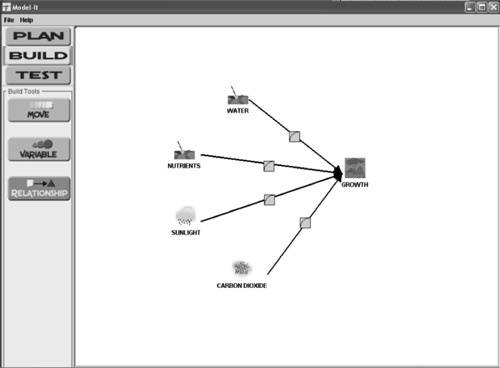 Figure 1. A model about the growth of plants.
As shown in Figure 1, the model consisted of four entities, namely plant, sun, soil, and air. In addition, students defined variables for each entity such as, growth for the plant, light for the sun, water and nutrients for the soil, and carbon dioxide for the air. Subsequently, as shown in Figure 2, students defined cause and effect relationships among the various variables.
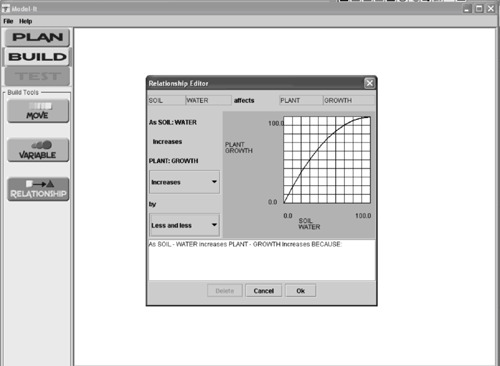 Figure 2. Defining relationships in Model-It.
Initially, students suggested using linear relationships for all variables to indicate that an increase in the value of the causal (independent) variable will affect the dependent variable by about the same amount. For example, as the amount of water in the soil increases, the growth of the plant will increase by about the same amount as if the amount of water was the only factor affecting plant growth. It was interesting to observe that, despite the fact that students initially suggested only using linear relationships, they changed their minds after they were asked to consider how Model-It graphically represented relationships of various orientations (i.e., increases or decreases) and different variations (i.e., about the same, a lot, a little, more and more, less and less, bell-shaped curve). Students perceived this part of the modeling experience to be valuable. The software triggered cognitive puzzlement as students were disagreeing with each other regarding the kind of variation they needed to use in the relationships, and they provided evidence based on their life experiences to back up their arguments. Students then proceeded, as shown in Figure 3, to test the model and control variables in order to test their initial hypotheses.
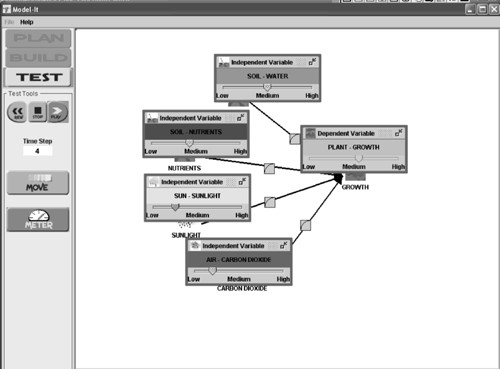 Figure 3. Testing a model in Model-It.
The first reaction was related to the amount of light a plant needed in order to grow. Specifically, students said that they kept the amount of light constant to a very low value, while they changed the values of the other independent variables to higher levels. The results of this investigation showed that plants could grow with very little light, provided that the value of at least one of the other three independent variables continued to increase. These results made the students skeptical and doubtful about the “correctness” and sophistication of their model. Participants concluded that the model was not close to the “real thing,” and that it was a naïve model that did not really capture the complexity of the growth of plants.
When students were asked to suggest how one could go about changing the model, some suggested defining relationships among the independent factors, while others felt that they needed to read more about the growth of plants in order to become more knowledgeable about the conditions that needed to persist for the four entities to co-exist. When the course instructors asked students if it was possible to use Model-It to build a model that was an imitation of the real phenomenon, they said that probably this was not possible with the scaffolds of the software, but even if it was possible they felt that 12-year-old school children might not be able to understand a more complicated model.
Concisely, the results of the whole-class modeling activity indicated that Model-It, through its scaffolds (i.e., Plan, Build, and Test modes), enabled students to create models and that students’ models, although structurally correct, were initially very simplistic and did not adequately model the real phenomenon. The activity triggered, however, deep cognitive processing of information and better understanding of the growth of plants.
Individual Lesson Plans
The individual lesson plans were analyzed independently by the authors of the paper with qualitative research methods (Lincoln & Guba, 1985; Merriam, 1988), using as guides the three research questions stated at the beginning of the paper. There was an intercoder agreement of .82, but all identified differences between the two authors were discussed and resolved. The findings are discussed in detail in the following subsections.
Use of software scaffolds. As mentioned previously, model building requires students to identify the important entities of a system, their variables, and the cause-and-effect relationships among the entities’ variables. It is worth mentioning here that Model-It scaffolds the model-building process, but it cannot detect the conceptual validity of models. Thus, it is possible to build a model using Model-It that has a correct surface structure (i.e., entities, variables, relationships), but no conceptual validity. Of the 47 participants, 20% of them constructed models about the human systems, 7% about the simple electric circuit, 7% about the phenomenon of perspiration, 12% about the phenomenon of evaporation, 15% about photosynthesis, 17% about food chains, 7% about thermal expansion, and 15% about the water cycle. Moreover, 72% of the participants constructed models with Model-It that had a correct structure. Thus, participants identified the correct entities and variables for the scientific phenomena under investigation and determined meaningful relationships.
In essence, the scaffolded design of Model-It helped students to break down the task into manageable parts and, through the sequenced tasks of building and testing a model using the Plan, Build, and Test features, it provided learners with a language and a systematic process to think about and describe scientific systems.
The remaining 28% found it difficult to identify appropriate entities and variables for the scientific systems they selected to deal with, indicating that model building for these students was a rather complex cognitive task. The results also showed that modeling activities need to be used sensibly with learners who do not have any prior experiences with model building and that teacher educators need to engage preservice teachers systematically in modeling activities so they gradually comprehend how to construct viable scientific models, as well as how to effectively integrate them in science teaching.
Simplistic or “naïve” models. Of the 47 participants, 13% constructed models with more than three entities, more than one variable per entity, and proper relationships. The overwhelming majority (87%) of students used Model-It to construct models that had two or three entities, one variable per entity, and linear relationships of the form “as X increases Y increases by about the same amount.” Jonassen (2004) noted that there is probably a “dynamic and reciprocal relationship between internal mental models and the external models that students construct. The mental models provide the basis for external models” (p. 4). Based on the fact that almost in their entirety participants’ models were “naïve” or oversimplistic, the results indicate that participants probably held naïve beliefs or internal mental models about science content and naïve beliefs about the epistemological aspects of scientific modeling.
This conclusion corroborates the previous finding that students did not have a deep conceptual understanding of the concepts involved in the respective phenomena they tried to model. However, students’ inability to accurately model scientific models could also be attributed to the fact that they had limited experiences with models and Model-It and that they might possess complicated concepts but could not express them with Model-It.
Moreover, based on the results the participants could be classified as Level II modelers according to the classification scheme of Grosslight, Unger, Jay, and Smith (1991). According to this classification scheme, Level II modelers realize the purpose of a model and that some aspects of a model may be wrong and need to be changed. What Level II modelers do not realize is that a model is a tool to trigger thinking in a community of learners and not a representation of some phenomenon that is used by an expert to explain a complex phenomenon to a novice. Thus, as novice modelers, which the participants of the study were, they created “safe” models that simply depicted their own subjective point of view of how a phenomenon could be modeled and did not use the software as an idea-testing tool to investigate complex phenomena.
Preferred modeling method. In their lesson plans, 27% of preservice teachers used the expressive modeling method and asked elementary school children to build their own models using Model-It. Of the remaining preservice teachers, 65% of them used the explorative method and asked their students to run a teacher-made model, control variables, observe, and draw conclusions based on their investigations. Only 8% of the participants used both types of modeling methods. Specifically, the 8% of participants who used both modeling methods initially asked their students to build their own models to express initial beliefs about a phenomenon, and then provided them with different teacher-made models of the same phenomenon and asked them to compare and contrast the teacher’s models with their own models. Then, they asked their students to revise their initial models if they thought they needed to do so.
Conclusions
The purpose of this study was to engage preservice elementary science teachers in a modeling experience with a computer modeling tool and, thereafter, study the effects of this experience on their abilities to construct viable scientific models and design a science lesson. Based on the results, the task of thinking with models in science proved to be demanding for the participants of this study. Specifically, the results showed that the majority of them created simplistic and “naïve” or “safe” scientific models indicating that their comfort level in thinking with models in science, as well as teaching science with models, was not very high. Of course, considering the fact that through most of their secondary education and probably college education students are never asked or encouraged to think with models, the results of this study should not surprise anyone.
Evidently, this study provides limited evidence, and the results cannot be totally attributed to students’ simplistic structure of knowledge but also to their limited experiences with modeling activities. Undoubtedly, an investigation of whether model building follows a developmental trajectory could give us insights into how models can be used most effectively in teaching and learning.
In summary, despite the fact that 90% of the participants had no previous experience with modeling in science, the results indicated that prospective teachers developed a more articulate way to talk about models. There was also evidence, as shown in preservice teachers’ lesson plans, that they understood the role of models in science teaching and learning and attempted to teach their students through models.
Findings also showed that it was possible to use Model-It in order to engage preservice teachers in rich modeling experiences in a relatively brief amount of time. The software provided participants with a tool to build and test models quickly, as well as to reflect on the viability of the models based on the simulated outcomes. Thus, Model-It effectively scaffolded preservice teachers’ first modeling learning experiences in science.
The results of this study are promising and point out that if teacher educators undertake serious and coordinated efforts in systematically integrating computer modeling tools in science education courses, then prospective teachers will benefit from these learning experiences, both in terms of better understanding science concepts and developing pedagogical skills about how to teach science through models. As Halloun (2004) stated, “Models are at the core of any scientific theory and model construction and deployment are fundamental, if not the most fundamental processes in scientific inquiry” (p. ix). Undoubtedly, coordinated efforts toward this direction will greatly benefit learners’ understanding of the processes of science.
References
Bliss, J. (1994). From mental models to modeling. In H. Mellar, J. Bliss, R. Boohan, J. Ogborn, & C. Tompsett (Eds.), Learning with artificial worlds: Computer based modeling in the curriculum. London: The Falmer Press.
Bransford, J. D., Brown, A. L., & Cocking, R. R. (2001). How people learn: Brain, mind, experience, and school. Washington, DC: National Academy Press.
Bruner, J. S. (1961). The act of discovery. Harvard Educational Review, 31, 21-32.
De Jong, O., & Van Dreil, J. H. (2001, March). Developing pre-service teachers’ content knowledge and PCK of models and modeling. Paper presented at the annual meeting of the National Association for Research in Science Teaching, St. Louis, MO.
Dewey, J. (1938). Experience and education. New York: McMillan.
Ertmer, P. (2003). Transforming teacher education: Visions and strategies. Educational Technology Research and Development, 51(1), 124-128.
Frederiksen, J. R., & White, B. Y. (1998). Teaching and learning generic modeling and reasoning skills. Journal of Interactive Learning Environments, 55, 33-51.
Gilbert, J. K. (1993). Models and modeling in science education. Hatfield, UK: Association for Science Education.
Gilbert, S. (1991). Model building and a definition of science. Journal of Research in Science Teaching, 28(1), 73-80.
Grosslight, L., Unger, C., Jay, E., & Smith, C. (1991). Understanding models and their use in science: conceptions of middle and high school students and experts. Journal of Research in Science Teaching, 28(9), 799-822.
Halloun, I. A. (2004). Modeling theory in science education. Science & Technology Education Library. London: Kluwer Academic Publishers.
Hestenes, D. (1987). Towards a modeling theory of physics instruction. American Journal of Physics, 55(5), 440-454.
International Society for Technology in Education. (2002). National educational technology standards for teachers: Preparing teachers to use technology. Danvers, MA: Author.
Jackson, S., Stratford, S., Krajcik, J., & Soloway, E. (1996). Making dynamic modeling accessible to pre-college science students. Interactive Learning Environments, 4, 233-257.
Jonassen, D. (2004). Model building for conceptual change: Using computers as cognitive tools. In M. Gregoriadou, A. Rapti, S. Vosniadou, & C. Kynigos (Eds.), Information and communication technologies in education (pp. 3-17). Athens, Greece: New Technologies Publications.
Jonassen, D. H., & Reeves, T. C. (1996). Learning with technology: Using computers as cognitive tools. In D. H. Jonassen (Ed.), Handbook of research for educational communications and technology (pp. 693-719). New York: Simon & Schuster Macmillan.
Lehrer, R., & Schauble, L. (2003). Origins and evolution of model-based reasoning in mathematics and science. In R. Lesh & H. M. Doerr (Eds.), Beyond constructivism: Models and modeling perspectives on mathematics problem solving, teaching, and learning (pp. 59-70). Mahwah, NJ: Lawrence Erlbaum Associates.
Lesh, R., & Doerr, H. M. (2003). Foundations of a model and modeling perspective on mathematics teaching, learning, and problem solving. In R. Lesh & H. M. Doerr (Eds.), Beyond constructivism: Models and modeling perspectives on mathematics problem solving, teaching, and learning (pp. 3-33). Mahwah, NJ: Lawrence Erlbaum Associates.
Lincoln, Y., & Guba, E. G. (1985). Naturalistic inquiry. Newbury Park, CA: Sage.
Merriam, S. B. (1988). Case study research in education: A qualitative approach. San Francisco, CA: Jossey-Bass.
Morrison, M., & Morgan, M. S. (1999). Models as mediating instruments. In M. S. Morgan & M. Morrison (Eds.), Models as mediators: Perspectives on natural and social science (pp. 10-37). Cambridge: Cambridge University Press.
National Research Council. (1996). The national science education standards. Washington, DC: National Academy Press.
Pedersen, J. E., & Yerrick, R. K. (2000). Technology in science teacher education: Survey of current uses and desired knowledge among science educators. Journal of Science Teacher Education, 11(2), 131-153.
Penner, D. E. (2000/2001). Cognition, computers, and synthetic science: Building knowledge and meaning through modeling. Review of Research in Education, 25, 1-36.
Stratford, S. J., Krajcik, J., & Soloway, E. (1998). Secondary students’ dynamic modeling processes: Analyzing, reasoning about, synthesizing, and testing models of stream ecosystems. Journal of Science Education and Technology, 7(3), 215-234.
Valanides, N. (2003). Learning, computers, and science education. Science Education International, 14(1), 42-47.
Author Note:
Nicos Valanides
Department of Education
University of Cyprus
[email protected]
Charoula Angeli
Department of Education
University of Cyprus
[email protected]
