The United States has made tremendous progress toward equipping schools with computers and modern communication networks. Now, approximately 98% of our schools are connected to the Internet and the powerful opportunities for learning that the Internet makes possible (Parsad & Jones, 2005). These investments in computers and Internet access, professional development, technical support, and content have allowed many K-12 teachers and students to reap the benefits of powerful teaching and learning applications. Research and evaluation studies demonstrate that school improvement programs employing technology for teaching and learning yield positive results for students and teachers. For example, elementary and secondary students demonstrated significantly more learning when technologies were integrated into language arts, mathematics, science, and social studies lessons than when the same subject matter was taught without integration of technologies (Taylor, Casto, & Walls, 2004).
In response to the demand that teachers be prepared to educate 21st-century learners, great efforts and investments have been made in many projects and districts to prepare technology-proficient teachers. Despite the generous investment in putting computers and connectivity into schools, computers are not as widely used by students and teachers as many would suppose (Zhao, Pugh, Sheldon, & Byers, 2002). An “ecological perspective” was suggested by Zhao and Frank (2003), in which progressive (evolutionary) phases of technology adoption have been (or would be) more productive than sudden mandates (revolutionary) on teachers to learn and integrate technologies. Perhaps compromise between these two extremes might be most productive.
Although many educators and policy analysts consider technology a vehicle for transforming education, in fact, a National Center for Education Statistics study (U.S. Department of Education, 2000) found that only 33% of teachers (overall) and 44% of new teachers (three or fewer years in the classroom) feel well prepared to use computers and the Internet for a variety of potential applications in their teaching. That NCES report commented that it may be understandable that teachers who are many years removed from their undergraduate or graduate training would be less comfortable using newer, technology-infused teaching methods. However, a current problem is that too many of today’s new teachers are uncomfortable using technology in the classroom. The report held this circumstance, given the nearly ubiquitous nature of technology in society today, to be the fault of teacher preparation programs still producing underprepared teachers.
Ten years ago, Willis and Mehlinger (1996) indicated that, although a large number of students in teacher education programs were taking some coursework in information technology, by and large this instruction was not tied to curriculum, methods, field experience, or practice teaching. Current in-service and preservice education systems have been struggling to keep up with the rapid pace of change. Since the late 1990s, billions of dollars have been invested in preparing tomorrow’s technology-proficient educators, but few grants, programs, or projects have focused on preparing technology-proficient physical educators.
Physical education is a critical component of schooling. The physical education teacher has important roles as a planner, manager, colleague, professional physical educator, counselor, and representative of the school (Siedentop, Herkowitz, & Rink, 1984), as well as the primary role of instructor. Although it might seem that the gymnasium would be the last place where technology would have a strong influence in curriculum and instruction, it is certainly not the case. For instance, the principles that contribute to multimedia teaching effectiveness are as applicable to “catch” and “throw” for physical education teachers and students as to sentence construction in language arts or electric motor operation in vocational education (Mayer, Dow, & Mayer, 2003). Examples of using technology to enhance and improve physical education are everywhere:
- Physical-education listservs for e-mail can be created for each class or for a school physical education program. Electronic bulletin boards can allow individuals to post and read messages about physical education topics. Chat rooms can be created so that students may discuss issues related to their physical education class work. Web pages can be created for physical education programs to allow communication to students, parents, and the community. Links from Web pages can allow direct access to physical education resources needed by students and their parents (see Physical Education List Servs and PE Central). Editor’s note: For Web site URLs , see the Resources section at the end of this paper.
- Instructional CD, DVD video, and Internet-based student research on physical education topics offer learning resources and tools (e.g., Online Technology Newsletter).
- Heart monitors have enabled students to track exercise patterns, and the data collected may be downloaded or entered into a personal computer, where the data can be graphically displayed and analyzed by students and teachers (e.g., see EKHO Web site).
- Florida Virtual School is an Internet-based public high school offering online high school curriculum to more than 10,000 students. Of 65 courses offered in 2002-03, three were Fitness Lifestyle Design, Life Management Skills, and Personal Fitness.
- In recent years, some physical education teacher education programs in higher education across the country have been offering online master’s degrees (e.g., West Virginia University, University of Texas system, Virginia Tech University).
The purpose of this study was to investigate the confidence of preservice physical educators in their basic computer skills, as well as in integrating technology into their professional learning, research, and future teaching. The participants of this study were college physical education teacher education major students. The surveys conducted in this study were created by the International Society of Technology in Education and were designed specifically for college education-major students to assess technology proficiency by self-assessment. The surveys were (a) the Basic Computer Skills Survey (Appendix A), (b) the General Preparation Survey (Appendix B), (c) the Professional Preparation Survey (Appendix C), and (d) the Student Teaching Profile Survey (Appendix D). All the surveys were conducted as online surveys, which were hosted on a secure university server. The overall research question of this study was “How self-confident are preservice physical educators of their own technology proficiency?” More specifically, how do preservice physical educators, (general preparation, pre-student-teaching/internship, and post-student-teaching/internship) rate their own competence on (a) basic computer skill levels and (b) how well they could integrate technology into their learning, research, and future teaching?
Method
Participants
The participants were college physical education major students (N=145) from two universities in the midwest region of the United States. The students were divided into three groups based on their professional development stages: (a) “General-Prep,” prospective teachers who have finished the general preparation component of their program, (b) “Pre-Student-Teaching,” prospective teachers prior to their student teaching or internship experience, and (c) “Initial-Licensure,” teachers at the point of initial licensure after completion of their student teaching or internship experience. The numbers of participants in these three groups who took the Basic Computer Skill Survey were (a) General-Prep group, n = 77, (b) Pre-Student-Teaching group, n = 50, (c) Initial-Licensure group, n = 18. The numbers of participants in these three groups who took one of the other three surveys based on their professional development stages, were as follows: (a) 63 students took the General Preparation Survey, (b) 39 students took the Professional Preparation Performance Profile Survey, and (c) 18 students took the Student Teaching/Internship Performance Profile Survey. In both physical education teacher education programs at the two universities, no technology courses had been offered to the students, nor were there any technology requirements. Prior to the collection of data, approval was obtained from the Institutional Review Board for the Protection of Human Subjects.
Research Design
All the surveys were conducted as online surveys (on a secured university server). All the participants were directed to take the Basic Computer Skills Survey. Each question in that survey has four choices, ranging from 1 (unable) to 4 (fluent). By selecting one of the choices, participants each indicated their estimated skill or knowledge level about each of the technology-related indicators.
Additionally, based on their professional development stages of General-Prep, Pre-Student-Teaching, and Initial Licensure, the participants were asked to take one of the following three surveys, respectively, (1) General Preparation Survey, (2) Professional Preparation Survey, or (3) Student Teaching Profile Survey. Each question in those three surveys has four choices, ranging from 1 (not at all) to 4 (able to teach others). The total possible score for each survey ranged as follows:
- Basic Computer Skills Survey, from 30 to 120.
- General Preparation Survey, from 16 to 64.
- Professional Preparation Survey, from 24 to 96.
- Student Teaching Profile Survey, from 14 to 56.
Instrumentation
The four surveys administered in this study were developed by ISTE and were part of outcomes of the National Educational Technology Standards (NETS) Project, which is an ongoing initiative of ISTE “and a consortium of distinguished partners and co-sponsors. The primary goal of the ISTE NETS Project is to enable stakeholders in PreK-12 education to develop national standards for educational uses of technology that facilitate school improvement in the United States. The NETS Project is to define standards for students, integrating curriculum technology, technology support, and standards for student assessment and evaluation of technology use” (quoted from the ISTE NETS home page, http://cnets.iste.org/). Copyright permission was obtained from ISTE before the surveys were conducted.
Procedure
The four surveys were set up as online surveys by using online assessment software TestPilot (version 3.0) and were hosted on a secured university server. The participants took the surveys during regularly scheduled class times as groups in computer labs. Each participant took the Basic Computer Skills Survey, and, as described previously, one of the following three surveys: (a) General Preparation Survey, (b) Professional Preparation Survey, or (c) Student Teaching Profile Survey.
After the results of surveys were downloaded, data were examined, and incomplete data were taken out before the statistical analysis. The final data were analyzed by using SPSS 11.0. Results from the Basic Computer Skills Survey were analyzed by using descriptive statistics as well as one-way analysis of variance (ANOVA) to determine whether a significant difference existed among the three professional development stages. For Professional Preparation Survey, General Preparation Survey, and Student Teaching Profile Survey, data were analyzed by using descriptive statistics.
Results
Basic Computer Skills Survey
The Basic Computer Skills Survey was to explore the preservice physical educators’ self-assessments on basic computer skill level across the following three professional development stages: (a) prospective teachers who have finished the general preparation component of their program (General-Prep), (b) prospective teachers prior to their student teaching or internship experience (Pre-Student-Teaching), and (c) teachers at the point of initial licensure and after completion of their student teaching or internship experience (Initial-Licensure).
The results of the descriptive statistics for this survey show that across all participants (N =145), the basic computer skills overall mean for all the self-reported indicators was 79.4, with SD = 15.3. The range was 85, from 32 to 117 out of 120 possible points. When the total possible range of 30 to 120 was divided into fourths, 30 to 52 was defined as unable, 53 to 75 was defined as adequate, 76 to 98 was defined as familiar, and 99 to 120 was defined as fluent. Overall, 4.1% of the participants reported themselves to be unable, 38.7% reported adequate, 45.5% reported familiar, and 11.7% reported fluent. The distribution was a normal curve, with the scores distributed almost evenly around the mean (Table 1).
Table 1
Basic Computer Skill Overall
Points | Scale | Frequency | Percent | Cumulative Percent |
| 30-52 | Unable | 6 | 4.1 | 4.1 |
| 53-75 | Adequate | 56 | 38.7 | 42.8 |
| 76-98 | Familiar | 66 | 45.5 | 88.3 |
| 99-120 | Fluent | 17 | 11.7 | 100 |
| Total | 145 | 100.0 |
Based on this same scale (30 to 52, unable; 53 to 75, adequate; 76 to 98, familiar; and 99 to 120, fluent), the following results occurred for the three groups of preservice physical educators’ self-estimations of basic computer skills:
- The overall mean was 78.7, with SD = 14.2 for 77 General-Prep prospective teachers. The range was 76, from 32 to 108 out of 120 possible total points. 13.0% of the participants reported themselves to be unable, 39.2% reported adequate, 34.8% reported familiar, and 13.0% reported fluent (Table 2).
- The overall mean was 81.3, with SD = 16.9 for 50 Pre-Student-Teaching prospective teachers. The range was 64, from 53 to 117 out of 120 possible total points. Zero percent of the participants reported themselves to be unable, 40.0% reported adequate, 44.0% reported familiar, and 16.0% reported fluent (Table 3).
- The overall mean was 77.2, with SD = 15.4 for 18 Initial-Licensure teachers. The range was 61, from 48 to 109 out of 120 possible total points. 11.1% of the participants reported themselves to be unable, 38.9% reported adequate, 38.9% reported familiar, and 11.1% reported fluent (Table 4).
Table 2
Basic Computer Skill Survey—General (Prep) Group Overall
Points | Scale | Frequency | Percent | Cumulative Percent |
| 30-52 | Unable | 10 | 13 | 13 |
| 53-75 | Adequate | 30 | 39.2 | 52.2 |
| 76-98 | Familiar | 27 | 34.8 | 87 |
| 99-120 | Fluent | 10 | 13 | 100 |
| Total | 77 | 100.0 |
Table 3
Basic Computer Skill Survey—Professional (Pre-Student-Teaching) Group Overall
Points | Scale | Frequency | Percent | Cumulative Percent |
| 30-52 | Unable | 0 | 0 | 0 |
| 53-75 | Adequate | 20 | 40 | 40 |
| 76-98 | Familiar | 22 | 44 | 84 |
| 99-120 | Fluent | 8 | 16 | 100 |
| Total | 50 | 100.0 |
Table 4
Basic Computer Skill Survey—Student Teachers (Initial Licensure) Group Overall
Points | Scale | Frequency | Percent | Cumulative Percent |
| 30-52 | Unable | 2 | 11.1 | 11.1 |
| 53-75 | Adequate | 7 | 38.9 | 50 |
| 76-98 | Familiar | 7 | 38.9 | 88.9 |
| 99-120 | Fluent | 2 | 11.1 | 100 |
| Total | 18 | 100.0 |
The results of the one-way ANOVAs were used to compare the self-estimation of basic computer skill level from the preservice physical educators across the three professional development stages. Although there was no significant overall statistical difference, significant differences were found for three of the indicators (Figure 1).
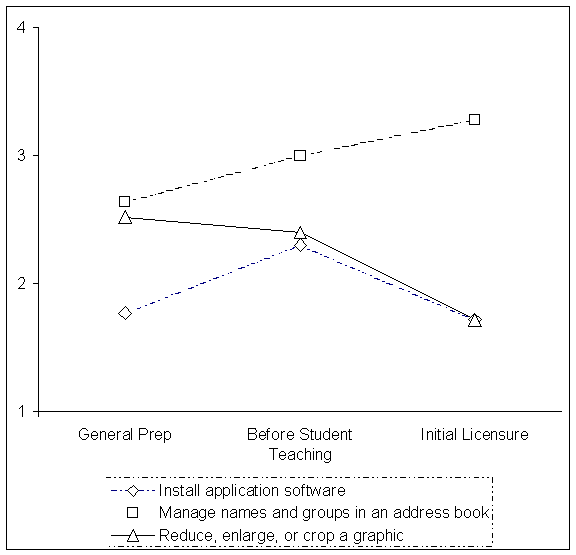 Figure 1. Mean ratings by the three groups of physical education students of three significant (p < .05) items from the Basic Computer Skills Survey.
Item 11, “Install application software,” yielded F (2,142) = 6.35, p < .05, and the Tukey follow-up test indicated that Pre-Student-Teaching participants rated their ability higher than General-Prep students and Initial-Licensure teachers on this item (both p < .05). Item 20, “Manage names and groups in an address book,” yielded F (2,142) = 4.09, p < .05, and the Tukey follow-up test indicated that Initial-Licensure teachers were significantly more confident than the General-Prep students on this item (p < .05).
Item 29, “Reduce, enlarge, or crop a graphic,” yielded F (2,142) = 5.56, p < .05, and the Tukey follow-up test indicated that both the General-Prep and the Pre-Student-Teacher groups had more confidence in their own ability than the Initial-Licensure group (both p < .05). As is illustrated in Figure 1, performance rose from General-Prep to Pre-Student-Teacher to Initial Licensure, as one might wish, for the “manage names and groups in an address book,” but his trend was not true for the other two skills.
General Preparation Survey
The General Preparation Survey was to investigate how well the General-Prep participants who had finished the general preparation component of their program estimated their abilities on integrating technology into their learning, research, and future teaching (n = 63). The results of the descriptive statistics for this survey indicated a mean of 37.8, with SD = 6.9 at this professional development stage. The range was 30, from 23 to 53 out of 64 possible points. When the total possible range of 16 to 64 was divided into fourths, 16 to 28 was defined as not at all, 29 to 40 was defined as minimally (need help), 41-52 was defined as confidently (knowledgeable and fluent), and 53-64 was defined as able to teach others. There were 12.7% participants who reported themselves to be unable, 47.6% reported minimally (need help), 38.1% reported confidently (knowledgeable and fluent), and 1.6% reported able to teach others. The distribution was a normal curve (Table 5).
Table 5
General Preparation Survey Overall
Points | Scale | Frequency | Percent | Cumulative Percent |
| 16-28 | Not at all | 8 | 12.7 | 12.7 |
| 29-40 | Minimally | 30 | 47.6 | 60.3 |
| 41-52 | Confidently | 24 | 38.1 | 98.4 |
| 53-64 | Able to teach others | 1 | 1.6 | 100 |
| Total | 63 | 100.0 |
Professional Preparation Survey
The Professional Preparation Survey was to investigate how well the Pre-Student-Teaching prospective physical education teachers prior to their student teaching or internship experience estimated their abilities to integrate technology into their learning, research, and future teaching (n = 39). The results of the descriptive statistics for this survey indicated the overall mean was 59.0, with SD = 11.1 at this professional development stage. The range was 45, from 41 to 86 out of 96 possible points. When the total possible range of 24 to 96 was divided into fourths, 24 to 42 was defined as not at all, 43 to 60 was defined as minimally (need help), 61 to 78 was defined as confidently (knowledgeable and fluent), and 79 to 96 was defined as able to teach others. There were 7.7% participants who reported themselves to be unable, 51.3% reported minimally (need help), 33.3% reported confidently (knowledgeable and fluent), and 7.7% reported able to teach others. The ratings were normally distributed (Table 6).
Table 6
Professional Preparation Survey Overall
Points | Scale | Frequency | Percent | Cumulative Percent |
| 24-42 | Not at all | 3 | 7.7 | 7.7 |
| 43-60 | Minimally | 20 | 51.3 | 59 |
| 61-78 | Confidently | 13 | 33.3 | 92.3 |
| 79-96 | Able to teach others | 3 | 7.7 | 100 |
| Total | 39 | 100.0 |
Student Teaching Profile Survey
The Student Teaching Profile Survey was to investigate how well the Initial Licensure physical education teachers at the point of initial licensure and after completion of their student teaching or internship experience estimated themselves on integrating technology into their learning, research, and future teaching (n = 18). The results of the descriptive statistics indicated the overall mean of self-estimation as 30.3, with SD = 7.8 at this professional development stage. The range was 27, from 18 to 45 out of 56 possible total points. When the total possible range of 14 to 56 was divided into fourths, 14 to 24 was defined as not at all, 25 to 35 was defined as minimally (need help), 36 to 46 was defined as confidently (knowledgeable and fluent), and 47 to 56 was defined as able to teach others. There were 22.2% participants who reported themselves to be unable, 61.1% reported minimally (need help), 16.7% reported confidently (knowledgeable and fluent), and 0.0% reported able to teach others. Again, the normal distribution of ratings was evident (Table 7).
Table 7
Student Teaching Profile Survey Overall
Points | Scale | Frequency | Percent | Cumulative Percent |
| 14-24 | Not at all | 4 | 22.2 | 22.2 |
| 25-35 | Minimally | 11 | 61.1 | 83.3 |
| 36-46 | Confidently | 3 | 16.7 | 100 |
| 47-56 | Able to teach others | 0 | 0 | |
| Total | 18 | 100.0 |
With regard to integrating technology effectively into teaching, at the three professional development stages, only a small percentage of participants reported feeling very well prepared (able to teach others) to integrate educational technology into physical education instruction (1.6% for General-Prep, 7.7% for Pre-Student-Teaching, and 0.0% for Initial-Licensure). Meanwhile, a relatively small percentage of participants reported that they were confidently (knowledgeable and fluent) integrating technology effectively into teaching (38.1% for General-Prep, 33.3% for Pre-Student-Teaching, and 16.7% for Initial-Licensure).
Across the General Preparation Survey, Professional Preparation Survey, and Student Teaching Profile Survey, the results were remarkably similar. As is evident in Figure 2, relatively few respondents from each of the three groups indicated that their facility with the technology competencies was not at all. Also, very few of them indicated that they would be able to teach others. By far, the greatest proportion of the three groups, responding to three ISTE-recommended instruments appropriate for those three groups, reported their level of competence to be minimally.
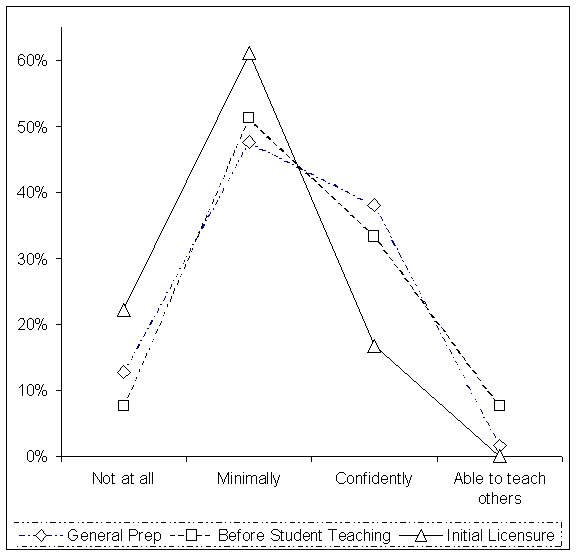 Figure 2. Percentage of students rating their facility with the technology competencies in the ISTE-recommended instruments appropriate for those three groups.
Discussion
The findings of this study demonstrated that preservice physical educators who participated in this study had limited technology ability. Only 11.7% of the preservice physical educators reported themselves to be fluent overall on their basic computer skills, and that percentage did not increase (11.1%) for physical education teachers at the point of initial licensure and after completion of their student teaching or internship experience.
Student teachers’ low ranking on their technology preparation should be a wake-up call to most physical education teacher education programs that prepare physical educators in this digital age. An ISTE report (The Milken Exchange and ISTE, 1999) suggested student teachers need more opportunities to apply technology during field experiences under qualified supervision. Considering the apparent shortage of technology mentors during field experiences, ISTE suggested that distance education (in the form of distance mentoring) could play an important role by linking new teachers to qualified supervisors or master teachers at other colleges and K-12 school sites.
In 1997, a task force of National Council for Accreditation of Teacher Education (NCATE) on technology in teacher education found that college faculty members were not making extensive use of technology in their own research and teaching. As a result, colleges and universities were (and probably still are) making the same mistake made by K-12 schools. They treated “technology” as a special addition to the teacher education curriculum—requiring specially prepared faculty and specially equipped classrooms—not as a topic that needs to be incorporated across the entire teacher education program.
Consequently, teachers-in-training were provided instruction in “computer literacy” and were shown examples of computer software, but they rarely were required to apply technology in their courses. Moreover, few likely saw faculty models who employed technology in their own work (NCATE, 1997). There has been, however, ample evidence that substantial professional development in technology integration can foster substantial gains for teachers and their students (e.g., Taylor et al., 2004).
If the two universities sampled in the present investigation are representative, most preservice physical educators do not feel competent to use and integrate technologies in their work. Besides the general computer literacy contents, for instance, there are health and fitness related software and hardware, heart rate monitor and pedometer, matching analysis software and hardware, motion analysis software and hardware, video editing and burning, Web delivery, and other technology process and product.
Gillingham and Topper (1999) discussed four methods by which teachers can be educated to adapt and use technology flexibly.
- The single-course approach consists of a course on technology within a teacher preparation program. An instructor familiar with technology and pedagogy teaches the course, which is placed strategically within the sequence of a program.
- The technology-infusion approach places aspects of technology within each course in a teacher-preparation program. This approach is especially beneficial to subject-matter experts because they can concentrate on pedagogical content knowledge and content-specific applications.
- The student-performance approach places the final responsibility of technology knowledge on students rather than on faculty. Using this approach, students choose their performances from a number of categories and can concentrate on advancing their existing knowledge.
- The case-based approach provides prospective and practicing teachers with a narrative “foundation” for classroom knowledge that can be constructed and analyzed as “wisdom of practice.” This approach provides instances of teaching theory for analysis and examination and allows prospective teachers to study and reflect on the efforts of existing teachers who have incorporated technology into their classroom practice.
Those methods in no way exhaust the different ways by which preservice teachers may be encouraged to use technology to support their teaching and learning in the physical education area. However, they can be used either singly or in combination to help preservice technology-proficient physical educators become conversant with different technologies and ways they can use them effectively and efficiently in physical education teaching and learning activities. This approach can be used to find middle ground between evolutionary (perhaps too slow) and revolutionary (perhaps too fast) ecological technology (Zhao & Frank, 2003).
In conclusion, the present research demonstrated that preservice physical educators do not evaluate themselves as having been very well prepared to be technology proficient in order to teach in this digital age. Physical education teacher education programs need to develop and implement technology plans that cover not only computer literacy content, but also those professional special technologies, such as health and fitness hardware and software. Teaching and learning methods to prepare technology-proficient physical educators may benefit, either singly or in combination, from the single-course approach, the technology-infusion approach, the student performance approach, and the case-based approach. Because of the special characteristics of physical education, which usually operates in gyms and playgrounds instead of classrooms, grant programs have not been targeted specifically to preparing technology-proficient physical educators. Such projects and grants should be solicited and requested in order to prepare technology-proficient physical educators to teach in this digital age.
References
Gillingham, M.G., & Topper, A. (1999). Technology in teacher preparation: Preparing teachers for the future. Journal of Technology and Teacher Education, 7(4), 303-321.
Mayer, R.E., Dow, G.T., & Mayer, S. (2003). Multimedia learning in an interactive self explaining environment: What works in the design of agent-based microworlds? Journal of Educational Psychology, 95, 806-813.
The Milken Exchange and the International Society for Technology in Education. (1999). A national survey on information technology in teacher education: Will new teachers be prepared to teach in a digital age? Retrieved January 16, 2006, from the Milken Family Foundation Web site: http://www.mff.org/publications/publications.taf?page=154
National Council for Accreditation of Teacher Education Task Force on Technology and Teacher Education. (1997). Technology and the new professional teacher: Preparing for the 21st century classroom. Washington D C: Author.
Parsad, B., & Jones, J. (2005). Internet access in U.S. public schools and classrooms: 1994–2003 (NCES 2005–015). Washington, DC: U.S. Department of Education National Center for Education Statistics.
Siedentop, D., Herkowitz, J., & Rink, J. (1984). Elementary physical education methods. Englewood Cliffs, NJ: Prentice-Hall.
U.S. Department of Education. (2000). Teacher quality: A report on the preparation and qualifications of public school teachers—Selected findings related to educational technology. Retrieved January 16, 2006, from http://www.ed.gov/offices/OUS/PES/edtech_TQ.html
Willis, J. W., & Mehlinger, H. D. (1996). Information technology and teacher education. In J. Sikula, T. J. Buttery, & E. Guyton, (Eds.), Handbook of research on teacher education (2nd ed., pp. 978-1029). New York: Simon & Schuster Macmillan.
Zhao, Y., & Frank, K.A. (2003). Factors affecting technology uses in schools: An ecological perspective. American Educational Research Journal, 40, 807-840.
Zhao, Y., Pugh, K., Sheldon, S., & Byers, J. (2002). Conditions for classroom technology innovations. Teachers College Record, 104, 482-515.
EKHO – http://www.ekho.us/en/
Florida Virtual School – http://www.flvs.net
Online Technology Newsletter – http://www.pesoftware.com/Technews/news1299.html
PE Central – http://www.pecentral.org/
Physical Education List Servs – http://www.sports-media.org/listserv.htm
University of Texas – http://www.telecampus.utsystem.edu/index.cfm/4,623,82,56,html
Virginia Tech – http://www.vto.vt.edu/progdesc.php?id=HPE
West Virginia University – http://www.wvu.edu/~physed/PETE/Masters/physed_index.htm
Author Note:
Guoli Liang
University of Wisconsin at Whitewater & Shandong Normal University
[email protected]
Richard T. Walls
West Virginia University
[email protected]
Virginia L. Hicks
University of Wisconsin at Whitewater
[email protected]
L. Brenda Clayton
University of Wisconsin at Whitewater
[email protected]
Lei Yang
Jinan University
[email protected]
