Beliefs About Literacy, Technology, and Pedagogy
In Inquiry-Based English Instruction (Beach & Myers, 2001) an English language arts curriculum is detailed in which students explore how words, objects, and symbols are used to enact literacy practices and discourses that construct multiple social worlds, each with its own valued identities, relationships, and activities. The book provides a framework for teachers and documents how students have made use of technology tools to conduct inquiries into issues related to their own lived peer, family, school, community, workplace, and virtual social worlds and the social worlds represented in literature and media.
In this multimedia, multicultural world, teacher educators must prepare future teachers of literacy, language, culture, and citizenship to expand the forms of representation typical in the school classroom and to reframe the purpose of school on the critique and production of diverse representations of experience and knowledge (Gallego & Hollingsworth, 2000). As students learn to use technology tools to build representations of a social world’s characteristics, they generate reflective critical thought through their analysis and critique of the identities, relationships, and values constructed by the cultural practices and discourses in that social world.
A social worlds curriculum focuses the study of language, literature, media, and culture on the central issue of how people construct meaning from experience. Meanings about the words people use, the objects we produce, and the activities in which we engage, are negotiated through social interaction with others in multiple, overlapping, and often contesting communities. Through our participation in these communities, or social worlds, we develop skills in using particular objects, or tools, or texts to accomplish the activities valued within these social worlds. In English language arts classrooms, these skills are often identified as reading, writing, speaking, listening, and viewing, with more specific subskills like summarizing, using transitions, intonation, note taking, and identifying propaganda techniques. In the study of literature, students focus on inferring elements of character, plot, theme, symbolism, and so on.
Often these literacy skills are defined as cognitive abilities with which some students struggle because they lack ability or motivation. Students’ lack of motivation helps English educators to envision language arts skills as socially constructed literacy practices, or goal directed ways of using language and symbols valued within a social group to which the student hopes to belong. Although skills may readily transfer to other social contexts, the skills taught in the typical English classroom seem to many students to be valuable only within the specific context/discourse of school. When students and teachers begin to understand skills as socially developed over time in particular cultural groups, they can analyze how language and symbols shape their identities, relationships, and activities within particular social worlds.
We (the authors) have found technology projects to be especially beneficial in supporting the development of language and symbol use within social worlds. These technology projects also support the realization that skills are socially negotiated ways of using symbols (not cognitive predispositions and limits) that enable all learners to extend different language actions into different contexts to develop new forms of negotiating meaning, belonging, and social activity within and across social worlds (http://www.ed.psu.edu/k-12/socialworlds).
Surrounding any classroom literacy project is a cultural practice that frames and directs individuals’ use of words, symbols, and objects to interpret and produce meaning. Words, symbols, and objects can be described as the tools through which individuals construct a social world with shared meanings for desired values, relationships, activities, and identities. Literature provides a wonderful example of just how this construction of a social world takes place. In teaching about character development, we have long focused on what a character thinks and says, on what others say about the character, and on what the author describes about the character. Words are the tools of constructing the meaning of a character’s identity, desires, and agendas. The character moves through many social interactions in a story that often creates some tension within a social world or between multiple social worlds. The character may be staunchly positioned in one world, caught between loyalties to several worlds, or challenged by others within an unraveling and uncontrollable social world. For example, the following excerpt from the novel, Bless Me, Ultima (Anaya, 1972), illustrates how Antonio moves within multiple, competing social worlds as he attempts to negotiate and construct his identity, relationships, and values:
Then the golden carp swam by Cico and disappeared into the darkness of the pond. I felt my body trembling and I saw the bright golden form disappear. I knew I had witnessed a miraculous thing, the appearance of a pagan god, a thing as miraculous as the curing of my uncle Lucas. And I thought, the power of God failed where Ultima’s worked; and then a sudden illumination of beauty and understanding flashed through my mind. This is what I had expected God to do at my first holy communion! If God was witness to my beholding of the golden carp then I had sinned! I clasped my hands and was about to pray to the heavens when the waters of the pond exploded. (p. 114)
As this story, and any story, develops and concludes, social worlds emerge, dissolve, retreat, overlap, and persevere, all through the symbolic meanings constructed through the words and objects used by the characters in particular social interactions or cultural practices. The worlds and its members are co-constructed dialectically through the symbols.
The English language arts curriculum needs to reframe activity with texts around the development of literacy activities that highlight and critique these social, constructive, negotiated practice of using words, symbols, and objects to negotiate membership within and across multiple social worlds (Alvermann, 2002). Students of all ages and language experiences are able to inquire into how words, symbols, and objects are used by various groups within their lived communities to define valued identities, relationships, and activities. Likewise, texts such as literature, film, and mass media, offer represented social worlds that can be analyzed in terms of the identities, relationships, and activities promoted within the media text world. Through inquiries into both lived and represented social worlds, students can use many technology tools to produce their own representations that describe the identities and activities valued in a social world. In some cases, students can also explain how valued ends are constructed through the way words, symbols, and objects are used in social interactions.
As teachers of English, we have come to think about video authoring as an indispensable technology tool for interpreting any work of literature. We have emphasized so often the strong connection between reading and writing, how one supports the development of the other. Similarly, media authoring supports the development of critical media literacy. When students author multimedia products, like video, they begin to see the way commercially produced film and video manipulates image and sound in an attempt to persuade an audience. Students have authored video biographies, novel enactments, film trailers for novels, issue documentaries, and mass media critiques. Students often liken their projects to music videos, sharing comments like the following:
The coolest part was the video. We really got to express our feelings on our topics. The least was the essay. I thought it was boring and not very fun. I learned a ton of technical stuff but I also learned to problem solve before looking for help. We wasted time and it affected us in the long run. I would have people do certain jobs. This project was really fun. It was almost like a vacation from English. (Teen Issues Project, 2/99; see http://www.ed.psu.edu/k-12/teenissues/)
We find it interesting as English teachers who seek opportunities for our students to learn to express their ideas, that they found that a rich ability in authoring a video but did not consider it an English classroom activity because it was not restricted to the printed word. As educators, we firmly believe that hypermedia authoring develops significant critical literacy skills.
However, as teachers we have noted one extremely difficult tension in our evaluation of students’ videos. The nature of the media itself relies on the implicit communication of ideas far more than the explicit communication of ideas characteristic of written essays. Thus, we often find ourselves in interpretive limbo, seeing some fascinating ideas in student videos and not knowing if they were intended critiques or messages. Likewise, we sometimes miss what we think students might have been communicating because we lack the intertextual background that the students take for granted in their peers because they share lived social worlds. Of course, we talk about these interpretive issues with students, because intention and audience are essential rhetorical issues in any act of representation and are part of the critical literacy practices of inquiry, questioning, and negotiating multiple perspectives. However, to evaluate video authoring intentions adequately, we require students to provide a written account of their process and product to help us most fully understand their rhetorical understandings. Students also write presentations to evaluate the larger rhetorical purposes for their videos in preparing them for display in classroom film festivals and award ceremonies. We have found that most all rubrics traditionally used to evaluate writing projects work equally well with evaluating students’ video projects.
Over the past decade, we have worked with students from the age of 12 and older in the authoring of QuickTime videos using various software projects. The most expensive and powerful of these tools has been Adobe Premiere, while Avid Cinema, Strata Video Shop, or iMovie have shipped free of charge with computers or video input devices. With all of these tools, we have found the learning curve to be very short with students and long with teachers. Although teachers may struggle with many technical issues, teachers who have experienced success with the use of these tools in their classrooms have been willing to take the risk of not knowing as much about the use of the tool as the students and to learn from them. As in any learning situation, giving students responsibility for teaching teachers and peers can bolster their sense of agency and membership in the social world of school achievement.
Video Editing Tools With Fahrenheit 451
Technology tools can be used to help students engage in critical inquiry about social worlds (Beach & Bruce, 2002; Jonassen, 2000; Myers & Beach, 2001; Myers, Hammett, & McKillop, 2000). These tools can be used to foster a collaborative inquiry stance and analysis of significant themes in and characteristics of the social worlds represented in literature.
Tenth grade English teacher Peg Vlasak and her intern Andrea Acker built the study of Fahrenheit 451 around the students’ identification of central themes over the course of reading the book, then included a culminating project in which small groups created their own video interpretation of one of the book’s themes. Drawing from a reader response style of discussion over 2 weeks of reading, the students identified “thought control, censorship, utopia, individuality, and knowledge as power” as five main themes in the novel. While reading and discussing the novel, the students connected their responses to the novel with other texts from their life experience, such as music, movies, pictures, news, or other books. They took turns bringing in these media texts to play for the class and explaining how the meanings of the media and novel intersected.
By juxtaposing various media texts to the quotations from the novel, the students established the critical literacy practices sought by the teachers. Playing a song or a movie clip created a meaningful connection between the literature and life. The meanings of the once separated media text and novel text became connected and generated new layers of meaning for each other. The discussion of connections and new meanings elicited multiple voices and perspectives in the class and raised new questions about the basis of interpretation from prior readings of the once separated text and media.
What pushed this study of a novel beyond what many English teachers already do were the culminating video projects accomplished by the students over the final week of the unit. During this week the students worked in small groups of three or four each in the computer lab to author QuickTime videos using Macintosh computers and software called Avid Cinema. Either Macintosh or PC computers can support video editing software, and most recent computers with hard drives of at least 4 gigabytes have plenty of memory for video editing. Video editing hardware components are abundant now and can be easily added to computers at a cost of approximately $100. The short 2-3 minute videos brought together images, movie clips, music, quotes from the novel, voiceovers, and text to make a statement about one of the five main themes identified by the class over the past weeks. The teachers noted high levels of engagement and collaboration as students often paged back through the novel for ideas and negotiated how to organize the material of their video to make the greatest impact. We will examine the literacy practices constructed through this tool by drawing from the videos produced by three classes and published on the web at http://www.ed.psu.edu/k-12/fahrenheit.
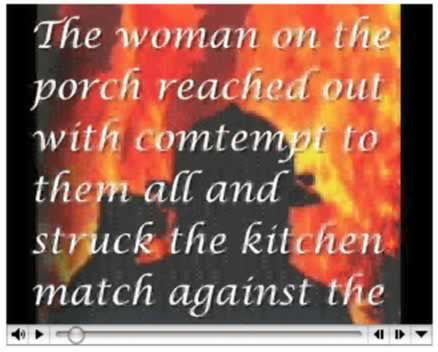 Figure 1. Knowledge as Power – Period 4
The critical literacy practice of defining intertextual connections forms the basis of play, creativity, and critique with this tool for deconstructing and reconstructing meaning. The students combined and juxtaposed multiple texts in ways that created new composite texts that interrogate the meanings of the original texts. The “knowledge as power” (http://www.ed.psu.edu/k-12/fahrenheit/knowledgeaspower4.mov) video made by a small group of 10th graders in fourth period includes one segment in which soft piano music frames the image of a fireman’s silhouette, surrounded by flames, with a scrolling quote from the novel about the calmness with which the character lights her porch on fire in resistance. As shown in Figure 1, the textual word “contempt” is visualized by the image of flames and the calmness of the music prompts reflection on the act of self-destruction as resistance.
Likewise, in the “utopia” (http://www.ed.psu.edu/k-12/fahrenheit/utopia8.mov) video authored by a small group in Period 8, a gospel voice singing “everybody is free” is used to replace the soundtrack for the “Wizard of Oz” scene of Dorothy and friends running through the field of flowers. This new juxtaposition redefines not only the pace and style of movement of the movie, but the sense of meaning about the characters’ goals as they run toward the Emerald City.
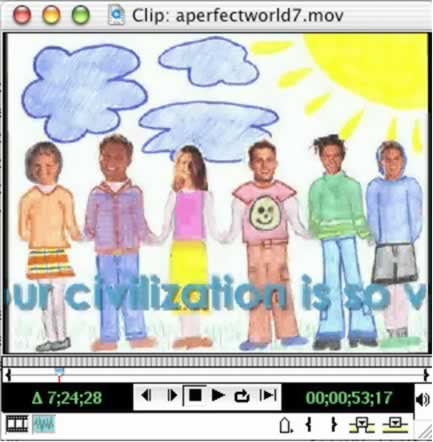 Figure 2. Utopia – Period 7
Peppy acoustic guitar music by Crosby, Stills, Nash, and Young begins the small group “utopia” (http://www.ed.psu.edu/k-12/fahrenheit/aperfectworld7.mov) video from Period 7, as four definitions of the term utopia are timed to flash as text on a black screen. The spirit of the music makes the ideals of the juxtaposed definitions of utopia seem possible in life. The cheerful music continues as a student-drawn cartoon of a sunny day with faces cut from photos form heads on cartoon bodies that bounce happily into the video frame (Figure 2).
This sequence illustrates how the careful use of transitions also supports the construction of a message by creating textual connections between sequential juxtapositions or links. The video continues with alternating text scrolling above or below images of smiling groups of people and the music changes over to a song from Rusted Root creating a very happy and optimistic utopian outlook.
However, the scrolling text suddenly begins to question the kind of utopia one should desire. This problematic representation heightens with the text over the image of Hitler that gives the viewer the incomplete sentence “Hitler’s idea of a utopia was one in which . . .” After time for the viewer to reflect, a flying block transition into the next image of two people illustrates the text that scrolls to complete the thought: “everyone with blonde hair and blue eyes.” In this video format the viewer most often misses the fact that over the entire sequence of words and images the text itself does not construct a grammatically complete statement or question because the entire experience of image, sound, and text creates a complete thought by enacting the critical literacy practice of posing questions that interrogate the basis of meaning for words, images, and sounds. The students quickly learned how to pose questions and critiques about ideas like utopia by using these new intertextual grammars of multimedia video authoring.
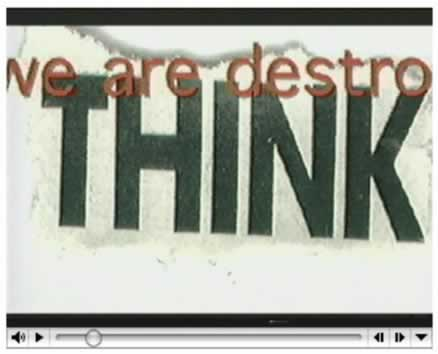
Figure 3. Knowledge as Power – Period 7
The vast number of ways to juxtapose media texts in a QuickTime video makes it easy for authors to integrate multiple voices and perspectives. The best examples of this integration invite the viewer to inquire into a variety of possible meanings about the video’s central idea. Period 7’s small group video on “knowledge as power” (http://www.ed.psu.edu/k-12/fahrenheit/knowledgeaspower7.mov) opens with a female vocalist repeatedly singing “sitting on top of the world” juxtaposed with words torn from magazines and newspapers: “Decide & Conquer,” with two frames of a cartoon featuring Garfield the cat sitting in front of a computer first in deep thought, then with a light bulb glowing in his thought balloon. A music transition to “you’re world champion now” accompanies a series of new images “ASK,” “THINK,” “LEARN,” and a scrolling quote from the novel about knowledge being lost for good if they die (Figure 3).
With this initial series of events, the video quickly suggests that knowledge involves different forms of thinking and remembering, all with consequences for great power over others in the world. The video next introduces a perspective on power through a movie clip in which a man tries to impress ladies by quoting fancy words from books as his own ideas. As the man is exposed as a fraud, the message suggests that one should think on one’s own to have genuine power. Then, music and scrolling text introduce another perspective “POWER INVOLVES LAWS.” This is followed by a cartoon, a quote from Fahrenheit 451 that emphasizes the importance of books and a student speaking, “Communication is the key to love. Communication is the key to life. There must be over a thousand ways to communicate,” to generate even more perspectives on power through communication and reading. The video later presents additional perspective on power through several dissolve transitions of sports cards with scrolling text “Knowledge about your interests makes you powerful!” (Figure 4).
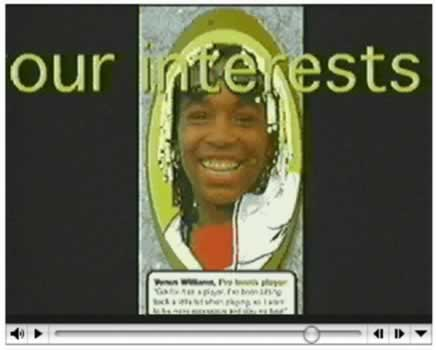 Figure 4. Knowledge as Power – Period 7
It concludes with an overlay of all the text presented in the video and a group singing repeatedly, “looking back, looking back,” which could very well suggest even another perspective about power and knowledge being based in the activity of reflection.
Critically Examining Media Representations Through Media Collages and Hypermedia
Another example is of using technology tools to examine critically media representations of different aspects of social worlds (as advocated by Alvermann, Moon, & Hagood, 1999; Hammett & Barrell, 2002). Media representations found in television, newspapers, magazines, art, photography, film, music, MTV, etc., are the ways in which the media portrays particular groups, communities, experiences, ideas, or topics from a particular ideological perspective. Rather than simply reflecting or mirroring “reality,” media representations serve to “re-present” or actually to create a new reality (Hall, 1997).
In studying ideas relevant to students’ lives by examining media representations along with the study of literary representations, students pose questions such as, “Where do these representations come from?” “Who produces these representations?” “Why are they producing these representations?” “How is complex understanding about life limited by these representations?” and “What is missing or who is silenced in these representations?” (Hall, 1997).
Media representations also reflect various discourses, or ways of knowing or thinking that guide how a representation is made, communicated, and interpreted (Fairclough, 1995; Gee, 1996). These include discourses of gender, class, race, age, business, religion, science, law, technology, etc., that shape the possible identities of people as they use these discourses. The way words and symbols are used in these discourses position the speaker and others according to certain ideological orientations. Museums frequently represented colonized cultures in terms of the discourses of “Orientalism,” reflecting a Western imperialist ideological position (Said, 1978). Discourses of gender construct models of identity are related to idealized notions of what it means to be a male or female. Different racial or ethnic groups are represented both in terms of the images portrayed and the discourses of race constituting those representations. Central to the cultural construction of race is a discourse of whiteness as the desired norm, against which people of color are defined as “other” (Roediger, 2002).
Rather than assume that students are passive dupes who readily accept these representations teachers can use technology tools to help students construct alternative representations that challenge various media representations (Radway, 2002; Tobin, 2001). Part of this entails assuming an active role in constructing their own alternative, counterrepresentations as is evident in Ad-Busters’ Magazine (http://www.adbusters.org/) that parodies ads. In doing so, students are taking the original, problematic representations and re-contextualizing those representations into their own critical framework or space. For example, the female adolescents use online zines as a tool to challenge and subvert sexist media representations (Knobel, 2002; Radway, 2002).
Creating Media Collages
Students may begin the critical thinking process by constructing media collages:
- Selecting a certain group, world, topic, issue, or phenomenon and then finding different representations of this topic/phenomenon in magazines, television, newspapers, literature, Web sites.
- Noting patterns in these representations in terms of similarities in portrayals/images, instances of stereotyping, or essentializing categories.
- Noting value assumptions in terms of who has power, who solves problems, how problems are solved, and who is best served by solving the problem.
- Defining the intended audiences for these representations: What appeals are made to what audiences? Whose beliefs or values are being reinforced or validated? How are certain products linked to certain representations for certain audiences?
- Defining what is missing or left out of the representation: What complexities or variations are masked over? What is included and what is excluded?
- Considering the larger discourses (gender, class, race, or age) and institutional forces shaping these representations.
In a recent media studies methods course taught by Beach, small groups of teachers selected a topic: gender, class, race, age, love, home, family, and body weight. They then cut out images from popular magazines that represented these different topics. Next they attached these images to poster-size sticky notes and shared their critiques with the class. The group dealing with representations of race noted that whiteness was the presumed norm—that people of color were shown only in limited roles as athletes or celebrities. The group dealing with representations of class noted that class was represented primarily by images of consumer goods functioning as upper-middle or middle-class status markers. The group dealing with love noted that most of their images related to sexuality; there were few, if any, images associated with romantic love.
Using Hypermedia Productions to Critique Media Representations
Through constructing and critiquing the representations in these media collages, students can also construct hypermedia productions that critique media representations. For example, a high school student named Stephanie created a Quicktime video containing a montage of images from magazines that portrayed how the media represents ways in which participation in sports is shown as marking one’s identity in a peer group or community (http://www.ed.psu.edu/k-12/socialworlds/stephanie.mov). As she explained,
For my final project I used the computer and scanned in pictures and added music to it. The social world I was portraying was sports teams while linking it to the social world of friends. In my final project I chose all the images from magazines for a purpose. I went through tons of magazines before I found them.…When you play on a sports team one thing you should expect is for people to cheer for you and give you team spirit at your games. The very first image of the fans in the crowd was chosen because not only do you become friends with your team but you become friends with the fans as well. Everyone’s dream and desire is to win their game they are playing. One of my pictures fitted this thought. This picture was of a baseball player sitting on the shoulders of his teammates because he won the game. (Beach & Myers, 2001, p. 99)
Technology can also be used as a tool for engaging in critical inquiry about community issues and representations of those issues. A group of preservice English teachers worked with middle-school students involved in study of a St. Paul neighborhood. Teachers and students communicated with each other on a WebCT bulletin board, in which they described activities related to the project, communication that can create ongoing dialogues about issues (Doering & Beach, 2002). Groups of students focused on studying a range of issues associated with particular aspects of an urban neighborhood: architecture, community development, community history, parks and recreation, business development, segregation, entertainment opportunities, employment opportunities, housing, public safety, restaurants, pollution, and recycling. Both teachers and students formulated perceptions of issues based on background reading of texts and Web sites, discussed issues common to urban neighborhoods, defined questions related to these issues, engaged in interviews with neighborhood people, and took digital photos and field notes. Based on the data, teachers and students then analyzed neighborhood people’s ability to address particular issues and how those issues are represented in the media. For example, the group focusing on crime examined the ways in which local television news often represented this and other St. Paul urban neighborhoods as crime ridden.
A central focus of these projects was the use of digital photography to document and display the nature of the problems facing community members. For example, students and teachers employed photos to document the range of available housing, from dilapidated to upscale, gentrified housing that local residents could no longer afford. The teachers and students used these photos for presentations of a poster-session in the school gym open to students and community members. Teachers developed hypermedia presentations in consultations with their students and created Web-based presentations about specific issues.
Integrating Hypermedia Inquiry Projects Into English Teacher Education
Our hope in this article was to illuminate how various technology tools can support critical literacy practices with the entire range of text and media and to describe some curricular activities for adding inquiry projects that make use of technology tools to the traditional print based English classroom. Additional inquiry frameworks for technology projects can be explored at http://www.ed.psu.edu/k-12; additional links related to critical inquiry can be found at http://www.inquiry.uiuc.edu/.
We encourage teachers to learn how to integrate these new technology tools for representing life worlds into the study of ideas and issues represented through text. Teacher educators must also include hypermedia projects in their teacher preparation courses if there is any hope of bringing the field of English education in line with the multimedia lives of citizens. Not only are these tools for making and sharing meaning pervasive among today’s youth, when the media texts they produce are brought into juxtaposition with print texts, both forms of representation are brought into a critical space in which meaning can be better negotiated as they seek to make sense of and construct shared value for life experience.
References
Alvermann, D. (Ed.). (2002). New literacies and digital technologies: A focus on adolescent learners. New York: Peter Lang.
Alvermann, D., Moon, J., & Hagood, M. (1999). Popular culture in the classroom: Teaching and researching critical media literacy. Newark, DE: International Reading Association
Anya, R. (1972). Bless me, Ultima. New York: Warner Books, Inc.
Beach, R., & Bruce, B. (2002). Critical inquiry and literacy tools. In D. Alvermann (Ed.), New literacies and digital technologies: A focus on adolescent learners. New York: Peter Lang.
Beach, R. & Myers, J. (2001). Inquiry-based English instruction: Engaging students in life and literature. New York: Teachers College Press.
Doering, A., & Beach, R. (2002). Preservice English teachers acquiring literacy practices through technology tools. Language Learning & Technology (6)3, 127-145. Retrieved November 2, 2004, from http://llt.msu.edu/vol6num3/doering/
Fairclough, N. (1995). Media discourse. London: Arnold.
Gallego, M., & Hollingsworth, S. (Eds.). (2000). What counts as literacy: Challenging the school standard. New York: Teachers College Press
Gee, J. (1996). Social linguistics and literacies: Ideology in discourses. Bristol, PA: Taylor and Francis.
Hall, S., Ed. (1997). Representation: Cultural representations and signifying practices. Thousand Oaks, CA: Sage.
Hammett, R., & Barrell, B. (Eds.). (2002). Digital expressions: Media literacy and English language arts. Calgary, Alberta: Detselig Enterprises.
Jonassen, D. (2000). Computers as mindtools for schools: Engaging critical thinking. Columbus, OH: Prentice Hall.
Knobel, M. (2002). Cut, paste, publish: The production and consumption of zines. In D. Alvermann (Ed.), New literacies and digital technologies: A focus on adolescent learners. New York: Peter Lang.
Myers, J., & Beach, R. (2001). Hypermedia authoring as critical literacy. Journal of Adolescent & Adult Literacy, 44(6), 538-546.
Myers, J., Hammett, R., & McKillop, A. M. (2000). Connecting, exploring, and exposing the self in hypermedia projects. In M. Gallego & S. Hollingsworth (Eds.), What counts as literacy: Challenging the school standard (pp. 85-105). New York: Teachers College Press.
Radway, J. (2002). Girls, reading, and narrative gleaning. In M. Green, J. Strange, & T. Brock (Eds.), Narrative impact: Social and cognitive foundations (pp. 183-204). Mahwah, NJ: Erlbaum.
Roediger, D. (2002). Colored white: Transcending the racial past. Berkeley, CA: University of California Press.
Said, E. (1978). Orientalism. New York: Peguin.
Tobin, J. (2001). “Good guys don’t wear hats:” Children talk about the media. New York: Teachers College Press.
Author Note:
Jamie Myers
Pennsylvania State University
Email: [email protected]
Richard Beach
University of Minnesota
Email: [email protected]
