Beliefs, Mathematics, and Instruction
A fundamentally important experience for preservice teachers (PSTs) in a mathematics methods course is the self-examination of beliefs about mathematics and the teaching and learning of mathematics. Research suggests that beliefs about mathematics have an impact on teaching practices (Ernest, 1989; Franke, Carpenter, Levi, & Fennema, 2001; Philippou & Christou, 1998, Thompson, 1984), but can be quite difficult to change (Cooney, Shealy, & Arvold, 1998; McGinnis, Kramer, Roth McDuffie, & Watanabe, 1998; Richardson, 1996). There is also evidence that beliefs about mathematics are more closely related to classroom practice than beliefs about mathematics pedagogy (Raymond, 1997). Because many preservice teachers enter methods courses with naïve views of both mathematics and constructivist pedagogy (Ball, 1996; Ma, 1999), it is vital that challenges to assumptions about the nature of mathematics be made to support a reanalysis of PSTs’ views of mathematical content and pedagogy.
If it is true that beliefs of preservice mathematics teachers can be changed through specific experiences provided in their teacher preparation (Bright & Vacc, 1994), then methods instructors must identify, provide, and facilitate such experiences. As reflection is a key to conceptual change (Hiebert, 1992; Kilpatrick, 1985), these experiences need to provide the opportunity for reflection over the long term, about meaningful issues and ideas (for preservice teachers), and with communal support. We chose to incorporate the use of an online discussion format into our methods courses for precisely these reasons.
Online Discussion Format
Online discussion can be a viable and worthwhile option as a means of promoting thinking and discussion outside of regular class time. Blackboard (http://www.blackboard.com), a web-based classroom environment, is becoming a widely used tool to create a virtual community in teacher education courses. This environment allows the use of real-time chat formats, document posting, and various other features. The feature that is the focus of this article involves the creation of threaded discussion around themes of the participants’ choice. Password protection allows for private discussion among the participating group.
Once in the online classroom, users select “Communications,” and from there choose “Discussion board.” On the discussion board, the instructor or a student initiates a thread, and subsequent participants either respond to an existing thread or initiate their own. For example, during the 13th week of the semester, the second author sent a prompt titled “Teaching WITHOUT Understanding”:
The division of fractions algorithm is pretty simple. In fact, the essence of the algorithm has been condensed down to three words: “flip and multiply.” We have discussed ways of teaching this algorithm for understanding. I have stated that, while algorithms such as addition, subtraction, and multiplication of fractions are likely to be invented by students if given time and appropriate experiences, the division of fractions algorithm is one that students are less likely to develop on their own. Further, the algorithm is somewhat difficult for students to understand. On the other hand, even attempting to understand the algorithm may support student development, and some students will come away with an understanding.
What do you think? Will you teach the division of fractions algorithm with understanding?
After posting this prompt, students responded to the prompt, responded to each other’s postings, and/or initiated new discussion threads (e.g., see “Flip those fractions” in Figure 1). Figure 1 shows the beginning of this threaded discussion as it appeared on the discussion board.
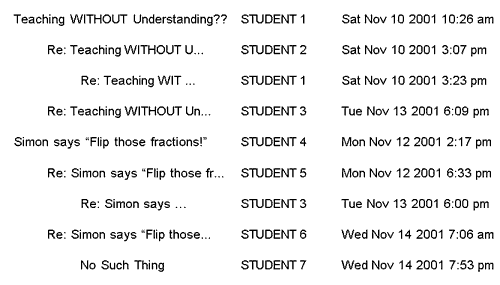
Figure 1. List of discussion threads
Other student comments continue in a similar manner.
Clicking on the title allows the participant to read each post, and a “REPLY” prompt allows for responses to be posted. Blackboard automatically threads the discussion in the format illustrated in Figure 1. Instructors can explore this environment by creating their own course site. Simply go to blackboard.com and click on “Course Service” to set up a trial site free of charge.
Using Online Discussion to Support Instruction
Both authors used the Discussion Board as a means of extending student-generated ideas from the weekly class discussions in a Methods of Teaching Elementary Mathematics course at two different campuses of Washington State University. The methods courses were each part of a preservice Master in Teaching elementary certification program (a 22-month program for the first author and a 15-month program for the second author). Both courses met once per week for three hours. Beyond these similarities, the authors had slightly different purposes and approaches in incorporating online discussions. Thus, this article includes separate discussions on the use of online discussion first, followed by the common themes of the benefits and challenges of using online discussion.
Roth McDuffie’s Implementation of Online Discussion
In addition to extending in-class discussions, Roth McDuffie’s goal in using online discussion was for the PSTs to reflect on their own experiences and beliefs regarding mathematics and learning mathematics and to generate a conceptual framework for their future teaching of mathematics. Considering the research on the difficulties in changing beliefs about teaching toward more reform-based practices (e.g., Richardson, 1996), and her own experiences with PSTs struggling to make sense of standards-based approaches to teaching and learning mathematics (e.g., National Council of Teachers of Mathematics [NCTM], 2000), Roth McDuffie sought to find opportunities for the PSTs to wrestle with and support each other in the process of changing beliefs.
As such, Roth McDuffie posted discussion prompts one to two times each month (see Appendix for examples), and the PSTs responded to the prompts and to each other’s comments, creating an interactive electronic conversation between class meetings. The prompts were prepared based on the readings, activities, discussions, and puzzling issues the PSTs were talking about both in and outside of class, and most often the PSTs had a choice of items in which to react within a given prompt. Additionally, Roth McDuffie often used online discussions to encourage the PSTs to synthesize ideas over a few weeks of the course, exploring the underlying principles and approaches across topics. The prompts were also used for ongoing assessment of the PSTs’ learning and the instructor’s assessment of her teaching approach.
A response was usually required within a week of the initial posting, and some of the ideas shared online were discussed at the next class meeting. The PSTs were encouraged to think further about the issues and post again, either at the main thread level or in response to classmates’ comments. In creating these discussions that oscillated between face-to-face discussions and online discussions, Roth McDuffie intended to foster a sense of community, while using the thinking time that online discussions afford. To ensure that the PSTs posted to the discussion board, their participation in the online discussion was included in their participation grade and represented 5% of their overall grade; however, it was made clear that this grade was based on regular contributions with thoughtful responses, rather than on specific aspects of the response.
Slavit’s Implementation of Online Discussions
Slavit’s methods course met once per week for three hours and was concurrent with a two-day per week field placement experience. This setting allowed for strong field-theory connections and the use of the classroom experiences of the PSTs’ students in course discussions.
Each week Slavit prepared a discussion prompt (see Appendix for further examples), based on the focus of the week’s readings, activities, and discussion, that was designed to extend the flow of the classroom activity and force deeper reflection on the part of the PSTs. Generally, the PSTs were given more than one discussion prompt each week, but each dealt with related ideas. The subsequent discussion around the prompt was referred to as a “table.” The PSTs were required to make at least one weekly posting and were asked to provide a balance of initiations and responses over the course of the semester. Slavit’s primary goal with online discussions was for PSTs to explore beliefs about mathematics and mathematics teaching, and the prompts were written to specifically support this goal. The PSTs were also encouraged to stay on the discussion topic but to extend this focus. As stated in the syllabus, “Please try to keep your comments to the focus topic, but also feel free to add any relevant insights that may extend the direction of the discussion.”
Participation in the online discussion was quantitatively graded by checking if the PSTs made weekly posts, and the overall level of commentary by each PST was “loosely” graded in a more qualitative manner. Online participation accounted for half of the PSTs’ classroom participation grade, or 7.5% of the total course grade.
Online Discussions Support Individual Reflection
Many teacher educators have reported success in using journals to promote reflection and learning in preservice teachers (e.g., Brownlee, Purdie, & Boulton-Lewis 2001; Carter, 1998). We found that participating in an online discussion facilitated reflection similar to the reflective thinking brought about in journal writing for PSTs, while providing the additional benefit of sharing their reflections with others. Specifically, the online venue helped facilitate the PSTs’ constructions of their teaching and learning philosophy in that it required the PSTs to think about and clearly state their viewpoints, and then to continue to clarify these views as other PSTs shared their experiences and supported or challenged their perspectives. The following prompt and response from Week 6 of Roth McDuffie’s class provides an example of this reflection. The first part of this prompt was used to extend the class discussion by asking the PSTs how they intended to apply content-specific ideas from the course in planning their instructional approach. In the second part of the prompt, feedback was sought on the value of a course assignment being used for the first time, and the PSTs were given a chance to share their out-of-class reading without having to use class time for this sharing.
WEEK 6. The past few weeks we have been discussing number sense, developing meaning for operations, learning basic facts, and algorithms (invented and traditional). Assuming that you are teaching in the primary grades, what will be your general approach and relative emphasis for instruction on the concepts and processes listed above? In responding to this question, reflect on the ideas from the text (Van de Walle, 2001) and other readings, the ideas you have concerns about or disagree with, and the ideas that you do not fully understand.
In the response, Andrea demonstrated how she was beginning to form her own philosophy about teaching and learning mathematics as she wrestled with specific pedagogical issues (in this case, teaching with story problems and use of basic facts). Additionally, she used the course readings as a referent in shaping her philosophy, with the online discussion providing another opportunity to explore the ideas in the readings. Andrea wrote,
There seems to be an aversion in many kids to story problems It would make sense to start having kids make up their own story problems very early on as they develop number sense Then I
would introduce more “tools” for solutions: knowing basic facts is a “mind tool” that facilitates problem solving . If the kids don’t have their facts nailed, it really slows them down when the more complex operations come along .This opinion is supported by Isaacs and Carroll (1999) in the reading handouts.
Thus, we perceived that the online discussions provided the opportunities for reflection that other approaches (such as journal writing) offer; however, we found that the public nature of these reflections enabled other PSTs to examine their classmates’ reflections, and correspondingly go beyond independent reflective thinking.
Online Discussions Enhance Classroom Discussions to Provide More Teaching and Learning Opportunities
Online discussions provided opportunities to support, continue, and/or extend class discussions. We describe specific ways in which the online discussions enhanced teaching and learning.
Online discussions build a community for reflection and learning. A primary outcome starting early in the semester was that the online discussions helped to build a sense of community among the PSTs and enhanced opportunities for reflection by providing a forum for dialog that might not have occurred in a face-to-face discussion. For instance, while many of the PSTs privately expressed their anxieties regarding mathematics to Roth McDuffie at the beginning of the semester, they had not been as willing to share these ideas with their classmates. However, in response to Roth McDuffie’s Week 3 prompt, they began to share these feelings and attitudes with the class from behind their computers. This prompt was intended to foster reflection and synthesis of foundational ideas for reform-based mathematics instruction as discussed over the first few weeks of the course.
WEEK 3. Thus far in the course, we have spent our time discussing some of the foundations for and guiding principles of teaching and learning reform-based mathematics. These discussions have included the NCTM Standards, the Washington EALRs (State Standards), what it means to know and understand mathematics, problem solving, and creating problem-based
lessons, assessment (with a focus on assessment as part of instruction, and more specifically, performance assessment), and teaching mathematics to ALL children. As I have mentioned in class, we spend the first few weeks building these foundations and examining underlying principles before moving on to exploring more concrete, grade-related, topics and activities. Before moving on to more specific topics, I would like you to take some time to reflect on these overarching themes that we have discussed. What are your reactions, feelings, attitudes, and/or beliefs about the teaching and learning of mathematics? Do you find that your viewpoints are changing or being called into question in light of our class discussions and readings? (Explain how and why or why not.) In your response, you may choose to focus on any of the areas listed above or provide a more holistic view, incorporating several areas.
Once the PSTs started responding, it became clear that the interactive nature of the online discussion was supporting the PSTs in their efforts to make sense of their past experiences in mathematics and in the ways they were coming to understand mathematics teaching and learning now. Moreover, the nature of the medium of communication, in that PSTs were able to read about their peers’ experiences, reflect on their own experiences, and then craft their responses on their own time, fostered the PSTs’ willingness to share their views. Several PSTs conversed about these issues with just a sample of the following conversation. Sienna asked her classmates,
Am I the only person in this class who didn’t feel successful in math? We must teach so that students have to have an opportunity to learn, not just those who seem to “just get it.” I worked hard and tried to understand, but it didn’t make sense for a long time. The key appears to me to be that students have to have an understanding of the big picture, concepts, to know how to approach a problem.
Lucia responded to Sienna and wrote,
No! You are not the only person who does not feel successful in MATH! I don’t know if I’ll ever overcome the fear of failure through math. I would like nothing better in life than to help young children have a positive, successful experience with math. So back to work I go.
The conversation went on in this fashion with most of the class sharing negative experiences in math. Many PSTs seemed relieved to hear that their feelings were not unique. The tone became that of colleagues supporting each other in a goal to learn to provide teaching and learning that would be more beneficial to children than the ones they experienced. This goal carried into our class discussions. Contrary to previous courses when online discussions were not used by Roth McDuffie, these conversations seemed to help the PSTs be much more open about areas in math in which they felt unsure. For the most part, they were comfortable admitting that they had never thoroughly understood certain concepts and/or processes (e.g., operations with fractions) and were ready to learn more, no longer trying to hide their lack of understandings. A similar discussion in Slavit’s classroom also extended into the online forum.
Online discussions support interactive, shared reflection time frame. Not only did the online discussions provide the foundation for future in-class interactions, they also enabled in-class discussions to continue beyond class time. The interactive nature of the online discussion combined with the lack of restrictions on time provided the PSTs with the opportunity to extend course discussion and activity, to build on others’ ideas and perspectives, and to more deeply challenge their own notions about the nature of mathematics and their beliefs about mathematics teaching. We illustrate this effect with Slavit’s Week 6 prompt and a sample of responses.
WEEK 6 Prompt: Most people believe that number sense, which has also been called numeracy, should be a high priority in elementary mathematics classrooms. Number sense, by definition, means different things to different people, as it is the totality of your awareness, experiences, uses, and understandings of numbers. We gave several different attributes of number sense in class, most of which were centered on understandings of number, relationships between numbers, estimation, mental computation, and uses of numbers.Discuss your current view of the role of number sense in your future mathematics classroom. You may want to comment on how you plan to incorporate number sense into your instruction, why you do not plan to incorporate number sense, any relationship or incompatibility between number sense instruction and the learning of algorithms, and/or the relationship or incompatibility between number sense and the WASLs (NOTE: The WASLs are assessments in the state of Washington).
The following PSTs’ comments represent the first three posts for the prompt. Although they are not included in this example, the PSTs made multiple posts to a given thread on several occasions.
Roberta: MY CURRENT VIEW OF THE ROLE OF NUMBER SENSE IN A MATH CLASSROOM
Traditionally, drills use conditioning to develop skills. Problem solving develops cognitive skills, rather than just concentrating on memorizing facts. It’s important for children to understand number meanings and numerical relationships. Flexible thinking about math concepts should be encouraged. For instance, when working with money, children should be encouraged to come up with as many ways of showing a certain amount, such as $1.36.
Children need to know items like the inverse relationship between addition and subtraction. Knowing the relative size of numbers help [sic] children to connect math to the real world. Number sense is as important to math as phonemic awareness is to reading.
In my classroom, I hope to use problem solving in groups to allow children to come up with many ways to an answer. When people verbalize their math processes (as we do in our math class) we can understand our thinking better. Number sense will also be taught using hands on materials. I guess that those are the four main ways that I will attempt to teach number sense: group work, verbalizing math processes, problem solving and using manipulatives.Sorry this is so babbly…
Roberta made a clear distinction in her belief about mathematics as being composed of a set of skills, concepts, and problem solving processes and articulated teaching strategies to facilitate each. She also discussed ways in which these constructs intersect and the need to utilize students’ sense-making activities in the development of certain aspects of mathematical development. These issues were focused on extensively in the previous classroom discussion.
Lisa extended these thoughts by introducing the notion of “authentic” problem solving into the discussion, probably in response to Roberta’s insertion of abstract mathematical ideas (e.g., “number meanings” and “inverse relationship”). Lisa also further expanded on the previous classroom discussion.
Hi Roberta,
I enjoyed reading your examples of how to incorporate number sense in the classroom. I agree with your four key ways to teach number sense: group work, verbalizing math processes, problem solving and using manupulatives [sic]. But I also think it is equally important to make sure that the problems students are working with are authentic. Like the money example you gave. Sometimes math concepts are so abstract and it is diffuclt [sic] to understand the real meanings. If our students have a clear understanding for number sense, than [sic] perhaps the core concepts will be more comprehendable [sic] for them. I especially agree with you about having students verbally explain their processes. I feel that this is not only valuable for the rest of the class to hear, but it is also beneficial for the student who is explaining. I have learned this through personal experiences in our math class. The way some people figure out problems blows me away sometimes! It is interesting to listen to how others process information. Lisa
Connie then responded to both of these posts.
Lisa and Roberta,
I agree with both of you and think that both of your ideas of how to “teach” number sense are very good. I think that it seems strange to teach something like number sense. It is difficult to understand what children are thinking and how they are processing the information that we give them. It seems that if we provide authentic situations as Laura stated that the children themselves will pick up on the relationships between numbers. This type of learning by doing seems, to me, to have a greater impact on learning and understanding mathematics. If children “see” things happening with numbers for themselves they will be more interested in figuring out why the relationship is so. My job as a facilitator is to provide the learning situation (although not always, sometimes learning situations come up naturally) and to provide further information to allow the children to construct their own ideas about the situation. As you both said, the children will learn so much from each other as they explain their understandings and try to help other children understand the problem. The tough part as a teacher is figuring out how to provide just the right amount of guidance so not to do all the learning for them. I guess this is my idea of how to teach a lot of math concepts, not just number sense. Oh well! J Connie
Connie’s remarks provide another example of a PST extending her thoughts, based on others and her own reflections, on some core mathematical beliefs in the context of instruction.
Online discussions enable more voices to be heard. Not only was Connie’s comment important in adding to the ideas of the discussion, the fact that Connie contributed to the discussion was notable. Connie was a rather quiet student who probably would have not contributed to the discussion in this manner during class time. In fact, data previously collected by the authors (Slavit, in press) found that student “talkativeness” does transfer to a virtual setting, but that the virtual arena does help to even out the “level of vocality” of the students. In a prior semester, Slavit ranked his PSTs as “highly vocal,” “providing adequate input,” and “little or no input,” based on their levels of classroom participation. PSTs who participated more than the minimum requirement of one post per week were equally balanced across the three groups. Further, although the average number of postings by the highly vocal, adequate, and little or no input groups were 14.2, 11.6, and 9.3, respectively, the participation level among the little or no input group in the online setting was significantly greater than during class time. These findings were consistent with Sliva’s (2002) research, in which students who were not participating in class were comfortable participating in an online forum.
In addition to more PSTs participating in discussions, the PSTs referenced each other’s postings frequently over the course of the semester during classroom discussions. By having their postings referenced, less vocal PSTs were given prestige and a platform that provided an entryway into the classroom discourse, something that would not have happened otherwise.
Additional time for each PST to share experiences and perspectives. Limited class time did not always allow for each of the PSTs to share their individual experiences and emerging perspectives in whole class discussions. The online forum provided an opportunity for this kind of contribution to discussions and reflection. In responding to Roth McDuffie’s Week 6 prompt (shown earlier) regarding ways to teach and learn mathematical operations, a PST’s comment showed how the PSTs used the forum to relate the ideas that we had been discussing in class to their personal experiences. Brad explained his views and experiences as follows:
It is important for our students to be encouraged to use their own invented strategies to solve problems….It should make sense to the students. They will take ownership in their techniques and will have a good understanding of how math works. I just wish that math had been taught in this way when I was in school. It was all rules that had to be followed. I had my own way of doing division problems. I actually multiplied the divisor until I got the number that fit best. I didn’t follow the rules and was told that was the wrong way to do the problem. I got the right answers but was not encouraged to use my own problem solving methods. The new ways of teaching math encourage students to be creative and try something that makes sense to them. I hope that I will be able to teach math in this way.
Additional assessment opportunities to inform instruction. As part of the previous discussion with Brad, one PST reflected on how she was making sense of the ideas we were discussing in class. In her response, she provided important assessment information for the professor in considering how she was understanding some of the issues and which instructional approaches were most helpful in her learning. Tanesha stated,
All students need to develop the meaning of operations and know their basic facts in order to explore creative ways in solving word problems. Van de Walle [2001] gives a lot of great examples on problems to pose to your class. These examples give me ideas [for] how to expand his examples and create my own. The most powerful tool for me was watching videos [of students sharing problem solving strategies]. The videos helped me to clarify my questions and [provided ideas for] how to set this up in my classroom. The videos showed me this method of teaching does work and how to go about doing it.
After reading Tanesha’s first sentence, Roth McDuffie was concerned that perhaps Tanesha was forming the view that basic fact knowledge and knowledge of the basic operations had to be gained before solving word problems. Given that a primary goal was for PSTs to understand current research and approaches indicating that children gain these understandings through early experiences with problem solving and while problem solving, her posting prompted the instructor to revisit these topics in a subsequent class discussion. Tanesha’s comments about the text and videos provided needed information in the instructor’s reflections on instructional decisions and approaches. In general, Roth McDuffie found that, just as classroom discussions provide assessment opportunities, online discussions provided an opportunity for ongoing assessment of how the PSTs were making sense of the ideas discussed and the efficacy of her own instructional approaches. Moreover, by having online discussions, more PSTs voiced their ideas and understandings, and therefore, McDuffie experienced more opportunities for assessing her teaching and the PSTs’ learning. This information was then used in planning the next class, rather than having a delay in response that results when using written assignments to inform instruction. Indeed, for every prompt that was posted, information was received as to how the PSTs were forming understandings and which readings, activities, discussions, and video case studies were most beneficial to the PSTs’ understanding and learning.
Conclusions About Benefits and Challenges of an Online Discussion Format in Elementary Mathematics Methods
Besides acting as an “equalizer” in regard to PST vocality, we found several benefits for the incorporation of an online discussion forum in an elementary mathematics methods course. Similar to a journal, online discussion provided a forum for personal reflections about thoughts and beliefs relevant to the teaching and learning of mathematics. However, the public nature of this forum changed the dynamics of the PST writing, and the dialogical aspect of online discussion allowed PSTs to share their reflections with everyone. This public dimension to the writing had two important consequences. It initiated an increase in self-regulation and subsequent reflection on the issues being shared, and it also allowed for a public debate about the issues that raised challenges and forced responses to the ideas and issues initially put forth.
The asynchronous nature of the discussion allowed PSTs to craft and edit their remarks prior to submission in a thoughtful manner. As in the earlier examples, PSTs’ comments were often more focused and reflective than if spoken extemporaneously, or if even written privately in a journal. Further, the variety of feedback from peers led to directions for further thought that were quite impossible to receive from a single instructor or in a classroom discussion. This combination of factors both initiated and extended the reflective process in the PSTs.
The online forum also provided another venue for the PSTs to pose their own questions and dilemmas. If appropriately created and monitored by the instructor, this forum can be a safe yet challenging place with which to put forth ideas and issues, as well as address questions and concerns specific to the participants of the online community. Constantly referring to PSTs’ comments during classroom discussion, making “model” posts as needed to provide examples of positive feedback or criticism, and providing relevant and thought-provoking prompts were important ways that the instructors supported the establishment of a positive and supportive, yet critical, online community.
We also found that creating an online community presented various social and technical challenges. Many PSTs had older equipment that led to long download time and subsequent frustration. Although Blackboard was a fairly easy site to navigate, PSTs with less favorable attitudes toward or less experience with technology also experienced frustration. In addition, both PSTs and professors needed to devote substantial time to contribute to the discussion. And if time was not devoted to checking the discussion even after a posting has been made, the discussion degenerated into a string of ideas rather than a coherent dialogue. This time aspect was the primary complaint about the use of an online discussion format by the PSTs, as there were many aspects of the short and intensive Master in Teaching programs with extensive time demands. Because of this, we surmise that, if the discussion is not used and supported in the fabric of the course, it can quickly be thought of as peripheral and subsequently not valued by the participants. From past experiences, we found that aspects of the program that take on this status are quickly dismissed as “busywork,” and the reflective value of the online discussion quickly dissolves.
We also faced a challenge in regard to our role as participants. We found that too much involvement can take ownership away from the PSTs, and too little involvement can send the message that the online discussion is not important or it can allow for discussion that is offtrack or superficial. There is clearly no correct way of handling this dilemma other than constant monitoring and appropriate instructor commentary when needed. However, we have also found that utilizing online comments during classroom discussion can clarify and monitor the online discussion without participating actively in it.
References
Ball, D.L. (1996). Teacher learning and the mathematics reforms: What we think we know and what we need to learn. Phi Delta Kappan, 77(7), 500 – 508.
Bright, G.W., & Vacc, N.N. (1994, April 4-10). Changes in undergraduate preservice teachers’ beliefs during an elementary teacher-certification program. Paper presented at the Annual Meeting of the American Educational Research Association, New Orleans, LA.
Brownlee, J., Purdie, N., & Boulton-Lewis, G. (2001). Changing epistemological beliefs in preservice teacher education students. Teaching in Higher Education, 6(2), 247-268.
Carter, C. (1998). The use of journals to promote reflection. Action in Teacher Education, 19(4), 39-42.
Cooney, J., Shealy, E., & Arvold, B. (1998). Conceptualizing belief structures of preservice secondary mathematics teachers. Journal for Research in Mathematics Education, 29(3), 306-33.
Ernest, P. (1989). The impact of beliefs on the teaching of mathematics. In P. Ernest (Ed.), Mathematics teaching: The state of the art (pp. 249-254). London: The Falmer Press.
Franke, M., Carpenter, T., Levi, L., & Fennema, E. (2001). Capturing teachers’ generative change: A follow up study of professional development. American Educational Research Journal, 38(3), 653-689.
Hiebert, J. (1992). Reflection and communication: Cognitive considerations in school mathematics reform. International Journal of Educational Research, 17(5), 439-456.
Issacs, A.l, & Carroll, W. (1999). Strategies for basic-facts instruction. TCM, 5 (9), 508-515.
Kilpatrick, J. (1985). Reflection and recursion. Educational Studies in Mathematics, 16, 1-26.
Ma, L. (1999). Knowing and teaching elementary mathematics: Teachers’ understanding of fundamental mathematics in China and the U.S. Mahwah, NJ: Lawrence Erlbaum.
McGinnis, J.R., Kramer, S., Roth McDuffie, A., & Watanabe, T. (April 1998). Charting the attitude and belief journeys of teacher candidates in a reform-based mathematics and science teacher preparation program. Paper presented at Annual Meeting of American Educational Research Association, San Diego, CA.
National Council of Teachers of Mathematics (NCTM) (2000). Principles and standards for school mathematics. Reston, VA: The Council.
Philippou, G.N., & Christou, C. (1998). The effects of a preparatory mathematics program in changing prospective teachers’ attitudes towards mathematics. Educational Studies in Mathematics, 35(2), 189-206.
Raymond, A.M. (1997). Inconsistency between a beginning elementary school teacher’s mathematics beliefs and teaching practice. Journal for Research in Mathematics Education, 28(5), 550-576.
Richardson, V. (1996). The role of attitudes and beliefs in learning to teach. In J. Sikula (Ed.) Handbook of research on teacher education (pp. 102-119). New York: Simon and Schuster.
Slavit, D. (in press). Expanding classroom discussion with an online medium. Journal of Technology and Teacher Education.
Sliva, J. (2002). Developing a mathematical community using an electronic discussion forum in an elementary mathematics methods course. Contemporary Issues in Technology and Teacher Education [Online serial], 2(1). Available:https://citejournal.org/vol2/iss1/currentpractice /article1.cfm.
Thompson, A.G. (1984). The relationship of teachers’ conceptions of mathematics and mathematics teaching to instructional practice. Educational Studies in Mathematics, 15(2), 105-127.
Van de Walle, J. (2001). Elementary and middle school mathematics: Teaching developmentally. New York: Addison Wesley Longman.
Appendix
Additional Prompts Used in Online Discussions
The following examples illustrate the nature of the prompts and the intent to encourage the PSTs’ reflection on their experiences and beliefs about mathematics teaching and learning.
- Both the Standards and the EALRs generate, among other things, a description of what mathematics is, how it could be taught developmentally over a students’ lifetime, how it could be assessed, and what the curriculum could look like. Choose a specific grade level (be sure to identify this in the title of your message) and describe what you feel is a “reasonable mathematics curriculum” for that level. Is there important mathematics that is missing in either the EALRs or the Standards? Is there anything in these documents that shouldn’t be there? (NOTE: The EALRs are the learning standards in the state of Washington).
- Do you agree with the statement: The two main components of Problem Solving are language and thought.If so, then elaborate on the role that each of these play. Try to be specific and contextualized – in other words, talk about these things in the context of (or provide examples involving) specific mathematical content. You are free to choose the math topic, but clearly discuss how the problem utilizes (depends on?) thought and language.If not, what other things are involved in problem solving. Again, try to talk about these things in the context of specific mathematical ideas.
- There are various tensions that arise when thinking about early arithmetic. Mental computation vs. written algorithms vs. calculators. Students’ invented algorithms vs. learned, standard algorithms. Patterns vs. heuristics vs. facts. All of these tensions have serious consequences on instruction. Assume that you will be teaching in the primary grades next year – How will you deal with some or all of these tensions in your classroom?
- We have spent the past few classes discussing fractions, decimals, ratios, and proportions. Specifically, we have focused on developing meaning for fractions and operating on fractions. This prompt is aimed at reflecting on these classes. I am listing two questions. You may respond to either or both.A. I have been asked, “What if I want to teach fractions by developing the concepts, but the school’s (or district’s) textbook is oriented to focus on drill and memorizing procedures without developing understandings?” We have discussed ways of developing concepts and understandings for processes, and we realize that this takes time to develop in students. But the textbook you may be handed (and the district) might be pushing an agenda to spend most of your time on drilling computation and algorithms. On the other hand, we have discussed how teachers are often in the best position to bring about change, and the [State Standards] and the [State testing program] support teaching for understanding. How would you handle the above situation (i.e., how do you overcome the forces of textbooks and district curricula that are not in line with current research about effective teaching and learning of fractions)? Please keep your comments specific to the teaching and learning of fractions, decimals, ratios, and proportions.B. Many of you seemed to experience an “aha!” sensation as we explored the teaching and learning of fractions in the past few weeks. For those that did, describe your insights and experiences and relate this to how this shapes your thinking for your role as a teacher and students’ learning of fractions.
- In your learning experiences with Geometer’s Sketchpad exploring triangles or quadrilaterals, you developed and/or reflected on how students might develop various geometric understandings. As a learner, consider where you feel situated among the levels of geometric understanding as described by Van Hiele, and how you might have progressed. Be sure to pay attention to your growth in specific understandings as well as the role that language (“everyday talk” and “math talk”) played in this development.
